
Practical Sales Training™ > How To Lose The Sale > Best Seller Fallacy

Best Seller Fallacy
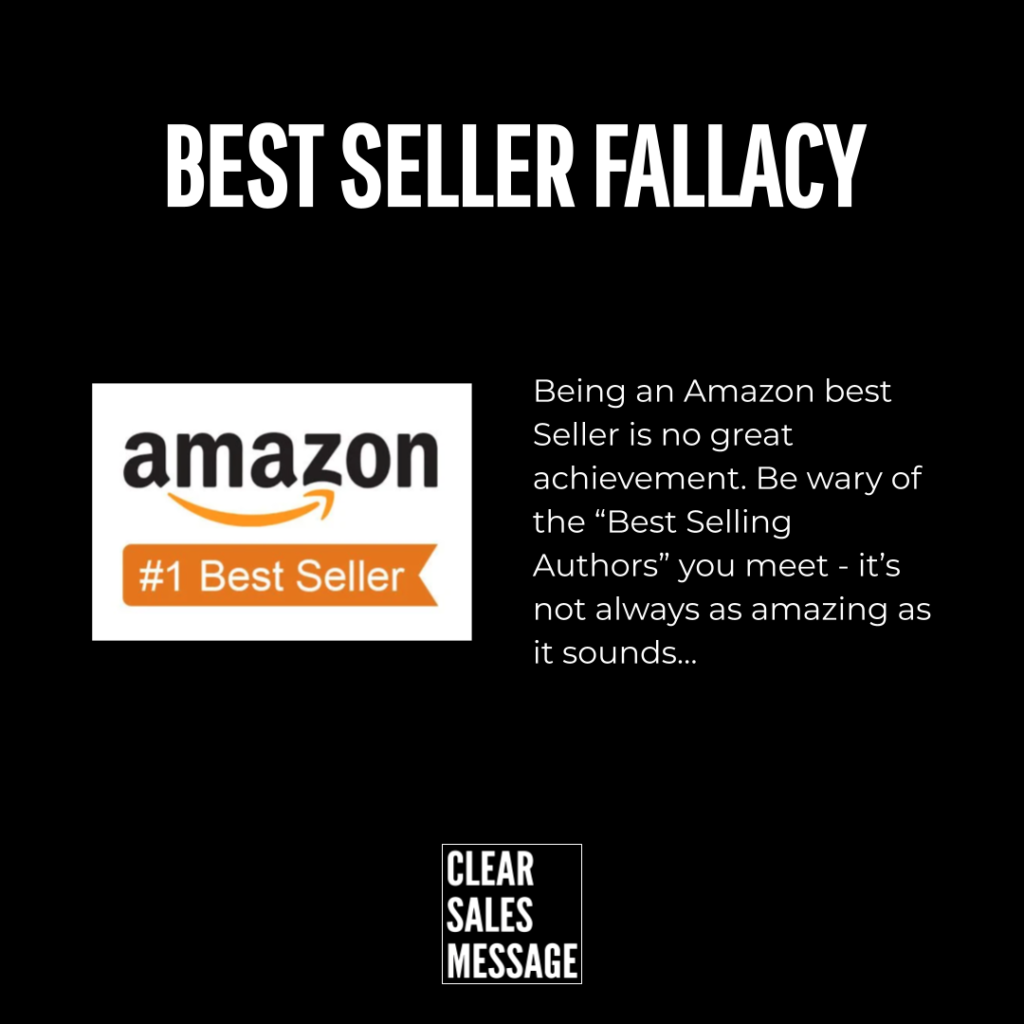
When someone leads with “best-selling author” in their bio or pitch, it feels like a signal of credibility. But in most cases, it is not. It is a badge that almost anyone can buy — sometimes for the price of a few copies.
Buyers who know how Amazon works will spot this instantly. And when they do, it does not just undermine that one claim. It puts everything else you say under scrutiny too.
So if you use this title and you have not earned it the hard way, you risk losing far more than you gain.
What Is The Best Seller Fallacy?
The Best Seller Fallacy happens when someone uses the “Amazon Best Seller” badge as a proof of credibility — without telling you what it actually took to earn it.
Since Amazon opened up self-publishing, anyone can release a book and target a niche category. Because some categories have very little competition, you can hit “best seller” status by selling as few as 5 to 10 copies. That earns you the badge and the screenshot to go with it.
Many coaches, consultants, and “gurus” use this in their marketing. However, most of their buyers have no idea how easy the title is to get. So the badge creates a false impression — and that is the problem.
Why Does The Best Seller Fallacy Work?
It works because “best seller” sounds like a big deal. We associate it with household names — authors who shift hundreds of thousands of copies. That association does the heavy lifting.
Buyers who do not know how Amazon categories work will take the claim at face value. They assume competition, volume, and genuine demand. In fact, none of those things are required.
The badge also looks real. Amazon displays it clearly. You can screenshot it, add it to your website, and put it in your bio. So it carries visual weight — even when the substance behind it is almost zero.
As a result, the fallacy spreads. More people use the title, more buyers accept it, and the badge keeps doing its job long after its meaning has gone.
How Can You Use The Best Seller Fallacy In Sales?
Use it to spot weak credibility signals
When you see “Amazon Best Seller” in someone’s marketing, ask which category and when. A genuine best seller will have no problem answering. Someone gaming the system will either deflect or give you a category so niche it barely exists.
Audit your own claims
If you use “best seller” in your own marketing, consider what your buyer thinks it means versus what it actually means. Because the gap between those two things is where trust breaks down. If you cannot defend the claim plainly, replace it with something you can.
Replace it with a stronger proof point
Instead of a badge that anyone can get, use proof that actually means something. Reviews, results, client names, or number of people helped — these are harder to fake. So they carry far more weight with buyers who know what they are looking at.
Use it to educate your buyers
If your competitors use inflated claims and you do not, say so. Buyers reward honesty — especially in markets full of hype. Pointing out what “best seller” really means positions you as the straight-talking choice.
When The Best Seller Fallacy Works Best (Against You)
This fallacy does the most damage with buyers who already do their research. A first-time buyer might not question the badge. But a senior decision-maker, a procurement lead, or someone who has bought from coaches before will often know exactly how Amazon categories work.
The more your buyer knows, therefore, the more this claim costs you. And because these are often the buyers with the biggest budgets, the risk is not small.
When The Best Seller Fallacy Becomes Dangerous
It becomes dangerous when a buyer catches it mid-sale. If they Google “how to become an Amazon best seller” and find out the truth, they will question every other claim you have made. That is very hard to recover from.
It also compounds over time. The more the title spreads, the more buyers learn to distrust it. So even if it helped you five years ago, using it today signals that you are either out of touch or willing to mislead. Neither helps you win the sale.
Common Best Seller Fallacy Mistakes
Leading with the badge instead of the outcome
The badge tells buyers nothing about what you can do for them. But many sellers lead with it anyway — and bury the actual value underneath. Flip it. Lead with what you help people do, not a title you gave yourself.
Assuming buyers do not know
Many sellers use the badge because it worked once or because they assume buyers will not question it. However, buyer awareness keeps growing. What confused people five years ago is common knowledge now. Do not assume ignorance.
Using it in high-trust sales environments
In a transactional sale, a weak badge might slip through. But in a consultative or high-value sale, buyers scrutinise every credibility claim you make. So using a hollow title in that context does not just fail to help — it actively creates doubt.
Not knowing the real threshold
A true best seller moves around 3,500 copies a day. If you are not close to that, the title does not mean what your buyer thinks it means. Know the real number — because your buyers might.
Best Seller Fallacy – An Example
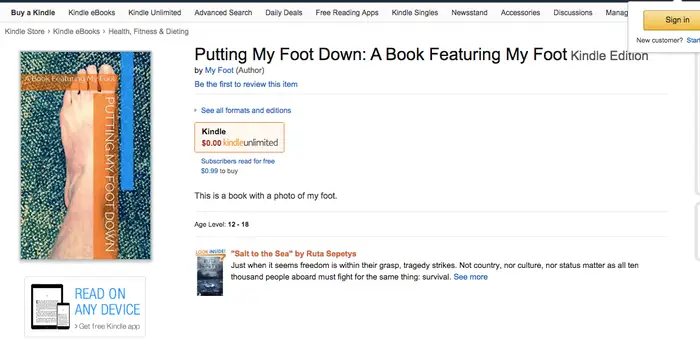
Brent Underwood famously proved the point by publishing a pointless book in an obscure Amazon category. He hit “best seller” status almost immediately. The book had no content worth reading. But it had the badge — and the screenshot.
His experiment showed exactly how hollow the title can be. Because best seller status is relative. It depends entirely on which category you pick and how few other books sit in it.
So the next time you see the badge in someone’s marketing, remember Brent’s book. And ask yourself what it actually took to earn it.
See Also