
Practical Sales Training™ > How to connect with your buyer > The Security Effect

The Security Effect
What Is It
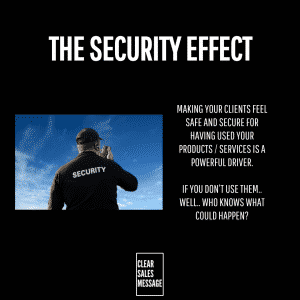
The Security Effect is where you use fear of the unknown to drive clients to buy or engage. Not manufactured fear, a genuine risk they hadn’t fully considered.
It works on a different level than most sales arguments. It’s not about asking a buyer to want something more. It simply asks them about fearing losing something they already have.
That shift in framing changes the whole conversation, from “should I buy this” to “can I afford not to.”
Why Does It Work
It works because one of the four main human drivers is defending. As primitive beings, one of our most vital motivators is staying alive and staying safe.
By bringing attention to safety, or the lack of it, you trigger this driver directly. It sits underneath a lot of other decision making, even when a buyer isn’t consciously aware of it.
There’s a reason this outlasts most rational arguments too. A logical case can be debated. A genuine fear for your own safety rarely waits around for debate.
How Can You Use It
Name the real downside of doing nothing
If there’s a negative downside to not using your product or service, allude to it directly. Or ask questions about how a client will deal with that situation when it arises. This shifts focus to safety and security, and drives the client toward purchasing.
Ask the question instead of just stating the risk
After all, if you don’t take that insurance policy, or fit those locks, how would you deal with losing all of your possessions if you were burgled? A question makes the buyer imagine the answer themselves, rather than just reading a warning.
Keep the risk specific and real
A vague “bad things can happen” barely registers. A specific, plausible scenario the buyer can actually picture is what makes the driver kick in.
When It Works Best
This works best when there’s a genuine, meaningful downside to inaction, insurance, security, health, data protection, anything with real stakes attached.
It also works best when the buyer hasn’t already considered the risk. Once it’s raised once, repeating it too often starts to lose its edge.
When It Becomes Dangerous
It backfires if the risk is exaggerated or invented outright. A buyer who senses a scare tactic loses trust fast, and takes that suspicion into every future interaction with you.
It also becomes risky if it tips into genuine distress rather than useful concern. The goal is a nudge toward action, not a buyer left anxious with nowhere productive to put that fear.
Overusing it flattens the effect too. Constant warnings about worst case scenarios eventually stop registering as real threats at all.
Common Mistakes
Exaggerating the risk beyond what’s credible
A buyer who checks your claim and finds it overstated stops trusting anything else you say. Keep the risk real and defensible.
Raising fear without offering a clear next step
Fear without a solution just leaves someone anxious and stuck. Always pair the risk with the specific action that resolves it.
Leading with fear when it isn’t genuinely relevant
Forcing a security angle onto a product where the stakes are genuinely low reads as manipulative. Save this approach for where the risk is real.
The Security Effect – An Example
A Cybersecurity Company
A cybersecurity company is selling its threat detection software to small business owners.
“60% of small businesses close within six months of a cyber attack. What steps have you taken to protect your client data if you’re targeted tomorrow?”
By raising the real threat and questioning the buyer’s current level of protection, the company shifts focus to safety and survival, triggering the “defend” response.
Result: The buyer starts to worry not about the cost of the software, but the cost of not having it.
See also