Practical Sales Training™ > How To Get Attention > Projection Advertising

Projection Advertising
Most outdoor advertising is permanent, expensive, and hard to change. Projection advertising is none of those things. It uses light to place your brand on a building or landmark after dark. The message goes up in minutes and comes down just as fast.
Because it uses a surface that already exists, there’s nothing to print and nothing to clean up. The light does the work. And because it’s unexpected, it stops people in a way that a standard billboard rarely does.
Brands use it for product launches, live events, city campaigns, and anything where impact, speed, and a strong visual matter more than permanence.
What Is Projection Advertising?
Projection advertising uses bright projectors to place images, video, or text onto buildings and large surfaces after dark. Some people call it building projection, light advertising, or projection mapping. Nothing gets printed or stuck to the wall. Your message appears with light, and disappears the moment you switch it off.
The scale can range from a single logo on a shop front to a full animation covering the side of a large building. At the smaller end, a good projector and a flat wall are all you need. At the larger end, specialist equipment, mapping software, and a crew make the image wrap precisely around the building’s architecture.
Because it leaves no trace, projection advertising can go places other outdoor formats can’t. Landmarks, heritage buildings, and busy public spaces that would never accept a permanent installation often welcome a well-planned light projection. So the format opens doors that print and digital simply can’t.
Why Does Projection Advertising Work?
It works because it’s unexpected. People are used to posters, screens, and banners. A large image of light on a building, especially one that moves or changes, fits none of those categories. So the brain pays attention before the viewer has consciously decided to look.
There’s also a social sharing effect. A striking projection is easy to photograph and very shareable. As a result, the audience who sees the projection in person is often much smaller than the audience who sees it online. The real campaign is the content the projection generates, not just the light on the wall.
And because nothing attaches to the surface, brands can use locations that other formats can’t touch. The message can also change instantly, so one setup can run multiple creative executions in a single night. Similarly, the temporary nature creates a sense of occasion that permanent advertising never can.
How Does Projection Advertising Work?
The process is straightforward. Here’s how to run an activation from start to finish.
1. Pick the Spot
Choose a clean, flat surface with a clear view from the street. Walls, bridges, landmarks, and event venues all work well. Lighter surfaces produce a brighter image. Check the sight lines from street level before you commit.
2. Plan the Creative
Keep it bold and high contrast so people can read it fast. A static logo or short message works well for a simple activation. A moving animation creates more impact and generates better social content. Design for the viewing distance, not for a screen. What looks good close up may be unreadable from the street.
3. Set the Kit
You need a bright projector, a stand or safe mount, a media player or laptop, and power. Aim the lens, focus the image, and square it to the surface. A simple logo projection takes minutes to set up. A full building wrap needs specialist equipment and a crew.
4. Map the Surface
For shaped or irregular buildings, use mapping software to align the content with the edges, avoid windows, and follow the architecture. Good mapping makes the building look like part of the creative rather than just a backdrop. This is what separates a professional projection from a basic one.
5. Switch On at the Right Time
Start after sunset for maximum impact. Run on a loop and capture photos and video throughout the activation. The projection looks its best in the first hour after dark, so plan your content shoot for that window. Make sure someone captures it properly rather than relying on phone shots from the ground.
How Can You Use Projection Advertising In Sales?
Projection advertising works for brand awareness, launches, and live events. Here’s where it performs best.
Product Launches
Light up a landmark with your logo and tagline on release night. A launch projection generates immediate attention and gives you social content that keeps working after the activation ends. Because the image appears and disappears in a single evening, it creates a genuine sense of occasion around the moment.
Event Takeovers
Guide guests to the entrance, display schedules, and build hype outside the venue. A projection on the building exterior sets the tone before anyone walks through the door. Sponsors can also use projections to create presence at events where physical branding is limited or expensive.
Pop-Up Promos
Create a moving billboard wherever your audience already gathers. Unlike a fixed poster, a projection can go up in any location with a suitable wall and power source. As a result, you can place your brand at the right place and time rather than wherever permanent advertising space happens to be available.
City Campaigns
Run a multi-site night trail so people see your message across town. Hitting several locations in a single night creates a sense of scale and generates multiple pieces of content from different angles. Because each location produces its own images, the campaign looks larger than any single activation suggests.
Sponsorship and Sports
Celebrate wins, count down to kick-off, or project live stats near fan zones. Sports projections work well because the audience is already gathered and engaged. A well-timed projection around a big moment creates an emotional connection between the brand and the event that a pitch-side banner rarely achieves.
Practical Notes Before You Start
Before any activation, get written approval from the property owner and check local rules for outdoor light use. Some areas restrict projections near roads, heritage buildings, or residential windows. Sort permissions first, before you invest in equipment or creative. Because a projection that authorities shut down generates the wrong kind of coverage.
Keep the content clean and clear. Short words, big type, and strong contrast make the message readable at distance. Keep motion smooth rather than fast, because rapid movement is harder to process from the street. Avoid shining light through windows where people live or work, and keep projectors away from roads where light could distract drivers.
The main cost drivers are projector brightness, image size, length of the run, animation quality, crew, and permits. A simple logo on a small surface runs at relatively low cost. A full building show with custom mapping is a different level of investment entirely. So match the scale of the activation to the budget and the goal.
Common Projection Advertising Mistakes
Not Getting Permissions First
Projecting onto a building without permission can result in the activation shutting down and the brand attracting negative attention. Always secure written approval from the property owner. Check local regulations before you set up any equipment. Because a projection that police switch off generates the wrong kind of coverage.
Underestimating the Brightness Needed
A projector that works in a dark room can be almost invisible on a lit building in a busy urban street. Always check the lumens rating against the ambient light of the specific location. Test on site before the activation night rather than discovering the problem during the event itself.
Making the Creative Too Complex
A message that reads clearly on a screen at close range may be unreadable on a building from the street. So design the creative specifically for the viewing distance and scale of the surface. Big, bold, and simple always outperforms detailed and elaborate in projection advertising.
Forgetting to Capture It
The activation lasts one night. The content can last far longer. So invest in a proper photo and video shoot during the projection rather than relying on phone shots. Because the visual lives of projection campaigns happen on social media, the quality of the capture determines how far the campaign reaches.
Projection Advertising – An Example
Jimmy’s Iced Coffee projected a large-scale version of their product bottle onto the side of a building in Glasgow, alongside the message “Glasgow, this one’s for you.” The activation combined brand visibility with a direct, city-specific message. As a result, it felt less like an advert and more like a gesture toward the city, which made it more shareable and more memorable than a standard outdoor format would have achieved.
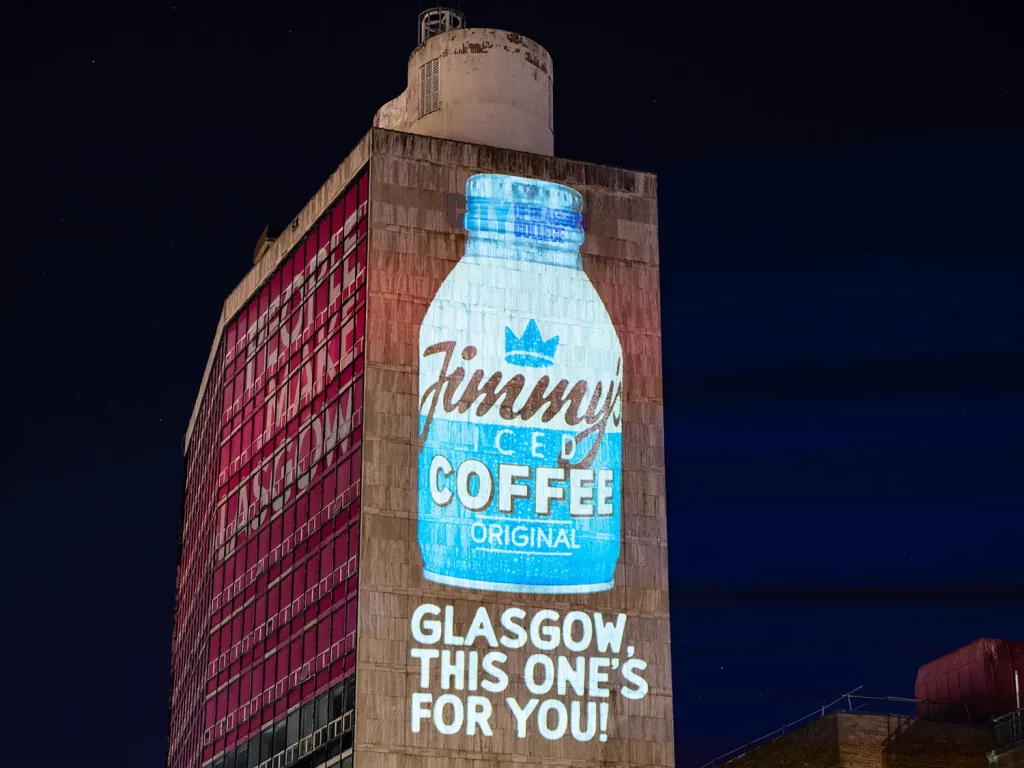
That combination of scale, specificity, and shareability is what makes projection advertising work when brands get it right. The light goes out. But the image keeps travelling.
See also