Practical Sales Training™ > How To Convert > The “Until” Follow Up

The “Until” Follow Up
Most salespeople follow up two or three times and then stop. They assume silence means no. But silence rarely means no. More often, it means not yet.
The Until Follow Up challenges that assumption. Rather than stopping when there is no reply, you keep showing up – politely, professionally, and with something worth saying – until the prospect tells you otherwise.
It is a simple idea. But the discipline it requires is what separates the salespeople who close slow deals from those who give them away to competitors who stayed in touch longer.
What Is the Until Follow Up?
The Until Follow Up is the commitment to stay in contact with a prospect until they explicitly tell you to stop. No assumed rejection. No giving up after a few unanswered messages. Just consistent, respectful visibility until the timing, budget, or need aligns.
It is built on one core belief: most sales are not lost because people say no. They are lost because the seller stopped too soon, and the buyer went elsewhere when they were finally ready to move.
Used well, it keeps you front of mind without crossing into pressure. The approach is steady and helpful, not aggressive – because the goal is to be the person they think of first when the moment arrives.
Why Does the Until Follow Up Work?
Buying decisions rarely happen on the seller’s timeline. Budget cycles change. Priorities shift. The project that was paused in January gets approved in March. So a prospect who went quiet is not necessarily a lost prospect – they may simply be in a holding pattern.
Staying in touch through that period means you are there when the pattern changes. Competitors who stopped following up are not. As a result, your persistence becomes a competitive advantage without you having to do anything except show up.
There is also a trust signal in the approach. A salesperson who keeps turning up with something useful – a relevant insight, a quick update, a short check-in – demonstrates genuine interest in helping rather than just closing. That distinction matters to buyers.
How Can You Use the Until Follow Up In Sales?
Be upfront about your approach
“I’ll keep in touch unless you’d prefer I didn’t.” This one line changes everything. Rather than following up silently and hoping it is not annoying, you give the prospect control. Most will appreciate the honesty – and the ones who do not want to hear from you will tell you, which is also useful information.
Make each follow-up worth receiving
Share a useful insight, a relevant case study, or a short update rather than repeating the same pitch. Each message should give the prospect a reason to open the next one. When your follow-ups carry value, they feel like a service rather than a chase.
Space them out deliberately
Leave enough time between messages so each one feels intentional rather than desperate. Weekly follow-ups feel needy. Monthly ones feel considered. The right rhythm depends on the relationship and the deal size, but erring toward less frequent is almost always the safer choice.
Keep the tone human
A friendly, conversational message will always outperform a scripted one. Write as you would to someone you genuinely want to help, not as someone working through a sequence. Prospects can tell the difference, and the ones who can matter most in the long run.
When the Until Follow Up Works Best
It works best in long sales cycles where buying decisions take weeks or months. The longer the cycle, the more valuable consistent presence becomes – because a lot can change between the first conversation and the final decision.
High-value deals also suit this approach well. When the stakes are large enough to justify extended effort, staying in touch over a longer period is simply good commercial sense. The cost of one more follow-up email is negligible compared to the value of the deal.
Similarly, it works well when the prospect showed genuine interest early on but then went quiet. Radio silence after a good first conversation usually means something changed internally – not that they lost interest. So staying present keeps you in the running when the situation changes back.
When the Until Follow Up Becomes Dangerous
The risk is confusing persistence with pressure. A prospect who has gone cold is different from one who has said no. Following up after a clear rejection is not persistence – it is a boundary issue, and it damages reputation fast.
Tone is everything here. A helpful, low-pressure message that respects the prospect’s time feels professional. A pushy, self-serving one that ignores their silence feels desperate. The Until Follow Up only works when the delivery is warm and the content is genuinely useful.
There is also a personal judgement call involved. Some buyers find any extended follow-up sequence unwelcome, regardless of tone. So read the signals carefully, and when someone’s responses become shorter or cooler, adjust the frequency accordingly rather than pressing on at the same pace.
Common Until Follow Up Mistakes
Repeating the same message
Sending the same pitch twice does not improve it. Each follow-up needs to bring something different – a new angle, a fresh piece of evidence, or a simple check-in that feels human rather than automated. Repetition signals that you have run out of things to say, which is not the impression you want to leave.
Ignoring a soft no
Not every no is said out loud. When replies become one word, responses slow to weeks, or a prospect stops opening your emails entirely, that is a signal worth respecting. Continuing regardless does not demonstrate persistence – it demonstrates a lack of awareness, which is worse.
Following up without a reason
“Just checking in” is the weakest follow-up line in sales. Every message needs a hook – a reason for getting in touch that benefits the prospect, not just you. Even a brief one is enough, because a follow-up with context always lands better than one without.
The Until Follow Up – An Example
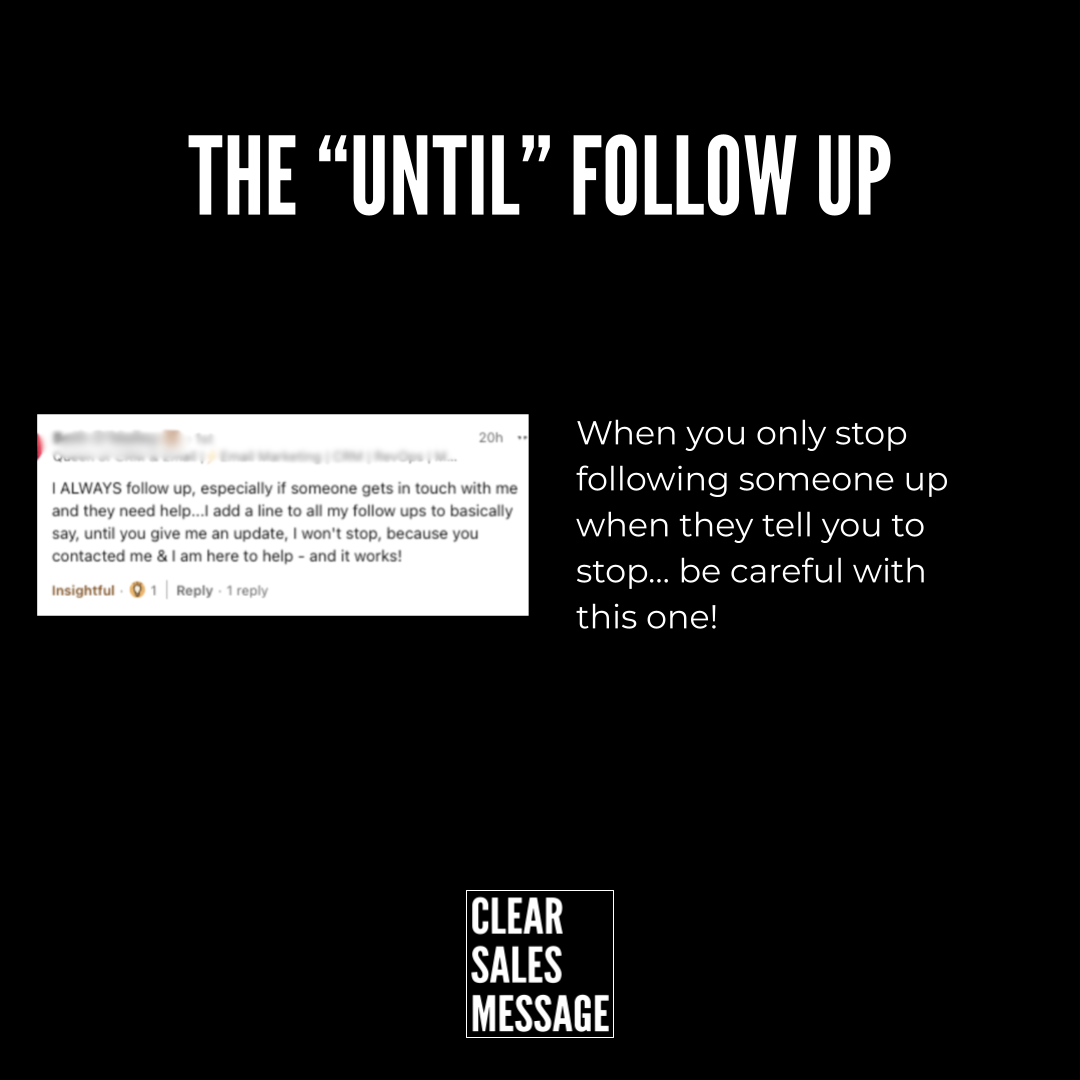
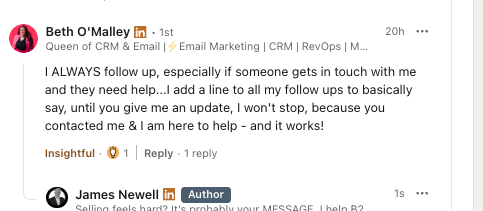
On LinkedIn, a comment from Beth O’Malley captures this approach perfectly. She adds a line to all her follow-ups that essentially says: “Until you give me an update, I won’t stop – because you contacted me and I am here to help.” Her view is that it works, and the logic is hard to argue with. Persistence framed as service is a very different thing from persistence framed as pressure.
See Also