Practical Sales Training™ > How To Get Attention > The Monoproduct Method
The Monoproduct Method
Most businesses think more choice means more sales. So they add options, packages, tiers, and add-ons – hoping something will appeal to everyone. But the opposite often happens. More choice creates more confusion, and confused buyers do not buy.
The Monoproduct Method is a different approach. Instead of spreading your offer wide, you narrow it down to one clear thing. One product. One service. One thing you are known for. As a result, buyers understand you immediately, trust you faster, and find it much easier to say yes.
This is not just a sales tactic. It is also a clarity tool. Because when you can only sell one thing, you have to make sure that one thing is brilliant – and that your message around it is sharp enough to stand on its own.
What Is The Monoproduct Method?
The Monoproduct Method is when a business focuses its offer around a single core product or service rather than a broad range. It does not mean you have nothing else to offer. It means you lead with one thing, make that thing the centre of your identity, and let everything else play a supporting role.
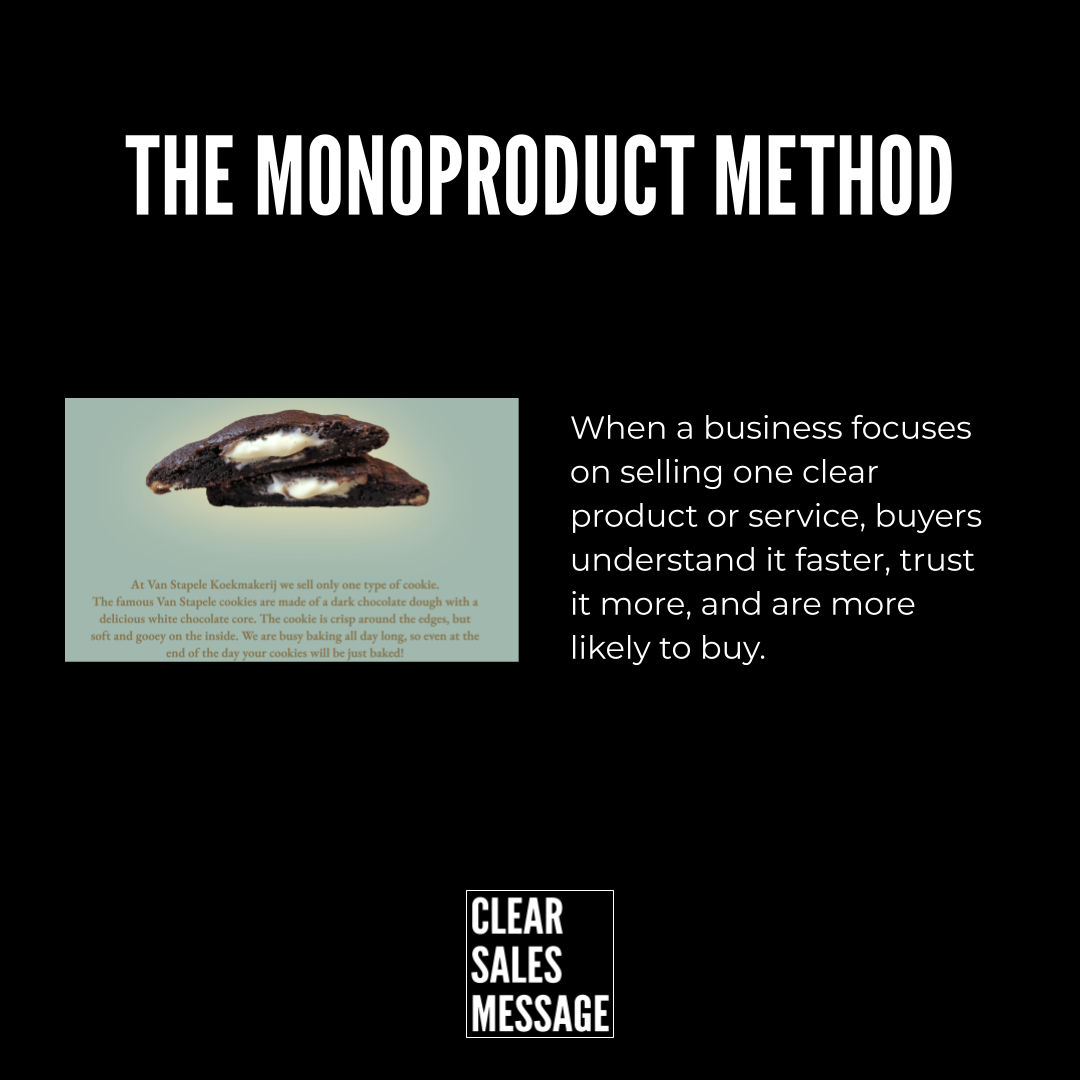
Think of Van Stapele Koekmakerij in Amsterdam – a bakery that sells one type of cookie. Just one. They do not offer a full menu or a wide range of baked goods. But because they do one thing and do it brilliantly, they have queues out the door and a reputation that spreads without any effort.
The principle works because it removes the work buyers have to do. There is nothing to compare, no decision to labour over, and no confusion about what this business is for. You know exactly what you are getting, so the only question left is whether you want it.
Why Does The Monoproduct Method Work?
Buyers have limited attention and limited patience. So when a business tries to explain five different things at once, most buyers switch off before they get to the end. However, when a business says one thing clearly, buyers can process it in seconds – and that speed builds confidence.
There is also a trust factor. A business that does one thing feels like an expert in that thing. In contrast, a business that does everything can feel like it has not committed to being brilliant at any of it. Specialisation signals skill, and skill is what buyers are really paying for.
Also, a single clear offer is easy to recommend. Word of mouth depends on simplicity. If someone asks a past client what you do and the answer takes a paragraph, the referral loses momentum. But if the answer is one sentence, it travels easily – and that is free marketing.
How Can You Use The Monoproduct Method In Sales?
You do not have to strip your business back to one product to use this idea. Instead, apply the principle to how you lead. Pick the one thing that best represents what you do and build your message around it first.
Lead with one offer, not a menu
When you meet a new prospect or write a homepage, resist the urge to list everything you do. Instead, lead with the one thing that solves their most common problem. You can introduce other services later – but only once the buyer understands and trusts the core offer.
Use it to sharpen your positioning
Ask yourself: if you could only sell one thing, what would it be? That question forces clarity. Because the answer usually reveals what you are best at, what buyers come back for, and what you are most confident delivering. That is your Monoproduct.
Make your one thing undeniably good
The Monoproduct Method only works if the thing you focus on is genuinely worth focusing on. So before you narrow your message, make sure the core product or service is as strong as it can be. The method does not rescue a weak offer – it amplifies a strong one.
Let it drive your brand identity
When you are known for one thing, that thing becomes your brand. Buyers remember you more easily, refer you more often, and search for you more specifically. For example, being “the HR consultant for care homes” is far more memorable than being “an HR consultant who works across multiple sectors”.
When The Monoproduct Method Works Best
This approach works best when your core offer is strong, clear, and repeatable. If you have a service that delivers a consistent result for a specific type of buyer, the Monoproduct Method gives you the fastest route to being known for it.
It also works well in crowded markets. When every competitor is offering a wide range of similar things, the business that focuses on one thing stands out immediately. The contrast does the heavy lifting for you.
Similarly, it suits businesses that grow through referrals. Because the simpler your offer is to describe, the easier it is to pass on. And the easier it is to pass on, the more often it gets shared.
When The Monoproduct Method Becomes Dangerous
The risk is real if your one product or service is too narrow for the market. If demand is limited, focusing everything on one offer can cap your growth. However, this is less common than people fear – most businesses that worry about being too narrow are actually still far too broad.
It can also cause problems if your core offer becomes outdated and you have nothing else to fall back on. So while you lead with one thing, it makes sense to keep developing and testing other ideas quietly – just not at the expense of the focus that got you known.
Also, the method does not suit every sales conversation. Some buyers arrive already knowing they want multiple things from you. In those cases, forcing a single-product conversation can feel restrictive. Therefore, use it as a default entry point, not a rigid rule.
Common Monoproduct Method Mistakes
Confusing focus with limitation
Leading with one offer does not mean you cannot do other things. It means you do not lead with other things. Many businesses resist this because they fear losing potential customers. But in practice, clarity attracts more buyers than range does.
Choosing the wrong product to lead with
Some businesses pick their most profitable offer to lead with rather than their clearest or strongest one. However, the best Monoproduct is the one buyers understand fastest and want most – not necessarily the one with the best margin.
Applying the method to the offer but not the message
You can narrow your product range and still confuse buyers if your message is cluttered. The Monoproduct Method requires both a clear offer and a clear message around it. One without the other does not work.
Giving up too soon
Focus takes time to pay off. Businesses that try the Monoproduct Method for a few weeks and then go back to listing everything have not given it enough time to work. Buyers need to hear and see a consistent message repeatedly before it sticks. Stay focused for longer than feels comfortable.
The Monoproduct Method – An Example
A marketing consultant offers strategy, copywriting, social media management, email campaigns, SEO advice, and brand design. She is busy but not growing. When new prospects look at her website, they see a long list of services and struggle to know where to start. Most leave without getting in touch.
She decides to apply the Monoproduct Method. After thinking about what she is best at and what clients value most, she narrows her lead offer to one thing: a 90-minute messaging session that gives businesses a clear positioning statement and a homepage rewrite.
Her website now leads with that one offer. Everything else moves to a secondary page. As a result, visitors understand what she does in seconds, enquiries go up, and she starts getting referred more often – because her clients can now explain what she does in a single sentence.
See also:
- 100+ ways to seize buyer attention
- 100+ ways to differentiate
- The Specialist Effect
- The Niche Effect
- The Coming Soon Effect