

Practical Sales Training™ > How to connect with your buyer > The Speed Effect
The Speed Effect
What Is It
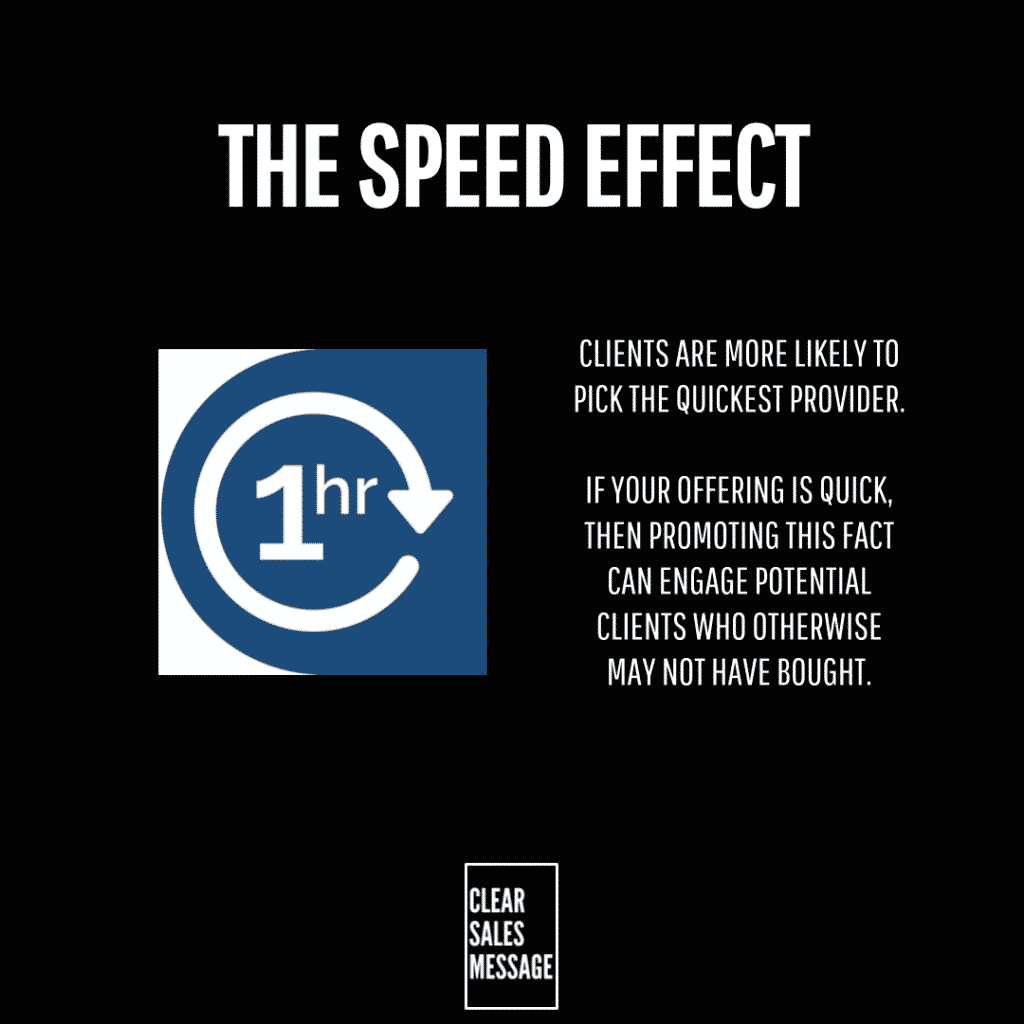
How quickly you deliver value to clients can be an important factor to engage them and help convert to sale. Speed itself becomes part of the pitch.
It’s not just about being fast. It’s about telling buyers exactly how fast, before they even ask.
That specificity is what turns speed from an internal efficiency into a genuine selling point.
Why Does It Work
It works because, as human beings, we follow the path of least resistance. We want to meet our needs and solve our problems in the quickest, simplest, easiest way possible.
By focusing on just how quickly you can deliver value, solve a problem, or do what you do, you appeal to the innate need in all of us to just get things done.
Most buyers assume things will take longer than they actually do. Correcting that assumption instantly makes your offer feel lighter to commit to.
How Can You Use It
Find the part of your offering you can deliver fast
Depending on your offering, is there a part of what you do that can be delivered quickly? Something that would appeal to clients as well as be simple to complete in a given period of time?
State the timeframe out loud, don’t leave it implied
Focusing on part of your offering, or the offering overall, and how long it takes can be a paradigm shift in engaging clients who might otherwise wrongly expect things to take much longer.
Assume they don’t already know it’s fast
It’s a variant of WYSIWYG. If you don’t tell them, they won’t know. Silence about speed just gets filled with a slower assumption.
When It Works Best
This works best when speed is a genuine differentiator, when your delivery time is faster than what buyers typically expect in your category.
It also works best paired with a clear, specific outcome. “Fast” alone means little. “Fast, and you get this exact result” means everything.
When It Becomes Dangerous
It backfires if the speed comes at the cost of genuine quality. A fast result that disappoints damages trust more than a slower one that delivers properly.
It also becomes risky if the promised timeframe isn’t consistently achievable. One missed deadline undoes several successful ones in a buyer’s memory.
Overpromising speed just to compete on it can cause its own damage, since a rushed process sometimes produces a worse outcome than a considered one.
Common Mistakes
Promising speed you can’t consistently deliver
A fast timeframe that only works on your best day sets an expectation you’ll eventually break. Set a number you can hit reliably.
Leaving the speed unstated
If your process really is fast but you never say so, buyers assume the industry standard timeframe instead. Say the number out loud.
Sacrificing outcome quality for speed alone
Speed only works as a selling point if the result still holds up. A fast but weak outcome undermines the whole pitch.
The Speed Effect – An Example
A Marketing Consultant’s 90-Minute Offer
A marketing consultant offers a “90-Minute Website Messaging Makeover” where clients walk away with a clear homepage draft, headline, and CTA copy by the end of the call.
This taps into the buyer’s desire for fast progress, and cuts through the assumption that clarity takes weeks or months.
The speed becomes part of the value proposition:
“Clarity in 90 minutes. No waiting. No fluff.”
By communicating a clear timeframe and quick result, you reduce resistance, signal confidence, and make your offer easier to buy.
See also