Practical Sales Training™ > How People Work > The Path of Least Resistance

The Path of Least Resistance
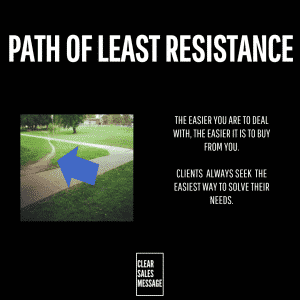
Given two ways to reach the same destination, most people take the easier one. Not because they are lazy, but because the brain conserves energy by default. When the easier option exists, it wins.
In sales, friction costs you buyers. Every extra step, every confusing page, every form that takes too long pushes people towards whoever makes it simpler. Because your buyers are always looking for the easiest path, the business that removes the most barriers wins the most customers.
The Path of Least Resistance is not just a principle to understand. It is a practical framework for redesigning how you sell.
What Is the Path of Least Resistance?
The Path of Least Resistance is the natural human tendency to take the easiest, most direct route to a goal. In a buying context, it means buyers gravitate towards the option that requires the least effort, the least thinking, and the least risk.
When you recognise that tendency and build your business around it, you stop fighting human nature and start working with it. The result is a buying experience so smooth that choosing you feels like the obvious and natural thing to do.
Why Does the Path of Least Resistance Work?
It works because the human brain actively avoids unnecessary effort. When a buyer faces two similar options and one is easier to buy, easier to understand, or easier to use, they choose the easier one almost every time. Ease of purchase is therefore not just a nice feature. It is often the deciding factor.
Companies like Amazon and McDonald’s have built entire empires on this principle. Every part of the Amazon experience exists to reduce the number of steps between a buyer and a completed purchase. One-click buying, saved addresses, stored payment details. Each small change removes a moment of friction, but in total the effect is enormous.
When buyers feel unsure or overwhelmed, they default to inaction. However, when the path forward feels clear and easy, they keep moving. That is why simplifying your process converts more buyers than any amount of persuasion.
How Can You Use the Path of Least Resistance In Sales?
Audit Your Buying Process From the Buyer’s Point of View
Walk through your entire buying process as if you were a new customer. Notice every moment where you have to think, search, wait, or work. Because each of those moments is a point where a real buyer might give up, every step you can remove or simplify is a direct improvement to your conversion rate.
Remove Unnecessary Blockers
Look for things that exist in your process because they suit your workflow rather than the buyer’s experience. A long contact form, a requirement to call during office hours, a complicated checkout. Each of these adds resistance. When you remove them, you make it easier for buyers to say yes and harder for them to drift towards a simpler alternative.
Make the Next Step Obvious at Every Stage
Buyers should never have to wonder what to do next. At every touchpoint, whether that is your website, a proposal, or a follow-up email, make the next step clear, simple, and easy to take. Because when the path forward is obvious buyers follow it, and when it is not they stop and often do not start again.
When the Path of Least Resistance Works Best
It works best when buyers face a choice between you and a rival who makes things harder. In a competitive market, ease of buying is a genuine differentiator. A buyer who finds your competitor’s process confusing will choose you, even with a similar product, simply because you made it easier.
Repeat purchases and referrals also benefit significantly. When existing clients find you easy to work with, they come back without shopping around and recommend you without prompting. Because ease creates loyalty in a way that other factors rarely match, investing in simplicity pays off long after the first sale.
When the Path of Least Resistance Becomes a Problem
The risk is in making things so easy that important steps get skipped. A checkout with no confirmation step can lead to accidental purchases. A sales process with no qualification step can bring in poor-fit clients. So the goal is to remove unnecessary friction, not all friction, because some steps exist for a good reason.
There is also a risk of confusing simplicity with low quality. A process that feels too slick or too automated can make buyers feel like a number rather than a person. So balance ease with warmth, because the ideal buying experience is both effortless and human.
Common Path of Least Resistance Mistakes
Designing the Process Around Your Needs, Not the Buyer’s
Many businesses build their sales and onboarding process to suit their own systems. The buyer, however, experiences the result of those internal decisions. When the process is clunky or confusing, the buyer pays the price. So always design from the buyer’s perspective first and fit your internal requirements around that.
Adding Steps That Serve No One
Over time, processes accumulate steps that no one can fully explain. A form that duplicates information already collected, a sign-off that adds days without adding value. Each of these slows the buyer down without helping either side. So review your process regularly and cut anything that does not serve a clear purpose.
Assuming Buyers Will Make the Effort
Motivated buyers will push through friction to get what they want. Most buyers, however, are not that motivated, especially early in the relationship. So design for someone who will walk away at the first sign of difficulty, because those buyers represent a large portion of your lost sales and they never tell you why they left.
The Path of Least Resistance – An Example
Skechers built an entire product line around removing a single moment of friction. Their Hands Free Slip-ins need no bending, no touching, and no laces. You simply step in and go. The selling point is not the shoe itself. It is the complete absence of effort.
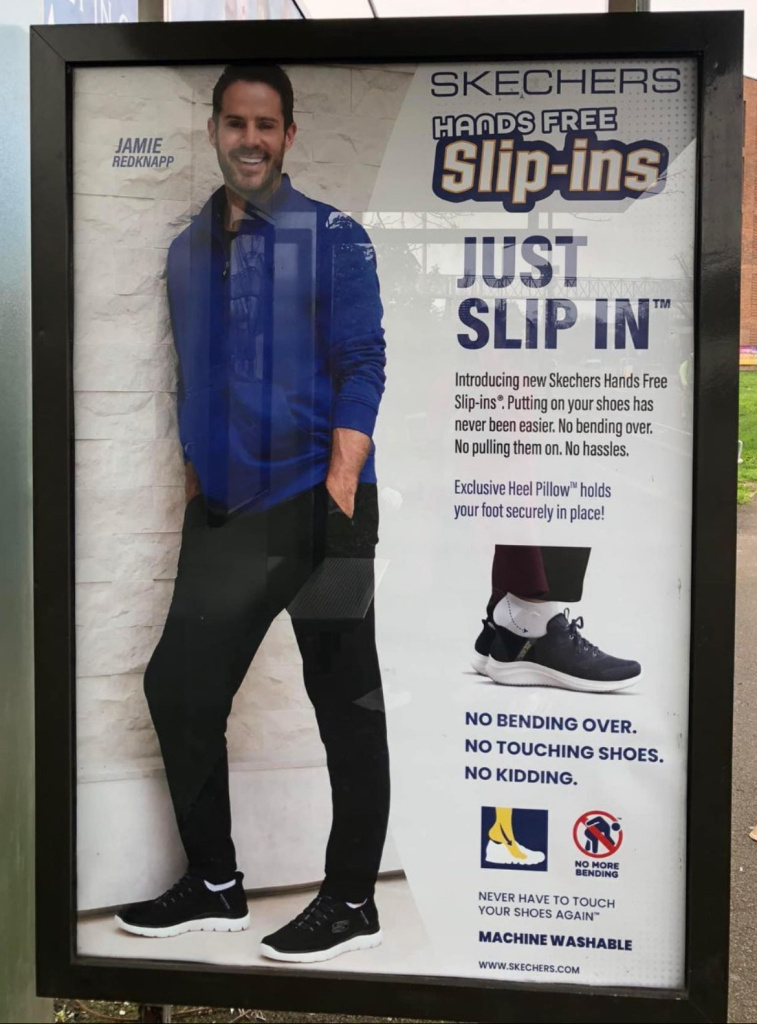
The ad makes no apology for the simplicity of the idea. Their tagline says it all: no bending, no touching, no kidding. Because the convenience is the product, the message sells entirely by describing the friction it removes. That is the Path of Least Resistance applied as a core selling point rather than a background feature.
See Also:
- Let me sell for you
- Delayed Sign Up
- Guest Checkout
- 50+ ways that people work and make decisions
- 100+ ways to be more memorable