Practical Sales Training™ > How People Work > Information & Opportunity

Information & Opportunity
Most sales problems are not closing problems. They are information problems. The buyer does not have enough to make a confident decision, so they stall, delay, or walk away. Pushing harder at that point makes things worse. Giving them what they need makes things better.
Information and Opportunity is a simple reframe. Instead of trying to convince someone to buy, you ask yourself whether they have everything they need to make the best choice for themselves. When the answer is yes, most of the selling is already done.
It takes the pressure out of sales and replaces it with something buyers respond to far better: clarity and control.
What Is Information & Opportunity?
Information and Opportunity is the idea that your job in a selling situation is not to push someone towards a yes. It is to give them the two things they need to decide: the right information and a clear chance to act on it.
Information means everything the buyer needs to understand what you offer, what it costs, what it delivers, and what happens if they do or don’t proceed. Opportunity means making it easy for them to say yes when they are ready. That might be a trial, a demonstration, a clear next step, or simply removing the friction from the buying process.
When both are in place, buyers make decisions. When either is missing, they hesitate. So the question to ask after every sales conversation is not “did I push hard enough?” but “did they leave with everything they needed?”
Why Does Information & Opportunity Work?
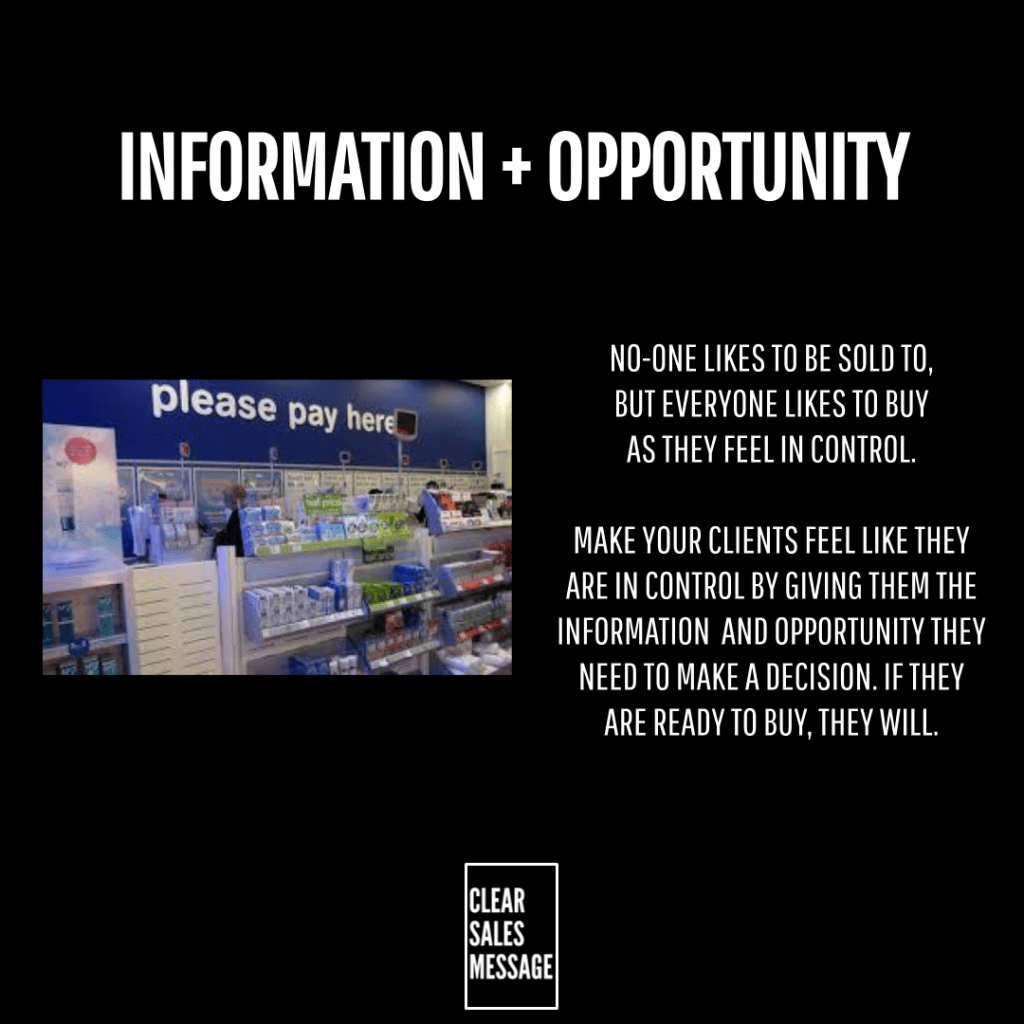
It works because no one likes to feel sold to. The moment a buyer senses pressure, their guard goes up. They start looking for reasons to say no rather than reasons to say yes. But when a buyer feels in control, the dynamic flips. They stop defending and start deciding.
Control is the key word here. When you hand the buyer the information and create a clear path to act, you give them ownership of the decision. That feels very different to being pushed. And buyers who feel respected rather than pressured are far more likely to convert, and far more likely to come back.
Also, this approach removes the need for pushy tactics that buyers see through anyway. Artificial urgency, manipulation, and pressure selling all create short-term wins at the cost of long-term trust. Information and Opportunity builds both the sale and the relationship at the same time. Because when buyers feel well-served in the decision process, they remember it.
How Can You Use Information & Opportunity In Sales?
The shift starts with how you think about your role. You are not there to close. You are there to make sure the buyer has what they need to close themselves. That changes the questions you ask, the content you share, and the pace you set.
Audit Your Information
After every sales conversation, ask: does this buyer have everything they need to make a confident decision? If not, what is missing? It might be proof, a clearer explanation of outcomes, answers to concerns they raised, or a comparison with what they currently do. When you identify the gap and fill it, you remove the last barrier between the buyer and a yes.
Create a Clear Next Step
Opportunity means making it easy to act. When a buyer is ready to move forward but the path is unclear, they pause. So always end a conversation with a specific, low-friction next step. A free trial, a follow-up call, a proposal, a demo, or a simple link to get started. Because a buyer who knows exactly what to do next is far more likely to do it than one who has to figure it out themselves.
Remove Friction From the Buying Process
Opportunity is also about removing anything that gets in the way. Long contracts, complicated onboarding, hard-to-find pricing, and slow response times all reduce the chance that a ready buyer follows through. So look at your buying process from the buyer’s point of view. Find the points where things slow down and smooth them out. Because the easier it is to say yes, the more people do.
Replace Pressure With Questions
Instead of pushing for a decision, ask what is standing in the way of one. “Is there anything else you need to feel confident moving forward?” gives the buyer space to name what is missing. When they tell you, you can address it directly. That conversation moves faster than any amount of closing pressure, because you are solving a real problem rather than trying to override a real concern.
When Information & Opportunity Works Best
It works best in considered purchases where the buyer needs time, evidence, and confidence before they commit. High-value B2B sales, professional services, and complex products all benefit enormously from this approach. Because in those situations, a buyer who feels rushed makes a slower decision, not a faster one.
It also works best when you know your buyer well enough to know what information they actually need. Generic information dumps do not help. But a targeted answer to the specific concern that is holding them back can unlock a decision instantly. So listen more than you talk, and tailor what you share to what each buyer is missing.
Also, it works best when the opportunity you offer matches where the buyer is in their process. A buyer at the start of their research needs different things to one who is ready to sign. So read the stage they are at and match the opportunity to it. A demo works early. A clear proposal works late. Offering the wrong opportunity at the wrong time creates friction rather than removing it.
When Information & Opportunity Becomes Dangerous
The main risk is using it as an excuse to avoid asking for the business at all. Giving information and creating opportunity is not the same as being passive. At some point, you still need to ask whether the buyer is ready to move forward. Information and Opportunity removes pressure. But it does not remove the need for a clear, confident ask when the time is right.
There is also a risk of over-informing. When you give a buyer so much information that the decision feels complex rather than clear, they freeze. So be selective. Share what helps them decide, not everything you know. Because clarity converts better than volume.
However, the biggest danger is assuming the buyer has enough when they don’t. Many buyers will not tell you what is missing. They will just go quiet. So check in actively. Ask whether they have what they need and whether there is anything else that would help. Because a buyer who feels heard is far more likely to move forward than one who feels left to figure it out alone.
Common Information & Opportunity Mistakes
Leaving the Next Step Unclear
One common mistake is ending a sales conversation without a clear next step. Even when the information has landed well, a buyer who does not know what to do next will often do nothing. So always name the step, make it easy, and confirm it before the conversation ends. Because momentum matters, and it is far easier to keep it than to rebuild it.
Sharing the Wrong Information
Another mistake is sharing generic information rather than the specific thing the buyer needs to move forward. A long brochure does not help a buyer who just needs to understand one key feature. A case study from the wrong industry does not reassure a buyer who wants proof from their own sector. So ask what would help most, then give them exactly that.
Confusing Giving Control With Losing It
A third mistake is interpreting this approach as sitting back and waiting for buyers to decide in their own time. Giving the buyer control does not mean giving up yours. You still guide the conversation, set the agenda, and ask for the business when the moment is right. The difference is that you do it from a position of service rather than pressure. That distinction changes everything about how the buyer responds.
Information & Opportunity – An Example
A software company demonstrates its project management tool to a potential client. Instead of pushing with lines like “you need to sign up today or you’ll miss out,” the salesperson focuses on informing and enabling:
“Here’s a 10-minute walkthrough showing exactly how you can save 5 hours a week using our automation feature. We’ll also give you a 14-day free trial so you can test it with your team. If you need more time or have questions, we’ll be here to help you decide.”
The buyer gets clear information and a low-risk way to try the product. There is no pressure, just the tools they need to make a confident call. As a result, they convert. Not because they were pushed, but because they felt respected and in control throughout.
That is what Information and Opportunity looks like in practice. And it is a far more reliable path to a yes than any closing technique ever will be.
See Also