Practical Sales Training™ > How People Work > Circular Reasoning

Circular Reasoning
You ask someone why their product is the best. They say it’s the best because it’s better than everything else. You ask how they know that. They say because it’s the best.
That’s circular reasoning. The argument loops back on itself instead of moving forward. No real evidence gets offered. The claim just restates itself in slightly different words and hopes you don’t notice.
In sales and business, this comes up more than you’d think. Spotting it in others protects you from weak arguments. Avoiding it yourself keeps your credibility intact.
What Is Circular Reasoning?
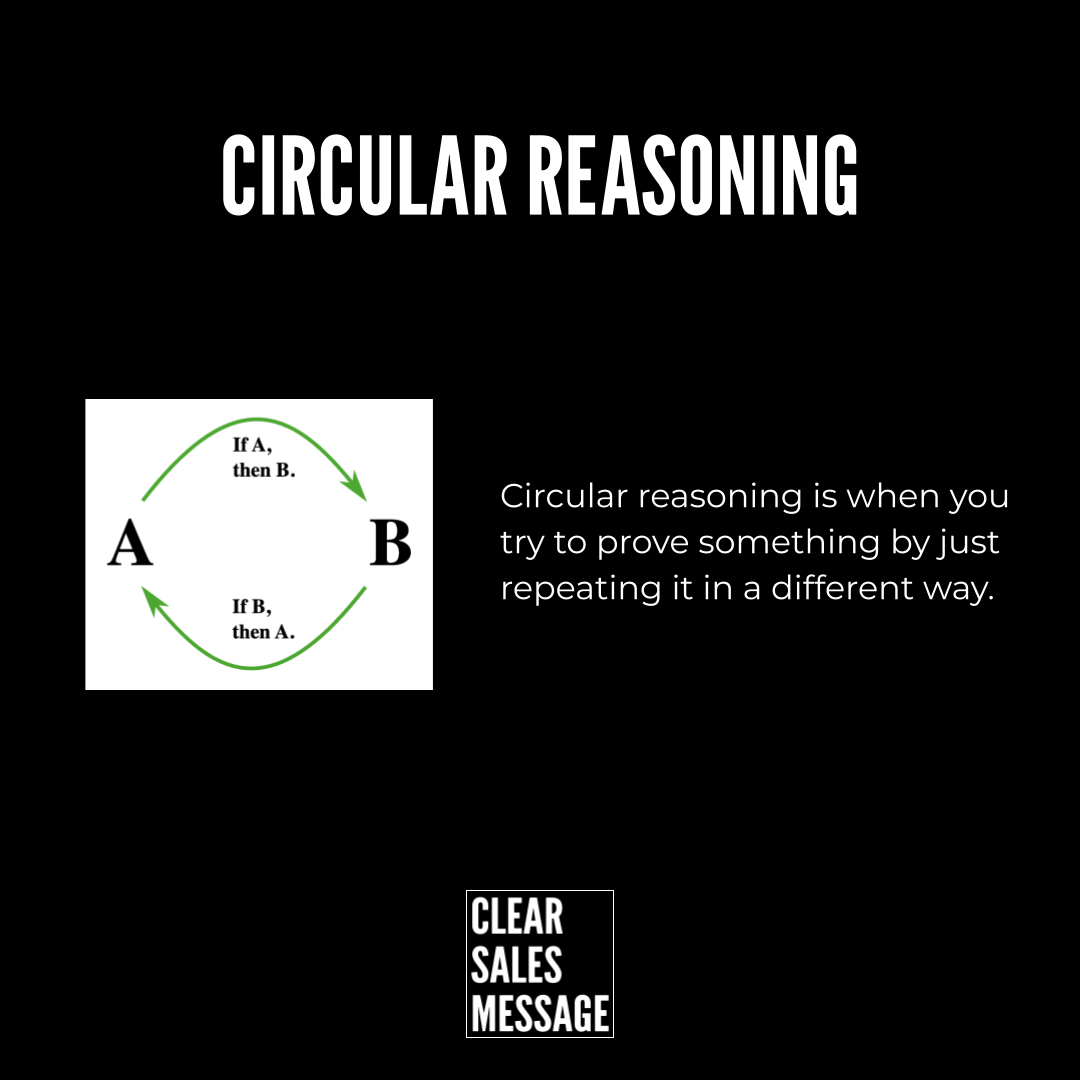
Circular reasoning is a logical fallacy where the conclusion and the proof are the same thing. Instead of offering real evidence, the argument loops back on itself. The claim gets used to prove the claim.
Two simple examples make this clear. “This product is the best because it’s better than all the others.” Or: “I’m trustworthy because I always tell the truth.” Neither gives you anything solid to stand on. Both just restate the opening point in different words.
The argument feels like it’s going somewhere, but it never actually arrives. That’s what makes circular reasoning a fallacy rather than a weak argument. There’s no real logic underneath it at all.
Why Does Circular Reasoning Work?
Despite being flawed, circular reasoning can still land. Repetition makes statements feel more credible over time, even when nothing new gets added. Hear something said with enough confidence and it starts to feel true.
People who already agree with a claim also tend not to look for extra evidence. Circular reasoning exploits that. When the listener’s bias does the work, the argument doesn’t have to.
And because it skips the complexity of real proof, it sounds simple and confident. In a fast-moving conversation, that can be enough to pass unchallenged. Most people don’t stop to ask whether the evidence actually supports the conclusion.
How Can You Use or Avoid Circular Reasoning In Sales?
Spot it in conversations
When a buyer or competitor makes a claim, ask yourself what evidence actually supports it. If the only support is a restatement of the claim itself, you’re looking at circular reasoning. Naming it calmly and asking for real evidence shifts the dynamic fast.
Avoid it in your own pitch
Saying “we’re the best because we’re better than the competition” sounds confident but proves nothing. Back every claim with something real. A case study, a number, a specific outcome. Real evidence is what separates a strong pitch from an empty one.
Use it carefully in branding
Short slogans sometimes use circular logic on purpose. “The best just got better.” It doesn’t prove anything, but for brand recall it doesn’t need to. Just don’t rely on it when a buyer is actively evaluating you against alternatives.
Teach your team to recognise it
Sales teams that can spot circular reasoning in objections and competitor claims are much harder to knock off course. Train people to ask “what’s the actual evidence for that?” It’s a simple habit with a big impact.
When Circular Reasoning Works Best
Circular reasoning works best when the audience already agrees. If someone believes your brand is premium, a statement like “our quality speaks for itself” lands well because the bias fills in the gap. No proof gets needed because the listener supplies it.
Brand slogans and advertising often use it this way. The goal isn’t logical proof. It’s emotional reinforcement. For that purpose, circular logic does its job quietly and effectively.
And in fast conversations where no one has time to analyse claims carefully, circular reasoning can pass unchallenged simply because it sounds assured. Confidence disguises the absence of evidence.
When Circular Reasoning Becomes Dangerous
In a sales context, circular reasoning becomes a problem the moment a buyer starts to think critically. If they ask “but how do you know that?” and the only answer is a restatement, trust drops quickly. Buyers who catch it feel like they’re being fobbed off.
It also undermines credibility over time. A brand or salesperson who consistently makes claims without evidence eventually gets a reputation for being all talk. That reputation is hard to shift once it forms.
And in high-stakes decisions, where buyers are doing proper due diligence, circular reasoning is the fastest way to lose the room. Serious buyers want real proof, not a confident loop.
Common Circular Reasoning Mistakes
Mistaking confidence for evidence
Saying something with certainty isn’t the same as proving it. A lot of circular reasoning hides behind a confident tone. Train yourself to separate how something gets said from what it actually shows.
Using it in writing without noticing
Web copy and proposals are full of circular claims. “We deliver exceptional results because our work is exceptional.” Read your own content and ask whether each claim has real support behind it, or whether it just restates itself.
Letting it go unchallenged in meetings
When circular reasoning appears in a meeting or negotiation, most people let it slide to avoid conflict. But a polite, specific question like “what data supports that?” keeps the conversation grounded and protects you from weak logic.
Confusing it with tautology
A tautology restates something as true by definition, like “a free gift.” Circular reasoning makes an argument that loops. Both are flawed, but in different ways. Knowing the difference helps you respond to each one more precisely.
Circular Reasoning – An Example
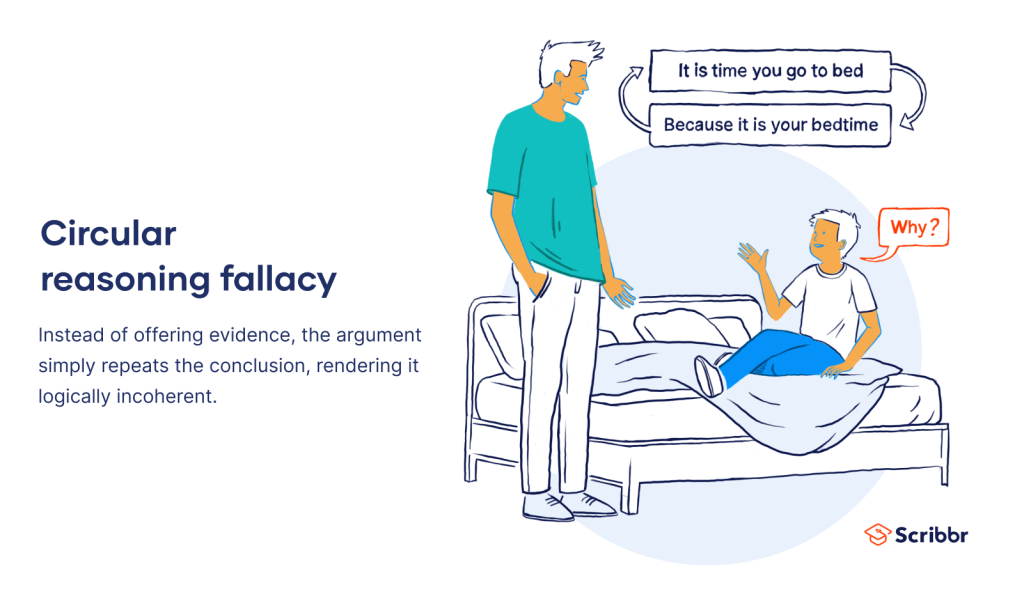
A parent tells a child it’s time for bed. The child asks why. The parent says “because it’s your bedtime.” The child asks why it’s their bedtime. The parent says “because it’s time for bed.”
No new information gets added at any point. The argument simply loops. That’s circular reasoning in its purest form, and it works on small children mainly because the parent has authority, not because the logic holds up.
In sales, the same thing happens when someone says “you should trust us because we’re trustworthy.” The claim and the proof are identical. Ask for something real instead.
See also