
Practical Sales Training™ > How To Get Attention > Client Retention

Client Retention
What Is It
Client retention is simply how many customers stick around instead of leaving. Show that number to a new buyer, and you’ve handed them proof before you’ve said a word about your product.
It’s one figure, but it carries weight. A high retention rate tells a stranger that people who already tried you chose to stay. That’s a stronger sell than most features you could list.
Why Does It Work
Buyers trust behaviour more than words. Anyone can claim to be great. Fewer people can show that real customers keep paying month after month. That’s proof, not promise.
It also removes risk from the decision. If 98% of people stay, a new buyer assumes they will too. The number does the reassuring so you don’t have to argue for it.
How Can You Use It
Put The Number Where It’s Seen First
Don’t bury your retention rate at the bottom of a page. Put it near the top, close to where someone’s still deciding whether to trust you at all. Early proof changes how they read everything after it.
Pair It With Other Proof
A retention stat lands harder next to other numbers, like revenue generated or an average rating. Together they build a fuller picture than any single stat can on its own.
Keep It Honest And Specific
A vague claim like “most of our clients stay with us” convinces no one. A specific number, even a slightly less impressive one, always beats a vague boast. Specific numbers feel earned. Vague ones feel invented.
When It Works Best
This works best when the number is genuinely strong and you can back it up if asked. It also works well on service pages, case studies, or anywhere a buyer is comparing you against a competitor.
When It Becomes Dangerous
If your retention rate isn’t actually strong, don’t lead with it. A weak number draws attention to a weakness you’d rather not highlight at all.
It also backfires if the number can’t be verified. Buyers are sharper than they used to be. An unbelievable stat with no source behind it damages trust instead of building it.
Common Mistakes
Rounding Up To Sound Impressive
Turning 91% into “over 90%” is fine. Turning 91% into “nearly 100%” isn’t. Buyers can smell exaggeration, and one inflated number makes them question every other claim on the page.
Showing The Number With No Context
A retention rate on its own means less than a retention rate next to a timeframe. “98% retention” says less than “98% of clients renew every year.” Context turns a good number into a convincing one.
Hiding It Too Far Down The Page
Strong proof buried at the bottom of a page does almost nothing. Move it up near your main pitch, where it can do its job while the buyer is still deciding whether to trust you.
Client Retention – An Example
A 98% Retention Rate On Display
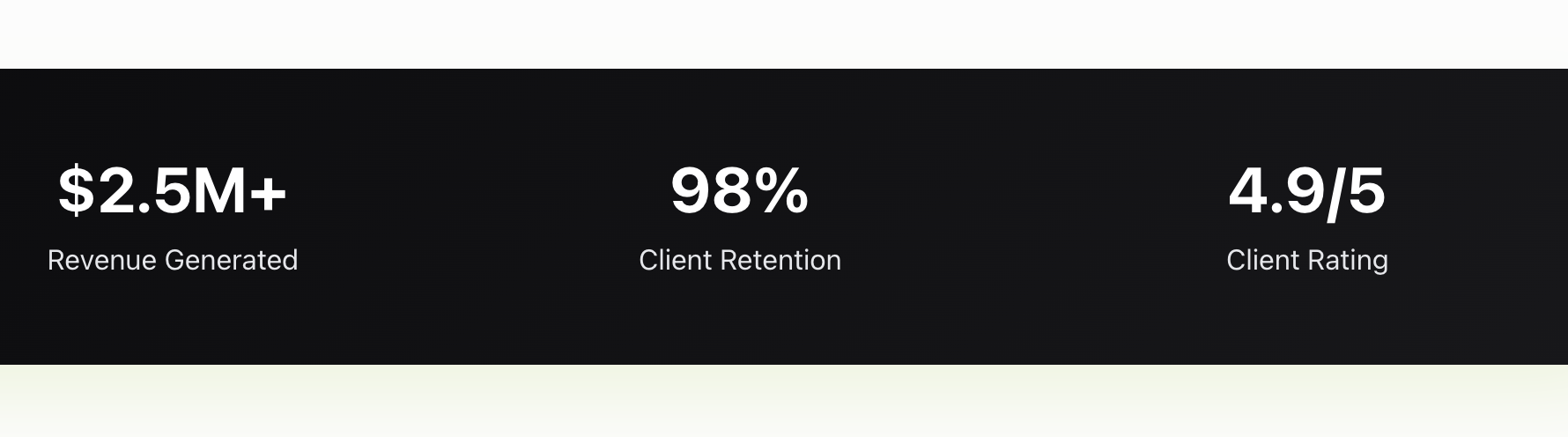
This company puts its client retention rate front and centre, right alongside revenue generated and average client rating. Ninety eight percent of clients stay, and that number sits in bold text where it’s impossible to miss.
Placed next to two other strong numbers, the retention stat does more work than a paragraph of testimonials could. A visitor sees proof before they’ve read a single word of the pitch underneath it.
See Also
- 100+ ways to seize buyer attention
- Activity Counter
- The Before/After Effect
- Transformation Statement
- Specific Proof