

Practical Sales Training™ > How To Convert > Specific Proof
Specific Proof
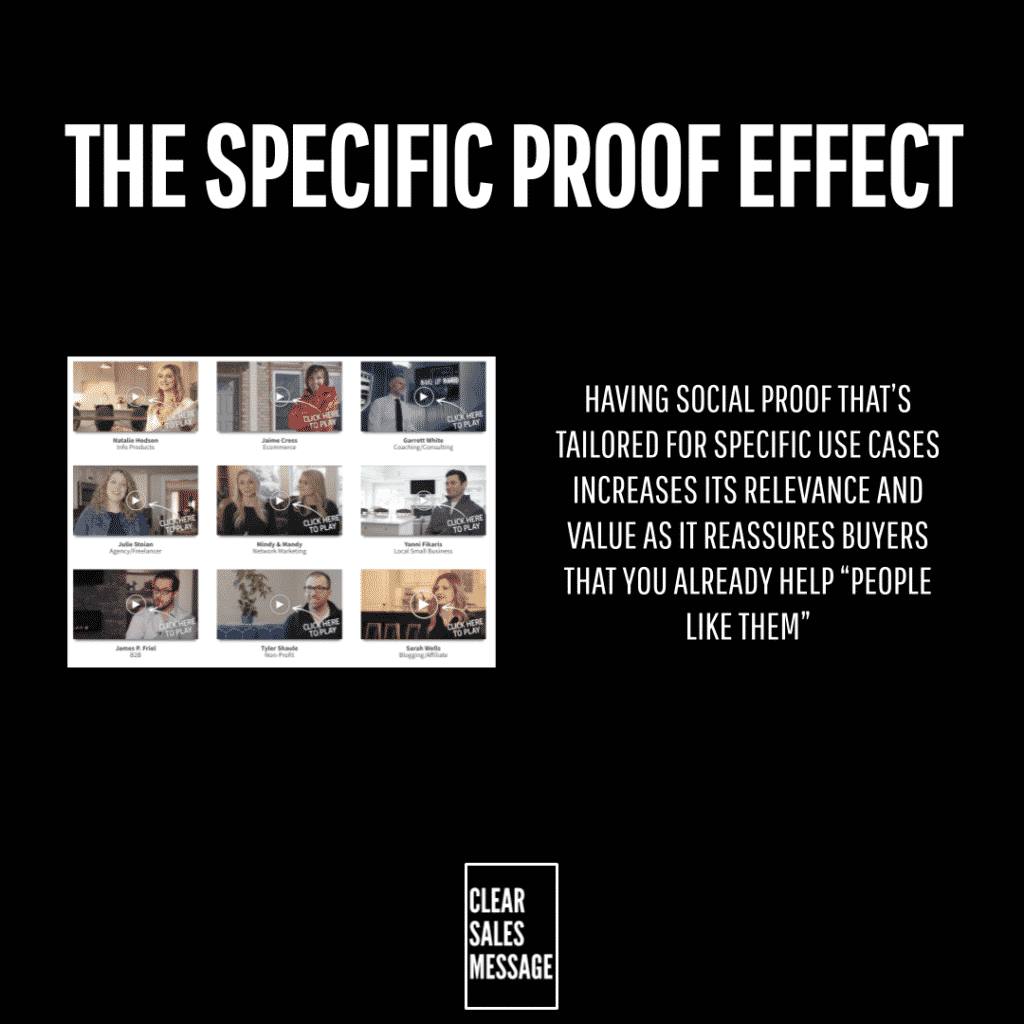
General Social Proof tells buyers that others have been happy. Specific Proof goes one step further. It shows buyers that others in their exact situation have been happy.
That shift matters more than it might seem. A buyer wants more than general reassurance that your clients are happy. They want to know that someone with their exact problem, in a business like theirs, got the result.
Specific Proof means using reviews, case studies, and testimonials tied to a particular product, service, or use case. It reassures buyers that you are good at the exact thing they need, not just good in general.
What Is Specific Proof?
When a buyer looks at your offer, they carry a specific fear. Not a general one. They worry that your solution works for other types of clients but maybe not for them. Specific Proof kills that doubt directly. It shows them that someone just like them already made the call and it paid off.
General Social Proof is still useful. But a buyer who sees proof matched to their situation feels something different. They stop wondering whether your offer applies to them. Instead, they start thinking about when to say yes.
The more targeted the proof, the harder it is for a buyer to discount. Because they cannot say “that is not like my situation,” the proof sticks. It removes one of the last reasons to hesitate.
Why Does Specific Proof Work?
Buyers do not make decisions in the abstract. They make them from inside their own situation, with their own fears, constraints, and pressures. Generic proof asks them to make the leap from someone else’s experience to their own. Specific Proof removes that leap entirely.
When a buyer reads a case study from a client with the same job title, in the same sector, with the same type of problem, they do not need to imagine the outcome. They can see it. Because the mental distance between the proof and their situation is so small, trust builds fast.
There is also a credibility signal. Specific Proof shows that you understand the detail of what you do and who you do it for. It signals depth. A firm that can point to proof across a range of specific use cases looks more capable than one with a generic wall of five-star ratings.
How Can You Use Specific Proof In Sales?
Start by mapping your offer. List every product, service, or use case you sell. Then look at your existing reviews and testimonials. Which ones speak directly to each part of that list? Where the gaps are, you know which clients to approach for more targeted proof.
Ask for the Right Detail
Ask for specifics when you request a review. Do not just ask whether a client was happy. Ask what problem they brought, what changed, and what they would say to someone in the same spot. The more precise the answer, the more useful the proof. A specific outcome is always more convincing than a general compliment.
Display It in the Right Place
Proof tied to a specific product should sit on the page that talks about that product. A buyer reading about one thing should see proof about that same thing. Mixing in proof from your whole range dilutes the impact. Match the evidence to the decision the buyer is making right now.
Sort and Organise What You Already Have
You may already have good proof that is not working hard enough because it is buried in a general testimonials page. So sort what you have by product, service, or outcome. Even a simple reorganisation can make existing proof far more effective without collecting a single new review.
When Specific Proof Works Best
Specific Proof works best when the buyer is weighing up options. At that stage they ask not just who is good, but who is good at this. Proof that answers that exact question moves the decision forward fast.
It also works well for higher-value or more complex offers. When the stakes are higher, buyers want to be sure the solution has worked in conditions like theirs. Generic proof does not satisfy that need. Specific proof does.
It is also powerful at the point of objection. When a buyer hesitates and says something like “I am not sure this applies to our situation,” a specific case study from a similar client answers that hesitation directly. Because the match is clear, it is hard to argue with.
When Specific Proof Becomes Dangerous
The main risk is showing the wrong proof in the wrong place. If a buyer considers product A but all the testimonials cover product B, the proof does not land. It can even feel misleading. Map your proof carefully to the right part of your offer.
There is also a risk of thin proof. One testimonial per product is not much. Build a habit of collecting specific proof regularly so each part of your offer has strong evidence behind it.
Common Specific Proof Mistakes
Mixing All Your Proof in One Place
The most common mistake is putting all your proof together on one page with no sorting or context. That asks buyers to do the work. They have to read every review and decide which ones apply to them. That friction slows the decision. Sort your proof so the buyer does not have to.
Only Collecting Proof From Easy Wins
A second mistake is only collecting proof after easy wins. Some of the strongest Specific Proof comes from clients who faced a tough situation and still won. Ask those clients too. Proof that shows your offer working under pressure is often more convincing than proof from a smooth, straightforward job.
Proof That Is Too Vague to Be Useful
Vague proof does vague work. If a review could have been written about any business in your space, it is not helping you stand out. Coach clients to be specific. Ask what the outcome was, how long it took, and what they would say to someone facing the same call. Specific answers make Specific Proof worth reading.
Specific Proof – An Example
On the Clear Sales Message™ examples page, deliverables are sorted into clear groups. Naming, taglines, terminology, and other outputs each have their own section. A buyer who wants to see what a naming project looks like can find that directly.
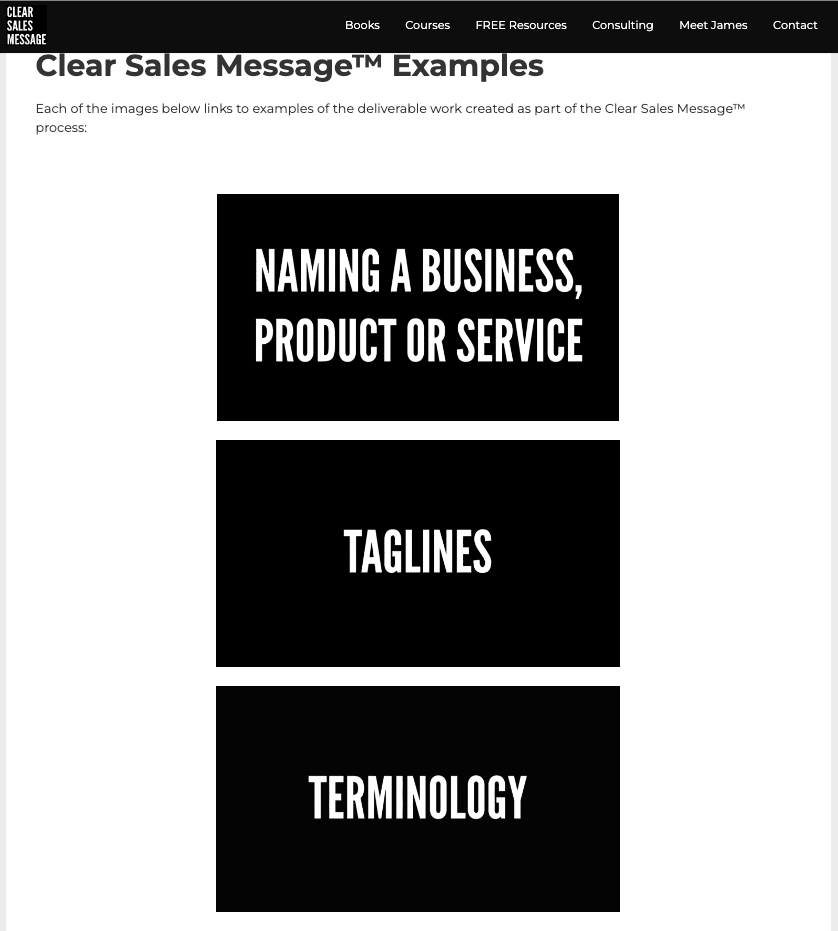
So a buyer at a specific point in their decision finds proof that speaks to their need. When you sort proof by type, it does its job far better than a mixed gallery. This is Specific Proof working as it should. Organised, targeted, and matched to the exact question the buyer is asking.
See Also
- The Before/After Effect
- Transformation Statement
- Social Proof
- 180+ ways to improve conversion
- 100+ ways to be more memorable