Practical Sales Training™ > How To Get Attention > Concentration Hook

Concentration Hook
Getting attention is one thing. Keeping it is another. Most sales and marketing content loses people halfway through because there’s no reason to stay. Nothing is promised. Nothing is coming. So the audience drifts.
A concentration hook fixes that. It gives people a specific reason to keep going. They’re no longer passively consuming your message. They’re waiting for something, and that waiting keeps them sharp.
It’s one of the simplest tools in sales communication. And it’s one of the most underused.
What Is a Concentration Hook?
A concentration hook is a device you use to keep your audience paying attention for longer. It gives them a reason to stay engaged because they’re waiting for something specific to happen.
Think of a radio show telling listeners “stay tuned for the new Taylor Swift track coming up” or “we’ll announce the winner after the break.” That small hook keeps people concentrating rather than switching off. The content hasn’t changed. But the listener now has a job to do: wait for the promised moment.
In sales, the same principle applies. When you tell a buyer “there’s one detail that makes this work, I’ll come to it in a moment,” you’ve just given them a reason to stay with you.
Why Does a Concentration Hook Work?
It works because anticipation changes how the brain processes information. When someone knows a payoff is coming, they shift from passive to active. They’re no longer just listening. They’re listening for something.
Three things happen as a result. First, attention has a job. People have been told what to look or listen out for, so their focus sharpens. Second, anticipation builds engagement. Waiting for a promised moment keeps the brain switched on instead of wandering. Third, curiosity aids memory. When people expect something, they’re more likely to remember both the wait and the payoff. The hook doesn’t just hold attention in the moment. It also makes the whole message more memorable.
Without a concentration hook, your message risks blending into the background. With one, your audience has a reason to stick with you until the end.
How Can You Use a Concentration Hook In Sales?
You can apply a concentration hook in any sales or marketing message where you want people to stay engaged until the end.
Webinars and Presentations
Tell people at the start that you’ll share a specific tip, tool, or bonus at the end. It gives the audience a reason to stay rather than drop off once they’ve heard what they came for. The promise of something valuable at the close keeps them seated through the middle.
Podcasts and Videos
Tease an upcoming story, guest, or reveal early on. “Later in this episode I’m going to share the exact question that changed how I pitch” is a concentration hook. It gives the listener a destination. So instead of dipping in and out, they stay focused because they’re waiting to arrive.
Emails
Promise an answer or reveal later in the message so the reader keeps going. Most emails lose people in the first few lines. But if the opening line sets up a question that the rest of the email answers, you’ve created a hook that pulls them through. The subject line can do the same job.
Sales Conversations
Drop a line like “there’s one detail that makes this work, I’ll explain in a minute” to hold attention during a pitch or meeting. It signals that something important is coming. As a result, the buyer stays engaged rather than half-listening while they check their phone.
Lead Magnets and Content
When sharing a video or piece of content with a prospect, hint at something unexpected inside it. A curiosity gap at the start gives them a reason to watch or read to the end. That’s far more effective than simply saying “I think you’ll find this useful.”
When a Concentration Hook Works Best
It works best in longer formats where attention is most likely to drop. A webinar, a long email, a video, a presentation. These are the formats where people are most tempted to drift, so a hook at the start does the most work.
It also works well when the promised payoff is genuinely worth waiting for. The hook creates expectation. But if the reveal is weak, it damages trust. So the stronger and more specific the promise, the harder the hook lands.
Similarly, it works well when the hook is placed early. The sooner you give people a reason to stay, the less you lose before you’ve made your main point. Front-loading the hook is almost always the right move.
When a Concentration Hook Becomes Dangerous
It becomes a problem when the payoff doesn’t match the promise. If you tell someone “I’ll share the one thing that changed my business” and then deliver a vague tip, the hook has done damage. The audience feels misled. That erosion of trust is hard to recover from.
It also backfires when it’s used too often in the same piece of content. One or two hooks keep people engaged. But if every paragraph promises something coming later, it starts to feel manipulative. Buyers notice when the format is more about holding them hostage than delivering value.
And it can misfire if the hook is too vague. “You won’t want to miss what’s coming next” is weak because it promises nothing specific. The best hooks name the thing people are waiting for, because that’s what creates genuine anticipation.
Common Concentration Hook Mistakes
Making a Vague Promise
A hook only works if it’s specific. “Something exciting is coming up” doesn’t create real anticipation because there’s nothing concrete to wait for. Instead, name the thing. “I’ll share the exact script I use to open cold calls” gives the audience something to fix their attention on.
Not Delivering on the Promise
Whatever you promise, you have to deliver. A concentration hook sets up an expectation. If the payoff is weak, late, or missing entirely, you’ve trained your audience not to trust your hooks in future. The reveal has to be worth the wait.
Placing the Hook Too Late
If you don’t give people a reason to stay until halfway through, you’ve already lost many of them. The hook needs to come early, ideally in the first few sentences or the opening minute of a video. Because you can’t re-engage someone who’s already gone.
Overusing It
One well-placed hook is powerful. But stacking hooks on top of each other throughout a piece dilutes the effect and starts to feel like a trick. Use it deliberately, not as a reflex. The best concentration hooks are memorable because they’re rare enough to feel intentional.
Concentration Hook – An Example
When sharing a lead magnet video with potential buyers, I mention a magic trick that appears in the video. That single detail creates a curiosity gap. The buyer now has a specific reason to watch to the end, because they want to see the trick. It’s a simple hook, but it works.
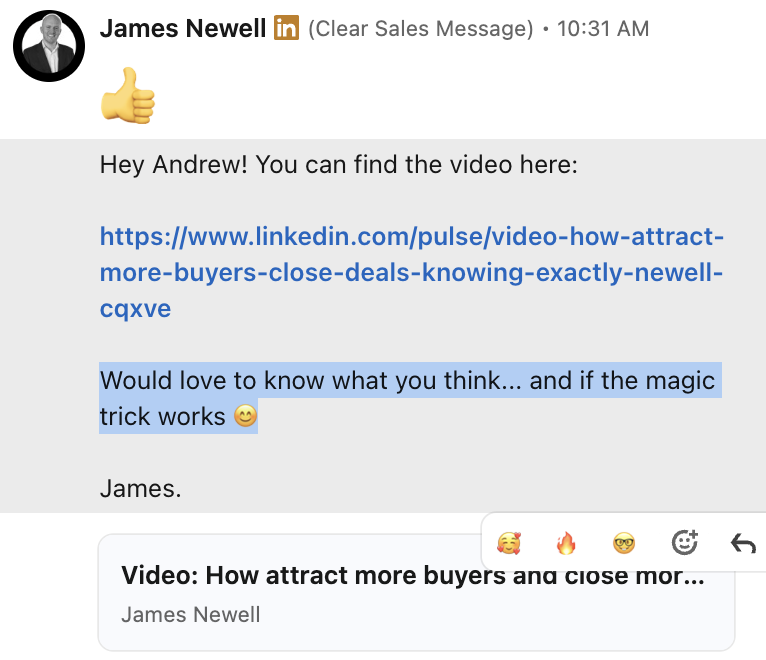
The message shown above does exactly that. It shares the video link and then adds “would love to know what you think… and if the magic trick works.” That line is the hook. It gives the reader something to look out for, so they watch with focus rather than half an eye.
See also