Practical Sales Training™ > How To Get Attention > False Interaction Cue
False Interaction Cue
Most content gets scrolled past in under a second. The brain makes a fast decision – worth stopping or not – and moves on. So the only way to win attention is to trigger a reaction before that decision happens.
A False Interaction Cue does exactly that. It borrows visual signals people already respond to on their phones and plants them in your content. The result is an instinctive pause, a swipe, or a tap – before the viewer has consciously chosen to engage.
That moment of micro behaviour is often all you need. Because once someone has stopped, your message has a chance to land.
What Is a False Interaction Cue?
A False Interaction Cue is a small visual hint that makes people think there is something to interact with, even when the post is completely static. It uses familiar interface signals – arrows, dots, cropped text, play buttons – to trigger automatic behaviour.
People see the cue and respond without thinking. They swipe because dots suggest more slides, or tap because a play button suggests a video, or t hey click “see more” because a sentence trails off mid-thought. These are learned responses built through years of using phones, and a False Interaction Cue exploits them.
The cue is not the content. It is the mechanism that gets the viewer close enough to see the content in the first place.
Why Does a False Interaction Cue Work?
It works because it borrows visual patterns people experience every day. Carousel dots, right-pointing arrows, cut-off sentences, and play buttons all carry meaning on a phone. That meaning has been reinforced through millions of interactions, so the response is close to automatic.
When you recreate those patterns in a static post, the viewer responds in the same way they would to the real thing. They interact even though nothing actually happens. That moment of interaction creates a stop in the scroll – and a stop is all you need to land a message.
There is also a curiosity element. A cropped sentence or a partially visible image suggests something is being withheld. Because people dislike incomplete information, they act to resolve it. As a result, the cue pulls them in before they have made a conscious choice to engage.
How Can You Use a False Interaction Cue In Sales?
Carousel dots on a single image
Adding pagination dots to a static post makes it look like a carousel. Viewers swipe to see the next slide, and on some platforms that swipe counts as an engagement. So the cue both stops the scroll and boosts your content in the algorithm at the same time.
A right-pointing arrow
An arrow pointing off the edge of the screen suggests another panel is waiting. The viewer swipes to find it. Even when there is nothing more to see, the arrow has already done its job – it pulled the eye and created a moment of focus on your content.
A cropped or trailing sentence
Ending a line of text mid-thought forces the viewer to click “see more” to resolve the tension. This is one of the simplest False Interaction Cues available, and it works because people are wired to complete incomplete things. Use it when your opening line creates genuine curiosity.
A play button on a still image
Overlaying a play button on a static image makes viewers tap to start a video that does not exist – or that leads them somewhere else entirely. The tap is the goal. For paid ads in particular, a play button can significantly lift click-through rates because the action feels natural.
Partially visible content
Cropping an image so something interesting sits just off-screen makes the viewer want to scroll or swipe to see more. The brain dislikes incomplete visual information, so it seeks to resolve it. That instinct works in your favour when the partially hidden content is something worth revealing.
When a False Interaction Cue Works Best
It works best when the feed moves fast and organic reach is low. On platforms like TikTok, Instagram, and Facebook, early engagement signals tell the algorithm your content is worth showing. A False Interaction Cue generates that early engagement, which means more people see the post as a result.
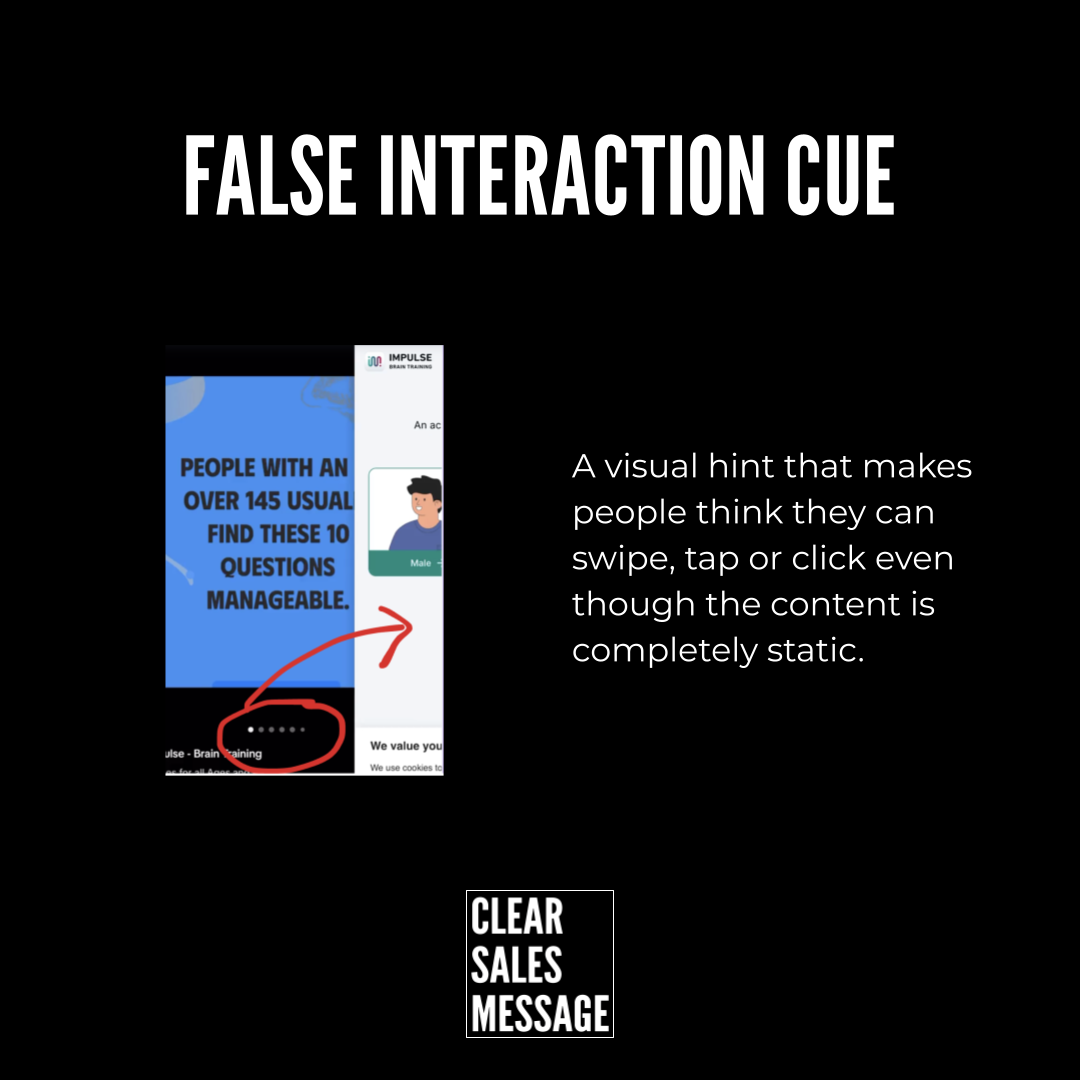
It is also effective in paid ads where cost-per-click matters. When a cue makes the tap feel instinctive rather than considered, click-through rates rise – and that brings the cost of each click down. The Impulse Brain Training ad in the example below uses this principle directly.
Similarly, it works well when your actual message is strong but your opening is not grabbing attention on its own. A False Interaction Cue buys you the extra second you need for the real content to land.
When a False Interaction Cue Becomes Dangerous
The risk is using it to cover up weak content. A cue can stop the scroll, but it cannot save a message that has nothing to say. When the viewer realises they were nudged into engaging with something unremarkable, the feeling left behind is mild irritation rather than interest.
There is also a trust issue if the cue feels deliberately deceptive. A play button that leads to an unexpected destination, or dots that promise more slides but deliver nothing, can frustrate users. So the cue should feel like a natural part of the content, not a trick that wastes the viewer’s time.
Overuse on a single account is another danger. When every post uses a False Interaction Cue, followers start to notice the pattern and the effect fades. Use it strategically, because it works best when it still feels surprising.
Common False Interaction Cue Mistakes
The payoff does not match the cue
If the cue suggests more is coming but the content does not deliver, the viewer feels cheated. The stop in the scroll has to lead somewhere worth stopping for. So make sure the content behind the cue earns the attention the cue created.
Using it on the wrong platform
False Interaction Cues rely on platform-specific behaviour. Carousel dots work on Instagram and TikTok because users expect carousels there. However, the same dots on a LinkedIn post may confuse rather than intrigue. Always match the cue to the platform norms your audience knows.
Making it too obvious
The cue works because it feels instinctive rather than deliberate. When it looks forced – a poorly placed arrow, an out-of-context play button – the spell breaks. Keep the cue subtle and native to the format so it blends in rather than stands out as a technique.
False Interaction Cue – An Example
This advert from Impulse Brain Training uses pagination dots to make the post look like a carousel. On TikTok, swiping a carousel is the same action as clicking the advert. So the dots do two jobs at once – they stop the scroll and they trigger the click. The ad also uses a bold claim designed to make the viewer want to prove something about themselves, which compounds the effect.

See Also