

Practical Sales Training™ > How to connect with your buyer > First Person Questions
First Person Questions
Consider the difference between “Pricing” and “How much does it cost?” Both point to the same information. But one is written for the business and the other is written for the buyer. And buyers respond to the one that sounds like them.
Most websites and sales materials are written from the seller’s point of view. Categories, labels, and headings describe what the business does or what it offers. But buyers are not thinking in those terms. They are thinking in questions: what will I get? how does it work? is it right for me?
First Person Questions is the practice of rewriting your content to reflect those questions. When a heading sounds like something the buyer would ask, the content feels relevant before they have even read it. And that feeling of relevance drives engagement.
What Are First Person Questions?
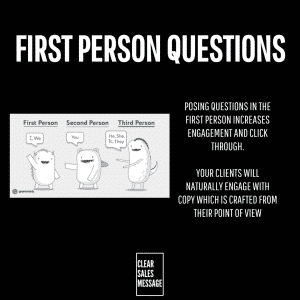
First Person Questions are headings, links, and labels written in the buyer’s language rather than the business’s language. “Benefits” becomes “What will I get?” and “How It Works” becomes “How does this work for me?”
The principle applies anywhere you present information to a buyer: website pages, FAQ sections, proposals, sales decks, and onboarding materials. In each case, the question is the same. Would a real buyer phrase this heading the way you have written it? If not, rewrite it in their voice.
You will notice that the headings on this very page follow this approach. Each section title takes the form of a question the reader might ask. That is not an accident. It is an example of the concept in action.
Why Do First Person Questions Work?
They work because humans are self-focused. We pay most attention to things that relate directly to us. When a heading uses the word “I” or “my,” it registers as personal. It feels like it was written for you rather than for a general audience. And that sense of direct relevance makes you more likely to read on.
It also works because it reduces the effort of understanding. “Pricing” requires translation. “How much does it cost?” needs none. The connection is instant.
There is also an SEO angle. People search in natural language, often as questions. A page titled in the same language as a buyer’s search is more likely to match what they needed. So First Person Questions can improve both engagement on the page and findability before it.
How Can You Use First Person Questions?
Rewrite your website headings in the buyer’s voice
Start by listing all the section headings on your website. Then ask yourself: would a buyer actually phrase it this way? If not, rewrite it as the question they would ask. “About Us” becomes “Who are you and why should I care?” “Services” becomes “What can you help me with?” This simple pass can transform how visitors experience your site.
Apply it to FAQ sections and proposals
FAQ sections are the most natural home for First Person Questions. Every entry is already a question. But many FAQs use business language rather than buyer language. So review yours and check whether each question sounds like something a real buyer would actually ask. If it sounds like something a company would write about itself, rewrite it from the buyer’s point of view.
Listen to how buyers actually talk
The best source of First Person Questions is your buyers themselves. Listen to the questions on discovery calls, in your inbox, and in your search data. Those are the exact phrasings to use. Copy written in your buyers’ language feels made for them. Because it was.
Use it in navigation and link text
Navigation menus and link text are easy to overlook, but they shape how buyers move through your content. “Learn more” tells the buyer nothing. “Show me how it works” tells them exactly where they are going and why. So review your link text and rewrite it in language that connects to what the buyer is thinking right then.
When First Person Questions Work Best
They work best anywhere a buyer is deciding whether to engage with content. When a buyer scans a page, they are looking for signals that the content is relevant to them. A heading in the buyer’s own voice is a strong signal. So First Person Questions are most powerful at the top of pages, in navigation, and in opening sections.
They also work particularly well in FAQ sections, where the format already encourages question-based language. A FAQ built in First Person Questions feels intuitive because every heading already matches what the buyer is thinking. That frictionless experience increases the chance they find the answer they need.
And they work in any sector. The principle is the same whether you are writing for consumers or businesses, for simple products or complex services. Every buyer thinks in questions. The business that reflects those questions back to them wins the attention of the ones that do not.
When First Person Questions Become Dangerous
The risk is going too casual for the context. “What will I get?” works on a consumer-facing website. But in a formal proposal or a regulated sector, overly informal phrasing can undermine your credibility. So calibrate the language to the setting. The goal is to sound like the buyer, not to sound like a text message.
There is also a risk of inconsistency. If some headings follow this approach and others do not, the mix looks accidental rather than deliberate. So if you adopt this approach, apply it consistently throughout a document or page. Partial adoption is more distracting than either approach used fully.
And be careful about the questions you choose to highlight. If a heading draws attention to a concern you cannot answer well, it may create doubt rather than resolve it. So pair the approach with honest, specific answers. First Person Questions open the door. The answer has to do the rest.
Common First Person Questions Mistakes
Keeping the old headings and just adding a question mark
Adding a question mark to “Pricing?” does not make it a First Person Question. The point is to write in the buyer’s voice, not to punctuate the business language differently. So do the actual work. Rewrite the heading from scratch in the language a buyer would use. That rewrite is where the value is.
Using it only in FAQs and ignoring the rest of the page
First Person Questions work wherever buyers scan for relevance. So do not limit the approach to one section. Apply it to page titles, section headers, navigation links, and call-to-action buttons. Every label is a chance to speak in the buyer’s language. The more consistently you do it, the more the whole experience feels built for them.
Guessing what the buyer asks rather than listening
Guessing what buyers ask is the weakest version of this concept. Using their actual words, from their actual questions, is the strongest. So review your sales call notes, your inbox, your chat logs, and your reviews. The real language is in there. Use it and the copy will feel like it was written by someone who truly understands the buyer. Because it was.
First Person Questions – An Example
The fitness coach who rewrote the FAQ
A fitness coach builds a FAQ section using traditional headings: Pricing, Benefits of Personal Training, How It Works. The headings describe topics but do not sound like questions a real person would ask.
So they rewrite them.
“Pricing” becomes “How much does it cost?”
“Benefits” becomes “What will I get from working with you?”
“How It Works” becomes “How do your sessions work?”
Visitors reading the new headings feel as though the page is responding to their actual thoughts. As a result, engagement increases and more visitors move further through the site. The information has not changed. Only the language has. That is the power of First Person Questions.
See Also