Practical Sales Training™ > How People Work > Hanlon’s Razor
Hanlon’s Razor
The proposal went in on Tuesday. By Friday, nothing. No reply. No acknowledgement. And the brain starts filling in the gaps. They didn’t like it. They’ve gone elsewhere. They’re ignoring you.
But what if the email just got buried? What if the buyer had a tough week? What if it was a simple oversight with no meaning behind it at all?
That’s the question Hanlon’s Razor asks. And in sales, asking it first changes everything about how you respond.
What Is Hanlon’s Razor?
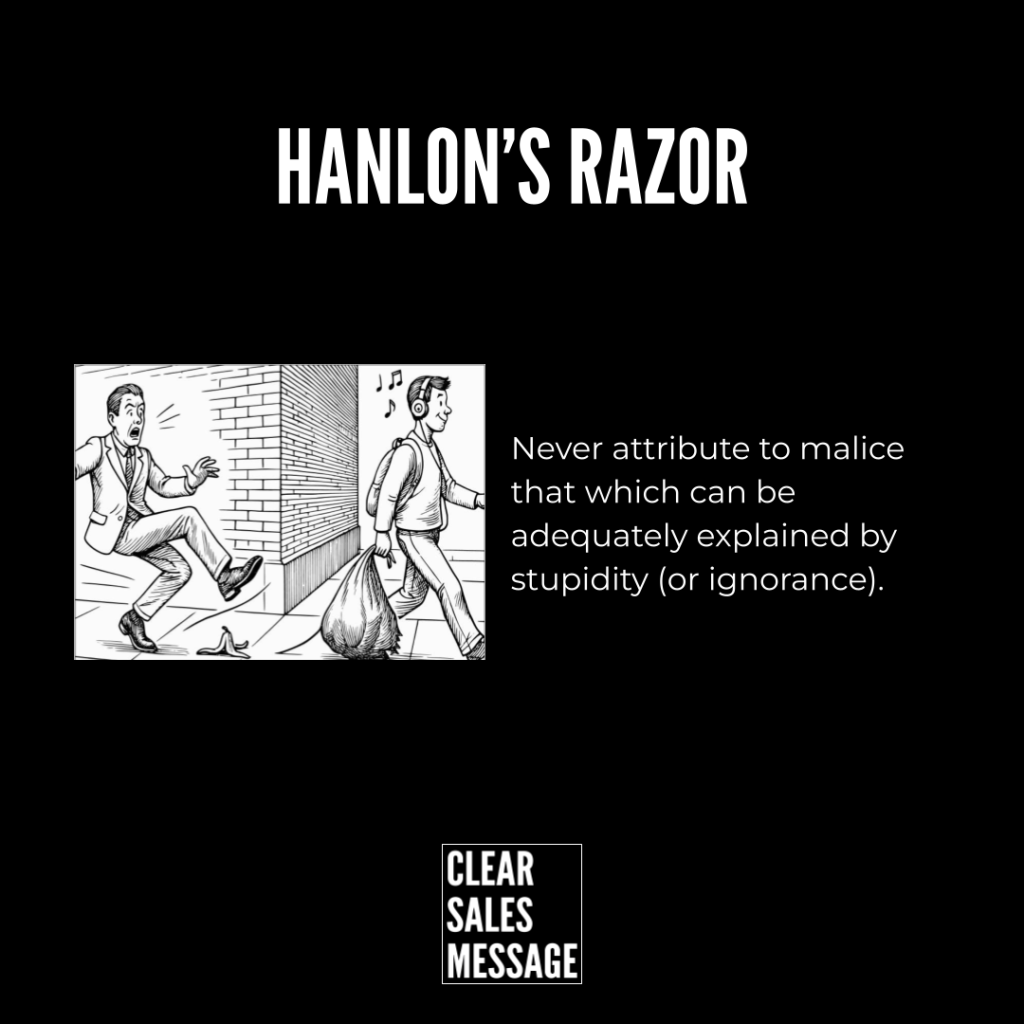
Hanlon’s Razor is a simple rule for clearer thinking: do not assume malice when a mistake or oversight explains the situation just as well. Most problems happen because people are busy, distracted, or simply human. Not because they want to cause harm.
The principle is named after Robert J. Hanlon, who submitted it to a book of Murphy’s Law observations in the 1980s. But the idea goes further back. Similar thinking appears in Goethe, Napoleon, and others. It’s a principle that keeps reappearing because it keeps being needed.
In everyday life, it’s easy to jump to intent. When something goes wrong, the brain looks for someone to blame. Hanlon’s Razor slows that jump. It asks a calmer question first: could this be a mix-up, a missed step, or a broken process? Usually, it could.
Why Does Hanlon’s Razor Matter in Sales?
Sales is full of moments that feel personal but usually aren’t. A buyer goes quiet. A complaint arrives. A deal stalls without explanation. In each case, the natural reaction is to interpret the silence or friction as rejection or hostility. But that reaction is often wrong. And it leads to responses that damage the relationship rather than repair it.
When you assume mistake over malice, you stay curious instead of defensive. You ask what happened rather than reacting to what you think happened. As a result, you find the real cause faster. And fixing the real cause is almost always more productive than responding to an imagined slight.
There’s also a trust effect. Buyers and customers feel the difference between a supplier who assumes the worst and one who assumes good faith. The one who assumes good faith is easier to work with. So over time, applying Hanlon’s Razor builds the kind of relationship that generates loyalty and referrals.
How Can You Use Hanlon’s Razor In Sales?
You can apply this principle across follow-up, customer service, team management, and process design. Here’s how it works in each context.
Before You React
When something feels off, pause. Assume positive intent first. Look for the simple cause before you reach for a more dramatic explanation. Is the inbox cluttered? Was the next step unclear? Did something come up on their side? Because nine times out of ten, the simple cause is the real one. And reacting to it calmly keeps the door open.
When You Follow Up
Don’t follow up with frustration baked into the tone. Be brief and helpful instead. Restate the outcome in one line, attach what they need, and offer clear yes or no options. A follow-up that assumes the buyer is busy and distracted will always perform better than one that assumes they’re avoiding you. Because the tone of the message shapes how the reader responds to it.
In Your Sales Process
Make next steps explicit. Send a summary after every meeting. Include an invite. Set reminders so you don’t rely on memory or hope. Many deals go quiet not because buyers have lost interest, but because the next step was never clearly defined. So instead of assuming disinterest, assume confusion and remove it. As a result, more deals move forward without you having to chase.
With Customers and Complaints
When a complaint arrives, treat it as a signal rather than an attack. Find the broken step. Something in the process didn’t work. Fix it and confirm the fix to the customer. Because a customer who complains and gets a genuine resolution often becomes more loyal than one who never had a problem. Hanlon’s Razor helps you get there by keeping your response diagnostic rather than defensive.
With Your Team
When someone on your team misses a deadline or drops the ball, ask what blocked progress before you judge intent. Was the brief unclear? Did a tool fail? Was the workload unrealistic? Remove the block or coach the skill. Because blaming intent when the cause is structural doesn’t fix anything. It just damages trust and makes the same problem more likely to happen again.
When Hanlon’s Razor Works Best
It works best in established relationships where a track record already exists. When you know someone to be reliable and things suddenly go quiet, the most likely explanation is external. A holiday, an internal reshuffle, a busy period. Hanlon’s Razor keeps you from treating a temporary disruption as a permanent change in intent.
It also works well when the stakes are high. In large or complex deals, delays are common and silence is often structural rather than personal. Applying the razor keeps your communication calm and professional. As a result, you remain the easiest person in the process to deal with, which is a significant advantage when the buyer is weighing up suppliers.
Similarly, it works well in customer service contexts. Customers often arrive angry. But anger is usually a response to a system failure, not a personal attack. When you treat it that way, the resolution is faster and the relationship is stronger for it.
When Hanlon’s Razor Becomes Dangerous
It becomes a problem when it tips into naivety. The razor says don’t assume malice when a mistake explains it. But some situations genuinely do involve bad intent. A buyer who has consistently misled you, a customer who is deliberately abusing your process, or a pattern of behaviour that goes beyond oversight. In those cases, assuming mistake keeps you vulnerable. So use the razor as a default, not a rule that overrides clear evidence.
It can also cause problems when it delays a necessary conversation. If something has gone wrong and a relationship needs addressing, applying the razor to avoid the discomfort of confrontation isn’t wisdom. It’s avoidance. Because assuming mistake is useful when it helps you respond well. It’s not useful when it’s a reason to not respond at all.
And it can mislead in pattern situations. One missed reply is probably a mistake. Five missed replies in a row is probably a signal. So apply the razor to individual incidents, but don’t let it stop you from recognising a consistent pattern that needs a direct conversation.
Common Hanlon’s Razor Mistakes
Reacting Before You Have the Facts
The moment you assume intent, your tone shifts. And a message sent in frustration is hard to take back. So before you respond to silence or friction, ask yourself what the simplest explanation is. In most cases, the simplest explanation is a process failure or a distraction, not a deliberate slight. Respond to the simple explanation first and leave the rest alone unless evidence contradicts it.
Confusing the Razor With Doormat Behaviour
Assuming mistake over malice doesn’t mean accepting poor behaviour indefinitely. You can apply Hanlon’s Razor on the first and second occasion. But if a pattern persists, that pattern deserves a direct and honest conversation. The razor helps you stay calm and constructive. It doesn’t mean absorbing every difficulty without comment.
Not Removing the Root Cause
When you find a process failure, fix it. Don’t just smooth over the individual incident and move on. Because if the same mistake keeps happening, the cause is structural and Hanlon’s Razor is telling you something important. Use it as a diagnostic tool, not just a way to stay calm in the moment.
Applying It Only to Others, Not Yourself
Hanlon’s Razor works in both directions. When a buyer assumes you ignored their email, they’re making the same leap you’d be making about them. So design your own processes to reduce the chance of being misread. Confirm receipt. Clarify next steps. Send reminders. Because the best way to benefit from the razor is to make sure others don’t need to apply it to you.
Hanlon’s Razor – An Example
A customer emails about a billing issue and hears nothing back for three days. They assume the company is ignoring them or simply doesn’t care. The feeling is understandable. But in reality, the support team’s ticketing system had misrouted the email into a spam folder. Nobody saw it. Nobody chose to ignore it.
Once the team discovered the issue, they replied, apologised, and fixed the problem. The customer accepted the explanation. The relationship held. The lesson is simple: it wasn’t malice. It was a broken process. Assuming error over intent kept the relationship intact, and fixing the process meant it couldn’t happen again.
That’s Hanlon’s Razor working exactly as it should. Find the mistake. Fix the system. Move forward.
See also