Practical Sales Training™ > How People Work > Hitchen’s Razor
Hitchens Razor
One of the biggest problems in sales and marketing is that businesses constantly make claims without backing them up. They say they are the best, the most trusted, the most innovative. But they rarely show why any of it is true.
Buyers hear this kind of language every day. So most of them have learned to tune it out. And that is where Hitchens Razor becomes useful.
What Is Hitchens Razor?
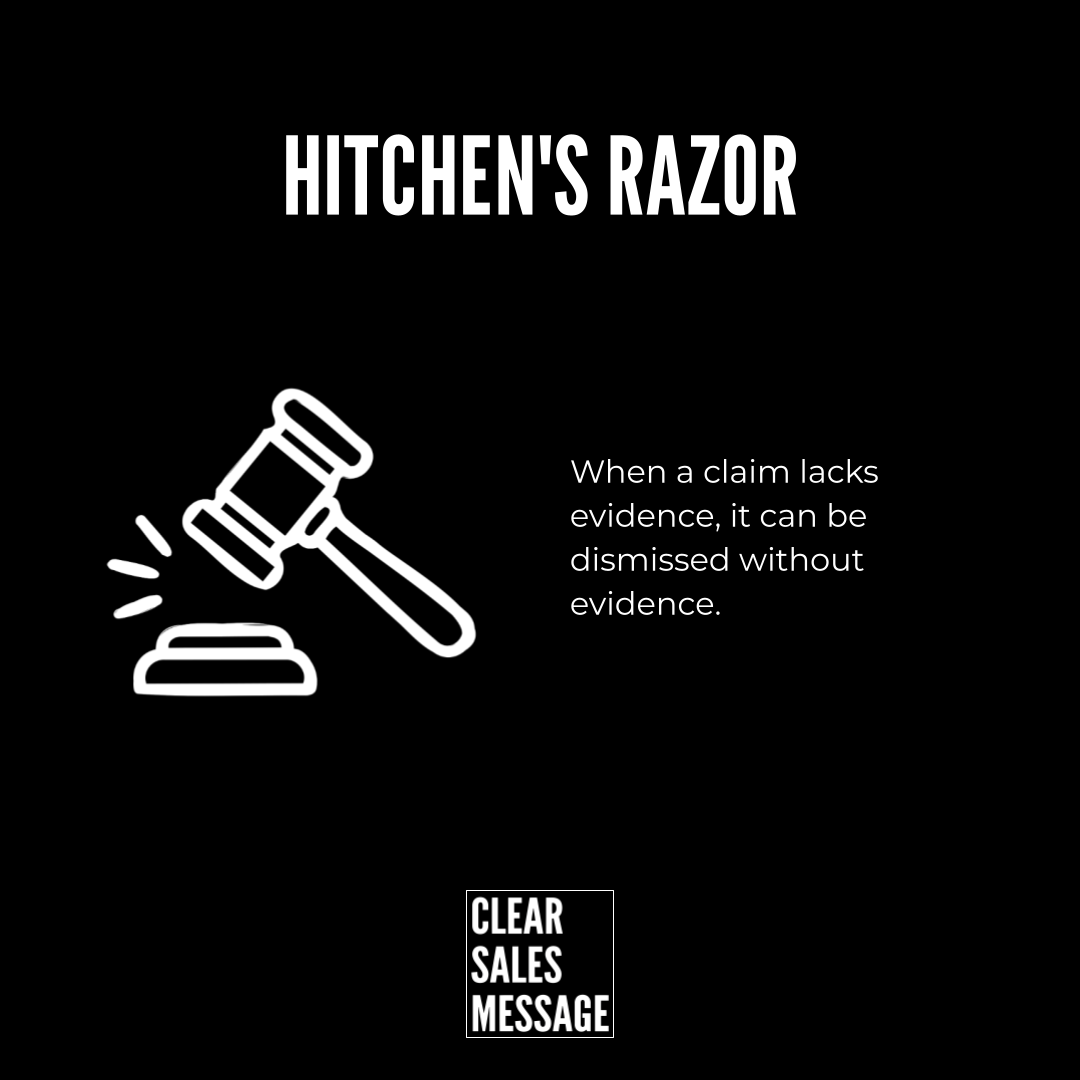
Hitchens Razor is a principle made famous by writer Christopher Hitchens. It is usually summed up as: “What can be asserted without evidence can also be dismissed without evidence.”
In plain terms, if you make a claim but offer no proof, no logic, and no support, buyers have no reason to believe you. The burden of proof sits with the person making the assertion. Not the person hearing it.
Why Does Hitchens Razor Matter in Sales?
Because buyers are exposed to unsupported claims all day long. “We are the best.” “We care about our clients.” “We deliver quality.” Most businesses say these things. But very few prove them. As a result, buyers have become more sceptical – not less – over time.
So trust no longer comes from the claim itself. It comes from the evidence around it. And businesses that understand this tend to convert far better than those that do not.
How Does Hitchens Razor Affect Buyer Psychology?
When buyers cannot verify a claim, the brain defaults to caution. That is not a flaw – it is a rational response to years of being overpromised and underdelivered. So scepticism is the starting point for most buyers, not the exception.
Claims alone rarely create trust
Many businesses think saying something with enough confidence will make it stick. But repetition without proof tends to create more doubt, not less. The buyer starts asking “where is the evidence?” and “who else says this is true?” Unsupported certainty often creates suspicion rather than confidence.
Evidence reduces buyer risk
Good proof reduces the mental uncertainty a buyer feels. For example, case studies, real results, client quotes, and specific examples all help because they give the buyer something concrete to hold on to. Specifics feel more believable because they are harder to fake. Generics just blend into the noise.
How Can You Use Hitchens Razor in Your Communication?
The most useful shift is simple. Stop telling buyers something is good and start showing them. Do not claim results – demonstrate them. Do not say you are trusted – show who trusts you and why. Evidence can include screenshots, data, case studies, demos, and real client outcomes. The stronger the proof, the easier the claim is to believe.
And importantly, strong evidence signals confidence. Weak or absent evidence tends to signal the opposite – even when that is not the intent.
When Hitchens Razor Becomes Most Important
It matters most when the buyer faces a high risk or high cost decision. The more that could go wrong, the more proof they need before they feel safe saying yes. So in B2B sales, consulting, software, finance, and professional services, claims alone rarely feel like enough. Buyers need to see the evidence before they will commit.
Common Hitchens Razor Mistakes
The most common mistake is assuming that buyers will believe a claim just because it sounds confident. But confidence is not proof. And buyers know the difference.
Using vague superlatives
Words like “world class,” “leading,” “best in class,” and “premium” appear on so many websites that they have lost almost all meaning. Without proof to back them up, these phrases do not build trust. They just add to the noise. So either drop them or show the evidence that makes them true.
Expecting buyers to just trust you
Another mistake is assuming that sounding professional is enough. Modern buyers are more sceptical than ever – especially online where big claims are easy to make and hard to check. So trust tends to grow when evidence becomes visible. And it tends to stall when all the buyer has to go on is your word.
Hitchens Razor – An Example
A firm claims it “dramatically increases conversion rates.” But the website has no case studies, no data, no client results, and no proof of any kind. The buyer reads the claim and moves on – because there is nothing to verify it against.
Another firm makes the same claim. But they back it up with before and after data, named clients, real outcomes, and specific numbers. As a result, the claim feels true because the buyer can see the evidence. Same claim. Very different result.
See also
- 50+ ways that people work & make decisions
- Correlation & Causation
- The Logic Effect
- Demonstrative Competence
- Burden of Proof