Practical Sales Training™ > Selling Communication Basics > Burden of Proof
Burden of Proof
When a buyer does not convert, it is easy to blame them. They did not do enough research. They just did not get it. But that thinking lets you off the hook too easily.
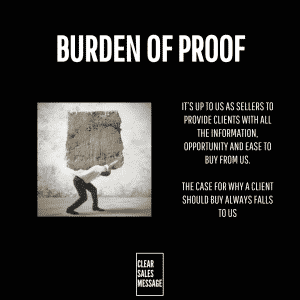
The Burden of Proof flips that. It says the responsibility to inform, reassure, and convert your buyer falls to you. If they left without buying, something in your process let them down — not them.
So instead of waiting for buyers to figure it out, your job is to remove every barrier, answer every question, and make saying yes as easy as possible.
What Is The Burden of Proof?
The Burden of Proof is the principle that you — as the seller — must do everything possible to give buyers the information and opportunity they need to buy. The burden does not sit with the buyer. It sits with you.
In a legal context, the burden of proof means the person making a claim must prove it. In sales, it works the same way. You are making the case for your product or service — so you must build that case fully, not leave it half-finished and hope the buyer fills in the gaps.
However, most sellers do leave gaps. They assume buyers will ask questions if they need to know something. But most buyers do not ask. They just leave.
Why Does The Burden of Proof Work?
It works because it puts your attention in the right place. When you accept that the sale is your responsibility, you stop looking for reasons why buyers did not buy and start looking for ways to fix the process.
It also works because buyers are busy. They will not dig through your website, chase your team for a price list, or sit through a confusing demo just to find out if you are right for them. Most will simply move on to the next option — one that made it easier.
The sellers who win are the ones who anticipate questions before they arise. They provide proof before it is asked for. Because by the time a buyer has to ask, you have already lost a little trust.
How Can You Use The Burden of Proof In Sales?
Put yourself in the buyer’s seat
If you were buying your own product or service, what questions would you have? What would make you hesitate? What information would you need before feeling confident enough to go ahead? Start there — and make sure every one of those answers is easy to find.
Audit your buyer journey for friction
Go through your website, your proposals, and your sales process as if you are a first-time buyer. Is pricing clear? Are features explained in plain language? Is it obvious what to do next? Because if any of those things require effort to find, you are losing buyers who simply will not bother.
Answer objections before they are raised
Every common objection you hear in a sales conversation is a gap in your communication. So instead of handling it live each time, build the answer into your materials. FAQs, case studies, comparison tables, and explainer videos all carry part of the burden — so you do not have to carry it all yourself.
Make the next step obvious
Buyers should never have to guess what to do next. A clear call to action, a visible phone number, a booking link — these things remove the final barrier between interest and action. However, many sellers bury them or leave them out entirely. Do not make your buyer work to give you their money.
Use proof that matches the fear
Different buyers have different worries. Some fear wasting money, others fear choosing the wrong supplier, and some just need to know it works. Therefore, match your proof to the specific fear — a testimonial from someone in the same industry, a case study with a relevant result, or a guarantee that removes the risk of being wrong.
When The Burden of Proof Works Best
It works best when you treat it as an ongoing audit rather than a one-off fix. Buyer expectations change, competitors raise the bar, and what felt like enough information last year may fall short today. So keep reviewing your process through fresh eyes.
It also works best when the whole team buys in. Sales, marketing, and customer service all carry part of the burden. Because a buyer might hit a gap at any point in the journey — not just on the website or in the first meeting.
When The Burden of Proof Becomes Dangerous
It becomes a problem when sellers take it too far and overwhelm buyers with information. Piling on every fact, feature, and case study does not help — it creates Cognitive Load and pushes buyers away just as fast as having too little.
The goal is not to dump everything you know on the buyer. Instead, give them exactly what they need, in the right order, at the right moment. Too much proof can signal desperation. Too little signals indifference. The sweet spot is a clear, confident case that leaves no important question unanswered.
Common Burden of Proof Mistakes
Blaming the buyer
The most common mistake is deciding the buyer “just didn’t get it.” That mindset stops you from fixing the real problem. Because if multiple buyers are not getting it, the issue is in how you communicate — not in the buyers themselves.
Hiding key information
Pricing buried on page four. Features listed only in the brochure. Testimonials that live on a page nobody visits. If important information is hard to find, it might as well not exist. Surface the things that matter and put them where buyers actually look.
Assuming buyers will ask
Most buyers will not ask for clarification — they will decide the uncertainty is too high and move on. Therefore, do not wait for questions. Anticipate them, and build the answers into every touchpoint before the doubt has a chance to form.
Treating proof as a one-time job
Your proof points go stale. A case study from five years ago carries less weight than a fresh one. Similarly, a testimonial from a company your buyer has never heard of does less work than one from a name they recognise. Keep your proof current — because outdated evidence raises questions instead of answering them.
Burden of Proof – An Example
A small SaaS company launches a project management tool. The website has no clear pricing, no feature breakdown, and no demo video. Buyers visit, look around, and leave — not because the product is bad, but because they do not have enough to make a confident decision.
The company updates the site. In go a feature comparison table, a set of case studies with real results, and a five-minute explainer video with a free trial link. Sign-ups increase. Nothing about the product changed — but the seller finally picked up the burden instead of leaving it with the buyer.
Same product. Same price. Completely different result. Because the seller did their job.
See Also