Practical Sales Training™ > How People Work > Overchoice
Overchoice
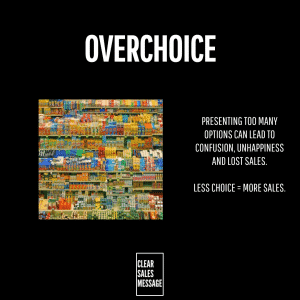
More options feels like more value. So most businesses default to showing everything they offer, assuming buyers will find what they need and choose. But that is not how the brain works.
When buyers face too many choices, they freeze. The decision feels too hard, the risk of getting it wrong feels too high, and the easiest option becomes doing nothing. That is Overchoice. And it is one of the most common ways businesses lose sales they should have won.
The fix is almost always to show less, not more.
What Is Overchoice?
Overchoice describes what happens when the number of available options exceeds what the brain can comfortably process. Rather than feeling empowered by a wide range, the buyer feels overwhelmed. Instead of choosing, they stall.
The term comes from psychology and describes a well-documented pattern in human decision-making. The more options on the table, the more mental effort the decision requires. At a certain point, the effort outweighs the reward and the buyer steps back entirely. No sale, no decision, no progress.
Why Does Overchoice Affect Buyers?
It affects buyers because every choice requires a comparison. More options mean more comparisons, and more chances to make the wrong call. The brain responds to that risk by avoiding the decision altogether rather than getting it wrong.
There is also a confidence factor. A buyer who picks from three clear options feels they made a considered choice. A buyer who picks from thirty options worries they missed a better one. So even when a buyer does commit under Overchoice conditions, they feel less satisfied with the outcome. That leads to doubt, second-guessing, and sometimes cancellation.
Simplifying the choice removes both problems. Because fewer options feel easier to evaluate, buyers decide faster and feel better about what they chose.
How Can You Use Overchoice In Sales?
Reduce the Number of Options You Present
Look at your product range, your website, and your proposals. How many choices do you put in front of a buyer at once? If the answer is more than three or four, consider whether you can strip some out or group them differently. The goal is not to hide options but to make the decision feel manageable. Fewer choices presented well will always outperform more choices presented poorly.
Step Buyers Through Your Offering
Rather than presenting everything at once, consider a step-by-step approach. Show the buyer the first decision, let them make it, then move to the next. Breaking a complex range into a sequence of smaller choices reduces the cognitive load at each stage and keeps the buyer moving forward rather than stalling.
Use a Recommended or Default Option
When you highlight one option as the most popular or the recommended choice, you give buyers a shortcut. They do not have to evaluate every option from scratch. Many will simply go with what you suggest, because that feels like the safe and sensible choice. That single label can significantly increase conversion without removing any options from the range.
When Overchoice Does the Most Damage
Overchoice does the most damage at the point of first contact. When a new buyer lands on your website or reads your proposal for the first time, too many options will cause them to disengage before they have even understood what you offer. First impressions shaped by complexity rarely recover.
It also causes harm in longer sales cycles where buyers have time to overthink. The more options they have to sit with, the more doubts they can generate. Narrowing the choice at each stage of the process keeps momentum going and reduces the risk of a buyer talking themselves out of a decision they were ready to make.
When Overchoice Feels Like the Right Strategy
The temptation to show everything is strongest when you feel proud of your range or worried about excluding a potential buyer. It feels inclusive and generous to show all your options. But from the buyer’s perspective, it reads as overwhelming and hard to navigate.
Some businesses also fear that cutting options will cost them sales from buyers who wanted the thing they removed. In reality, the opposite tends to happen. A focused, curated range converts more buyers than a comprehensive one, because it removes the friction of deciding.
Common Overchoice Mistakes
Presenting Everything on the First Page
A homepage or proposal that tries to cover your entire offering at once rarely lands well. Buyers scan, get confused, and leave. So lead with the most relevant or most popular option for the buyer in front of you, then let the conversation or their interest draw out the rest. Front-loading every option serves you, not the buyer.
Confusing Range With Value
A wide range does not automatically signal high value. For many buyers, it signals complexity and indecision. A curated, confident selection says you know what works and who it works for. That clarity reads as expertise, which is far more reassuring than a long list of options.
Never Reviewing What Buyers Actually Choose
Most businesses have a small number of options that account for the majority of their sales. If you identify those and lead with them, you serve most buyers better from the start. So look at your data. Find what most people buy, put that front and centre, and let the rest of the range sit further back for buyers who specifically need it.
Overchoice – An Example
A restaurant offers a ten-page menu with over 120 dishes. Five sections cover pasta alone. The drinks menu reads like a phone book. Customers spend ages trying to decide, often feel frustrated before they order, and leave less satisfied than they should.
A rival nearby offers ten popular dishes on a single page. Customers decide quickly, feel confident in their choice, and enjoy the meal more because the decision felt easy. Same food, same quality. The only difference is how many options each restaurant forced their customers to process. That is Overchoice in action.
See Also: