Practical Sales Training™ > How To Lose The Sale > Paid Awards
Paid Awards
You get a message out of the blue. It seems they love your profile. They want to name you in their “Top 10” list. Then comes the catch. There’s a fee.
That’s a paid award. Lots of firms say yes, because a badge on the website feels like proof. Yet buyers are getting better at spotting the difference between praise you earn and praise you buy.
What Are Paid Awards?
Paid awards are titles, badges or list spots you get by paying. Sometimes it’s an entry fee. Other times it’s a “feature fee” or a pricey table at the awards night. Either way, the money is what gets you in.
They come in lots of shapes. “Top 10 coaches to follow.” “Best firm in the region.” “Industry leader of the year.” They often look official, with logos, trophies and certificates.
Some real awards do charge to enter, and they judge fairly. The problem starts when paying is the main thing you need to win.
Why Do Paid Awards Lose the Sale?
Awards work as a shortcut for buyers. They think someone else checked you out, so they don’t have to. That’s why a badge on your site can feel so powerful.
But the shortcut only works if the award is real. Once a buyer finds out you paid for it, the badge flips. It stops saying “trusted” and starts saying “tries too hard”. In fact, it can make them doubt everything else you claim too.
Buyers also talk. If one person spots a pay-to-play award, others soon hear. And these schemes are easy to find, because the same names crop up in everyone’s inbox.
How Can You Avoid Paid Award Traps?
You still want proof on your side. So here’s how I’d go after the real kind, and spot the fake kind.
Check Who Judges It
A real award names its judges and explains how they decide. So look for real people with real track records. If nobody seems to judge anything, the fee is doing the judging.
Watch for the Cold Invite
Real awards rarely message you to say you’ve already won. So if praise lands in your inbox with a price tag attached, be wary. Flattery followed by a fee is the classic pattern.
Ask Whether Your Buyers Would Care
Picture your best client seeing the badge. Would they know the name? And would it change their mind? If not, it’s just decoration. Your money would do more good elsewhere.
Swap Badges for Proof
Buyers trust results more than trophies. So show a short case study, a named review or a clear number instead. For example, “Cut a client’s sales cycle from 90 days to 45” beats any “top 10” list.
Be Open About Sponsored Spots
Sometimes paying for a feature is fine. Think of an advert, a sponsored article or a stand at a show. Just call it what it is. A labelled advert keeps your name clean. But a disguised one puts it at risk.
When Paid Awards Seem to Work
A paid badge can look good to people who’ve never heard of you. So for a moment, it might help people notice you. Some first-time buyers won’t check where it came from.
It can also give your team a morale boost. Everyone likes a trophy on the shelf. Similarly, it can make a nice photo for social media.
But these wins are short-lived. And they rely on nobody looking too closely.
When Paid Awards Become Dangerous
The biggest danger is getting caught. Many buyers now get the same “top 10” messages you do. So when they see your badge, they may know exactly how you got it.
Senior buyers are sharper still. They’ve seen these schemes for years. As a result, a wall of odd awards can make you look less credible.
There’s also the cost. A few hundred here and there adds up. And that budget could have funded real proof, like case studies or client videos.
Common Paid Award Mistakes
Most of these come from wanting proof fast. So here’s what I see most.
Falling for Flattery
“Your profile is truly impressive” feels lovely. That’s the point. The compliment lowers your guard before the price appears. So when praise and a fee arrive together, slow down.
Plastering Badges Everywhere
Some firms fill their homepage with award logos. Too many looks desperate. Worse, buyers start to wonder which ones are real. So use one or two strong ones, or none at all.
Not Checking Who Else Won
Look at past winners. If the list is huge and full of names nobody knows, that tells you everything. A real award is hard to win. So if everyone who pays gets one, it means nothing.
Letting the Badge Do the Selling
Even a real award won’t close a deal on its own. Buyers still need to understand what you do and why it matters to them. So keep your message clear, and treat any award as a small extra.
Paid Awards – An Example
The “Top 10 Coaches” Cover Story
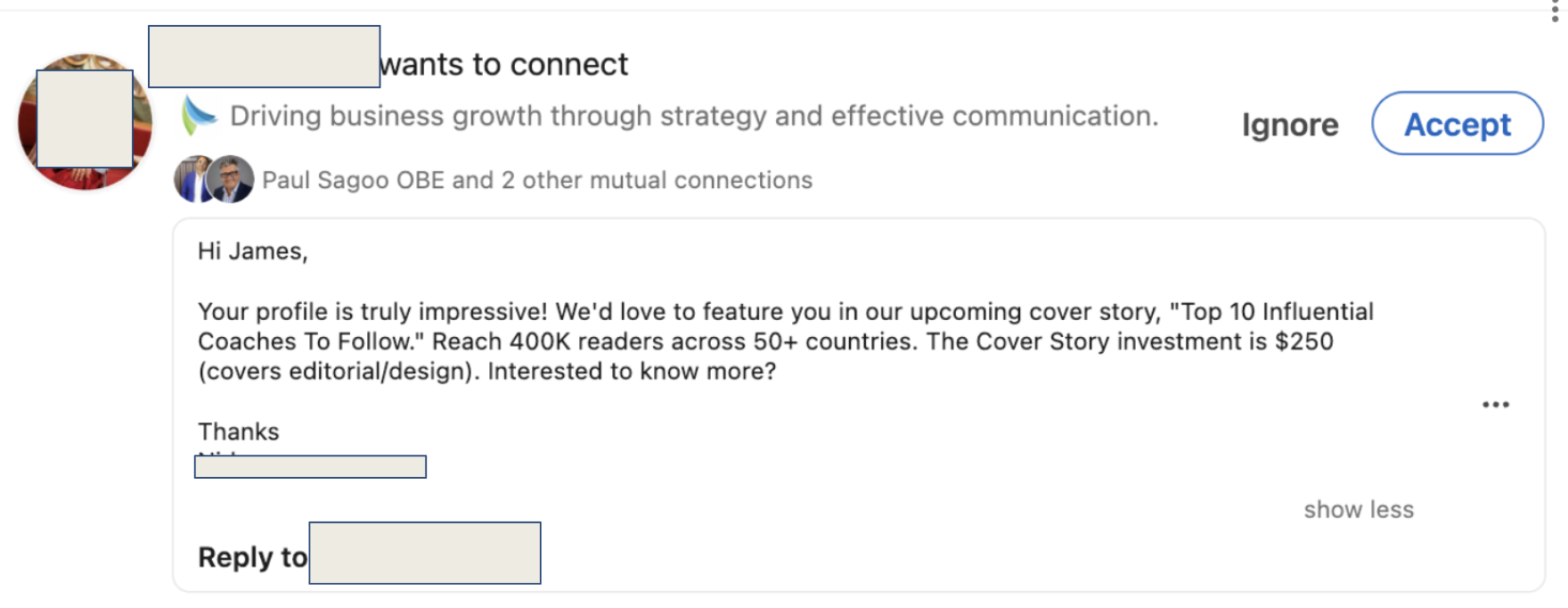
Here’s a LinkedIn message I received. It opens with a compliment about my profile. Then it offers me a spot in a cover story called “Top 10 Influential Coaches To Follow”.
The pitch sounds big. It promises 400K readers across 50+ countries. Then comes the catch. The “Cover Story investment” is $250, to cover editorial and design.
Notice the word “investment”. It makes a fee sound like a smart move. But think about what a buyer would see if I said yes. A “Top 10” badge, next to a message many of them have also received. So the badge would quietly eat away at trust.
See Also