Practical Sales Training™ > Wordplay > Palindrome

Palindrome
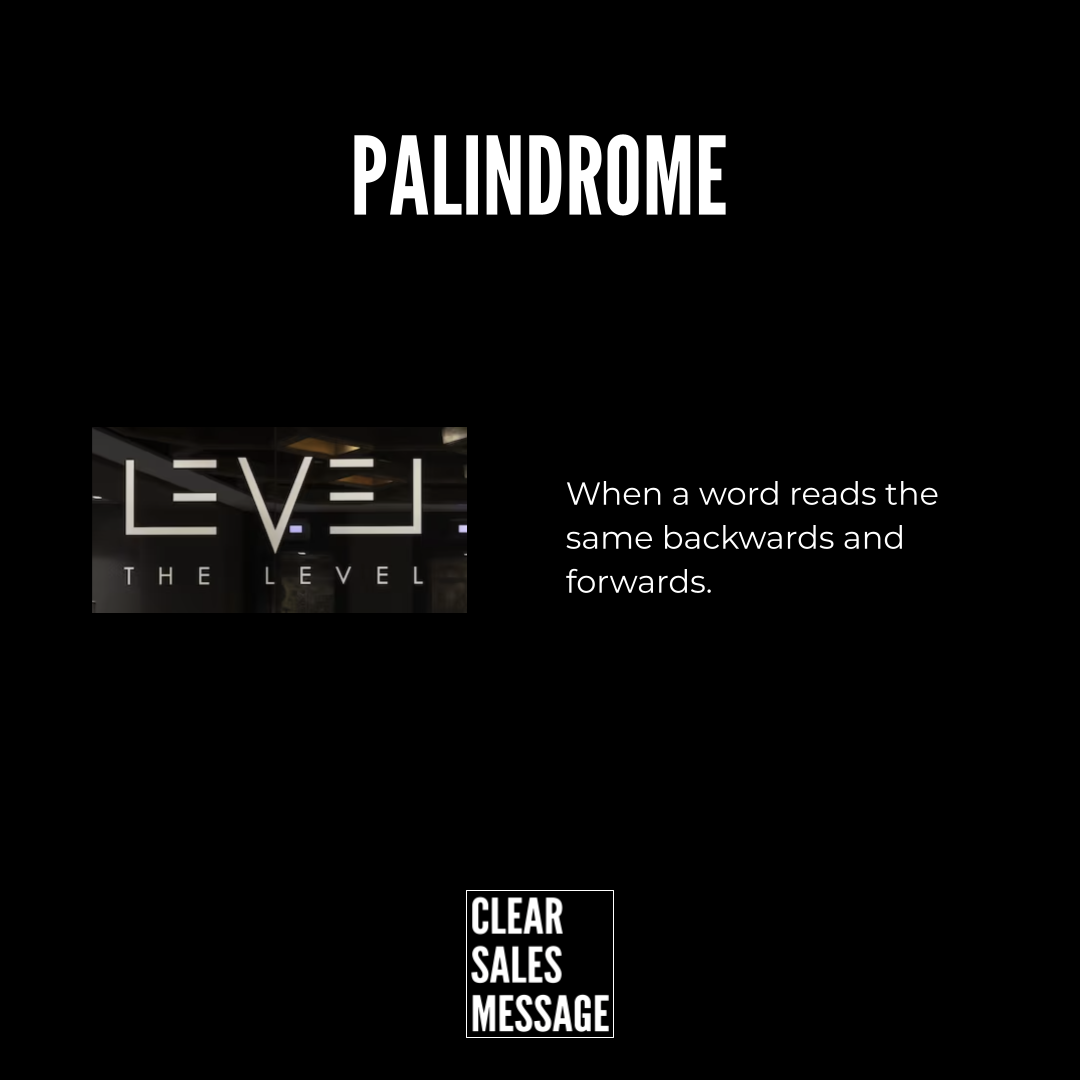
Some words have a natural symmetry that makes them instantly memorable. These are palindromes, words that read the same backwards and forwards. They feel neat, clever and visually balanced, which is why they work so well in branding.
Most people notice something pleasing about a palindrome before they can even explain what it is. The symmetry registers before the logic does. And that instinctive reaction is exactly what makes them so useful for names, logos and slogans.
In sales and marketing, being memorable is half the battle. A palindrome doesn’t just sound good. It gives the reader a small moment of satisfaction that makes the name stick.
What Is a Palindrome?
A palindrome is a word or phrase that reads the same in both directions. Simple examples include level, radar, civic, refer, noon and rotator. Each one looks and sounds the same whether you read it left to right or right to left.
Because palindromes are unusual and satisfying to look at, people remember them more easily than ordinary words. Brands often use them to create a distinct and balanced visual identity, because the structure of the word itself does part of the design work.
The effect is subtle but powerful. A palindrome doesn’t announce itself. It just feels right in a way that’s hard to pin down, and that feeling keeps the name in mind long after the first encounter.
Why Does a Palindrome Work?
1. The brain loves patterns
Symmetry is pleasing. The mind notices it instantly and processes it quickly, which makes the word more memorable. A palindrome satisfies a pattern-recognition instinct that most people don’t even know they have. As a result, the name lands faster and stays longer than a randomly constructed word would.
2. It creates a clean visual identity
Palindromes often look good as logos because the letters create natural mirror-like shapes. This makes the brand feel intentional and well designed, even before the visual work begins. The word itself carries a sense of balance that designers can build on rather than having to create from scratch.
3. It feels clever without being confusing
A palindrome adds interest without hurting comprehension. It’s the kind of clever that buyers appreciate rather than the kind that alienates them. So unlike abstract wordplay that can confuse, a palindrome rewards the reader with a small moment of recognition that feels good rather than frustrating.
4. It sticks in memory
Since palindromes are rare, they stand out. People are more likely to recall them later, even if they can’t explain why. That’s a significant advantage in any market where buyers encounter dozens of brand names and forget most of them within minutes.
How Can You Use a Palindrome In Sales?
1. Use palindromes for names or product lines
A palindrome makes for a strong brand or product name because it’s both memorable and visually distinctive. Words like Level, Radar, Civic and Refer have all been used as brand names for exactly this reason. They feel considered and they’re easy to spell, say and recall, which matters more than most people realise when choosing a name.
2. Use palindrome style in logo design
Even if the word itself isn’t a true palindrome, you can design it with visual symmetry or mirrored shapes to get a similar effect. The goal is to create the same sense of balance and intentionality that a palindrome word delivers naturally. Many strong logos use this principle without the name being a palindrome at all.
3. Use them in campaigns or headlines
Palindromes work well for slogans, social content or creative hooks because they feel neat and satisfying to read. A headline built around a palindrome draws the eye and creates a small moment of engagement that a straightforward statement wouldn’t. That extra attention can make the difference between a scroll past and a stop.
4. Use them to reinforce your brand values
If your brand stands for clarity, balance or precision, a palindrome supports that message through the structure of the word itself. The form and the meaning align, which gives the name an extra layer of resonance. Similarly, if your brand is about simplicity, a short palindrome communicates that at a glance.
When a Palindrome Works Best
Palindromes work best when the name needs to do a lot of work on its own. Startups, product lines, apps and personal brands all benefit because there’s often no long-established reputation to rely on. The name has to be memorable from day one, and a palindrome gives it a head start.
They also work well in visual-first contexts like packaging, signage and app icons, where the symmetry of the letters adds to the design rather than just the language. In these settings, the palindrome earns its place twice: once as a word and once as a visual pattern.
When a Palindrome Becomes Dangerous
The risk with palindromes is forcing them. If you contort your brand name or messaging just to achieve the effect, the result feels awkward rather than clever. A palindrome has to make sense as a word first. The symmetry is a bonus, not the brief.
There’s also a risk of the trick overshadowing the message. If people spend more time noticing the palindrome than understanding what you do, the wordplay has done its job too well. Cleverness should support clarity, not replace it.
Common Palindrome Mistakes
1. Choosing a palindrome that doesn’t suit the brand
Not every palindrome fits every business. “Rotator” might work for an engineering firm but feel odd for a beauty brand. The symmetry only adds value when the word itself also fits the tone, audience and positioning of what you’re selling.
2. Assuming the palindrome will be noticed
Most buyers won’t consciously register that a word is a palindrome. The effect works subconsciously. So don’t rely on people spotting it and being impressed. Instead, let the feeling of balance and memorability do the work quietly in the background.
3. Overcomplicating longer phrases
Palindrome phrases like “A man a plan a canal Panama” are clever but too complex for everyday branding. Short palindrome words are far more practical. The simpler the palindrome, the more useful it is in a real sales or marketing context.
Palindrome – An Example
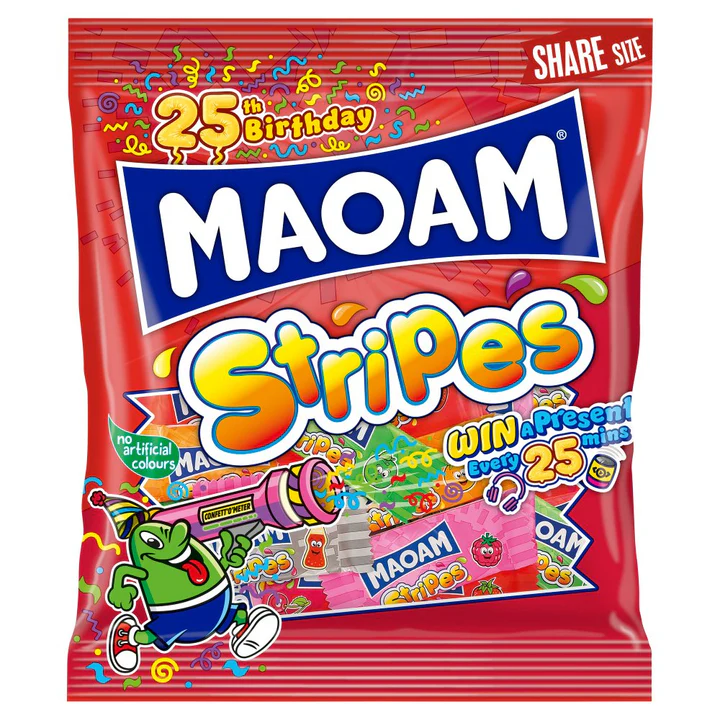
MAOAM
MAOAM is a chewy sweet brand sold across Europe. The name is a palindrome: M-A-O-A-M reads the same forwards and backwards. For a confectionery brand aimed largely at children and young people, that symmetry is a quiet but powerful asset.
The name is short, easy to say and visually distinctive. When it appears on packaging, the balanced letter structure gives the logo a natural rhythm that works well at small sizes and across different colourways. Most buyers won’t notice it’s a palindrome. But they’ll remember the name, and that’s the point.
MAOAM didn’t build its brand on the palindrome, but the palindrome supports everything the brand does visually and linguistically. It’s a small structural choice that pays off in recall, recognition and shelf presence over decades. That’s the long-term value of getting a name right from the start.
See also
- 25+ wordplay techniques that work (and sell)
- 100+ ways to seize buyer attention
- Matryoshka Words
- Picture Words