

Practical Sales Training™ > How To Convert > Payback Time
Payback Time
Some buyers are happy with the idea of your offer. But they are not sure the money is well spent. Payback time helps you answer that doubt before it becomes a reason to walk away.
It shows the buyer how long it will take to get their money back. Once they can see that point, the cost stops feeling like a risk. It becomes a smart move with a known finish line.
This is one of the simplest ways to reframe a price. And it works because the maths does the selling for you.
What Is Payback Time?
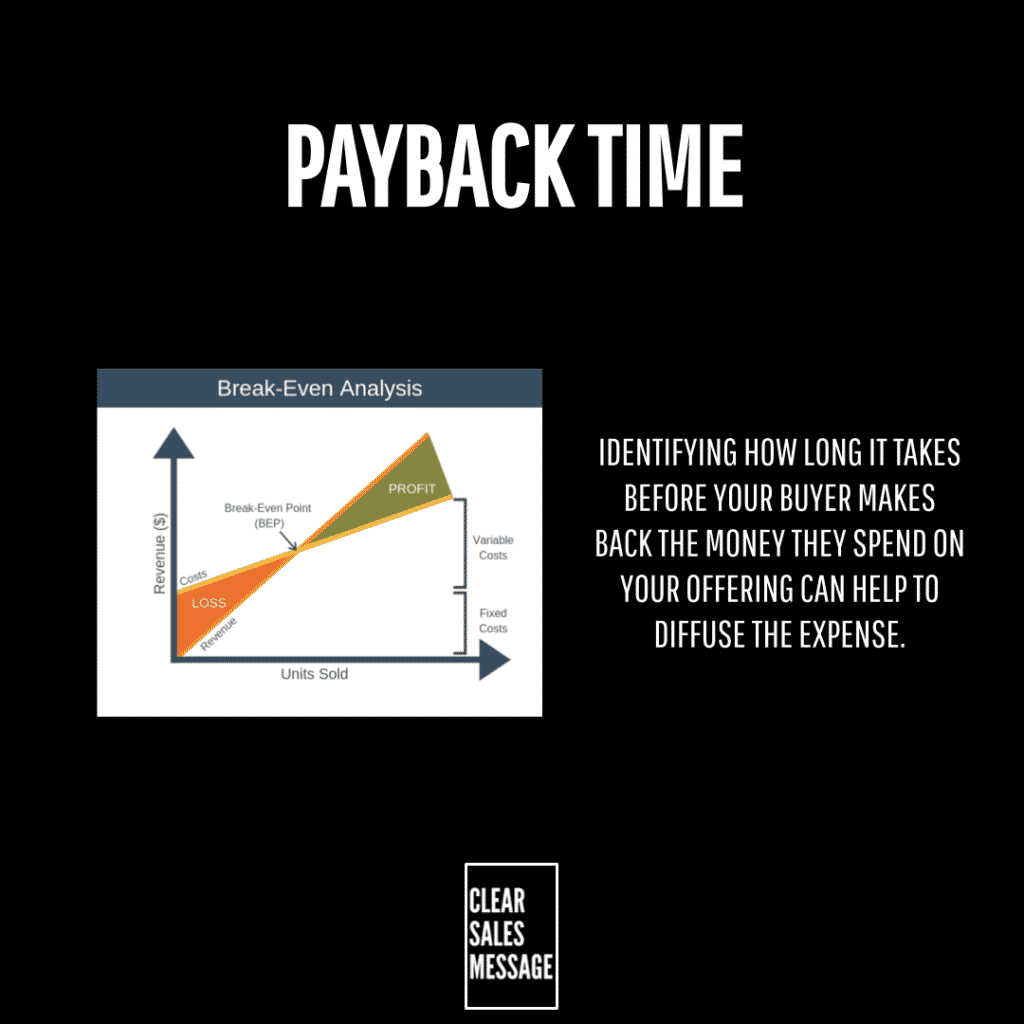
Payback time is the point at which your buyer has recouped what they paid. In other words, it is the moment their return equals their spend. It is a form of reframing. Instead of showing the buyer a cost, you show them a payback point. The price becomes a short-term outlay with a fixed end date, not an open-ended drain.
The concept works across many types of offer. It applies whenever your buyer makes money, saves money, or saves time as a result of buying from you.
Why Does Payback Time Work?
Many buyers are doubtful about the value they will get. They want proof that the money is well spent. Payback time gives them that proof in a way that is easy to grasp.
It works because it turns a vague value claim into a clear number. Instead of saying “you will save money,” you give the buyer a date. That date is the moment your offering has paid for itself. After that, every benefit is pure gain.
How Can You Use Payback Time In Sales?
Work Out the Number Before Your Pitch
Start by working out how long it takes for a typical buyer to recoup their spend with you. This might be based on money they make, money they save, or time they get back. Once you have that figure, build it into your pitch so it feels like a natural part of the conversation, not a last-minute add-on.
Use Real Dates, Not Vague Time Frames
To make it more powerful, use real dates rather than vague time frames. So rather than saying “three months from now,” you say “by the 14th of March.” A real date is easier to picture. And it makes the payback feel more certain, which helps the buyer commit.
Frame the Period After Payback as Pure Gain
Once a buyer knows when they break even, help them think about what comes after. If a product lasts ten years and pays back in two, that is eight years of pure return. Framing it this way shifts the buyer’s focus from the price they pay today to the gain they collect for years to come.
When Payback Time Works Best
Payback time works best when your offer has a clear, measurable return. This is common in sectors like solar, training, software, and services that save time or money. But even if your return is harder to pin down, a rough honest estimate is better than nothing. Buyers often just need a number to hold on to.
It also works well when your price feels high at first glance. Because the payback point reframes the cost, buyers who might have hesitated are more likely to see the purchase as a sound decision rather than a big spend.
When Payback Time Becomes Dangerous
This approach breaks down when your numbers are wrong or hard to defend. If you promise a three-month payback and it takes two years, trust is gone. So only use payback time when your figures are honest and you can show your working clearly.
Be careful about using it to pressure buyers, too. A payback claim that feels too neat or too fast will raise doubts, not lower them. Keep it real, keep it simple, and let the honest number do the work.
Common Payback Time Mistakes
Using Vague Time Frames
Saying “a few months” is not enough. Buyers need a real number to hold on to. So work it out before your pitch and give them something exact. Vague claims feel like guesses, and guesses do not build confidence.
Overstating the Return
It can be tempting to promise a fast payback to close the sale. But if the buyer does not see that return, you lose their trust and likely their future business too. Only quote payback times that are honest and easy to back up with real data.
Forgetting to Use Real Dates
Many sellers give a time frame like “within a year.” That is easy to ignore. Instead, tie it to a real calendar date. A date is harder to brush off because it feels concrete, not theoretical.
Payback Time – An Example
A solar panel company tells buyers how long until the system pays for itself. The numbers are laid out simply.
“With our standard 4kW solar panel system, you’ll save approximately £80 per month on your electricity bill. Since the total installation cost is £3,200, your payback time will be around 3 years and 4 months. After that, every penny you save is pure profit — and the panels last 25+ years.”
By putting a real date on the payback — “By November 2028 you’ll have fully recouped your investment” — the company turns a big cost into a smart buy. The buyer stops asking “can I afford this?” and starts thinking “when will this pay me back?” That is a much easier question to say yes to.
See also