Practical Sales Training™ > Wordplay > Pleonasms

Pleonasms
A gift is already free. A result is already an end. A warning already comes in advance. But most of us say these things anyway without thinking about it. Pleonasms are so embedded in everyday language that we stop noticing them.
The problem is that sales copy needs to work hard. Every word takes up space and uses up the reader’s attention. When a word adds no meaning, it is dead weight. And enough dead weight makes copy feel slow, padded, and unconvincing.
Understanding pleonasms helps you write tighter, cleaner, more direct sales messages. It also helps you spot the moments when a touch of redundancy might actually be doing useful work, and when it is just clutter.
What Is a Pleonasm?
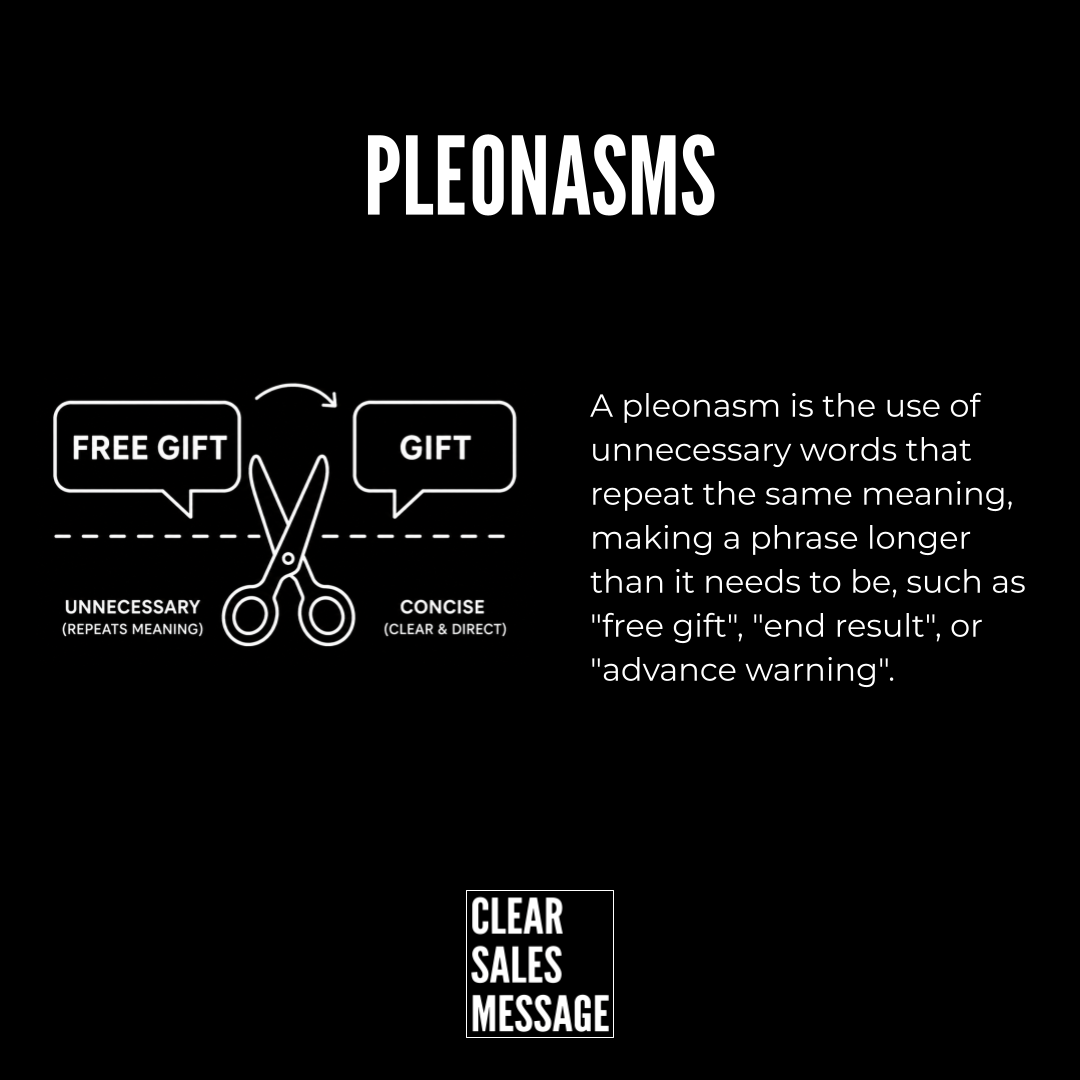
A pleonasm is the use of unnecessary words that repeat the same meaning, making a phrase longer than it needs to be. The extra word does not add new information. It just says the same thing twice in slightly different form.
Some common examples: “free gift” (a gift is already free), “end result” (a result is already an end), “advance warning” (a warning is already in advance), “past history” (history is already in the past), and “unexpected surprise” (a surprise is already unexpected by definition).
In everyday conversation, pleonasms are largely harmless. But in sales copy, where every word needs to earn its place, they are worth spotting and questioning. Because tighter writing is almost always more persuasive, removing redundant words is one of the quickest ways to sharpen a message.
Why Do Pleonasms Appear in Sales Copy?
They appear mainly through habit. Writers reach for familiar phrases without examining whether every word is doing a job. “Free gift” has been used in marketing for so long that it no longer feels redundant. It just feels like normal copy. But it is still a pleonasm, and tightening it to “gift” would be more precise.
Sometimes pleonasms appear because the writer is trying to add emphasis. “Completely free” sounds more generous than “free.” “Totally risk-free” sounds more reassuring than “risk-free.” The extra word is doing a small amount of work, even if it is not technically necessary. So the question is not always whether the word is redundant. It is whether the redundancy is pulling its weight.
In most cases, the answer is no. A cleaner version of the phrase will land harder and read faster. But there are exceptions, and knowing when a pleonasm is working for you, rather than against you, is the skill worth developing.
How Can You Spot and Fix Pleonasms In Sales Copy?
Read your copy back and ask one question for every adjective and qualifier: does this word add something the noun does not already contain? If the answer is no, cut it. Here are the most common offenders to watch for.
Redundant Adjectives
“Free gift,” “added bonus,” “new innovation,” “future plans.” In each case, the adjective repeats what the noun already means. Remove the adjective and nothing is lost. The noun carries the full meaning on its own. Because removing these words makes the phrase sharper without making it weaker, they are almost always worth cutting.
Redundant Qualifiers
“Completely unique,” “very essential,” “absolutely necessary,” “totally wrong.” You cannot be very essential. Something is either essential or it is not. These qualifiers try to intensify words that cannot be intensified because they are already absolute. So strip them out. The base word is always stronger on its own.
Redundant Verbs and Phrases
“Revert back,” “collaborate together,” “merge together,” “repeat again.” The second word in each pair says what the verb already says. “Revert” already means to go back. “Collaborate” already means to work together. Because the verb does all the work, the extra word just adds noise. Cut it and the sentence moves faster.
Padding Phrases
“At this point in time,” “in the event that,” “due to the fact that.” Each of these can be replaced by a single word. “Now.” “If.” “Because.” Because shorter is almost always clearer in sales copy, these padding phrases are easy wins when editing. Run a search for them before any piece of copy goes out.
When a Pleonasm Might Be Worth Keeping
Not every pleonasm is worth removing. Some are so embedded in buyer expectations that cutting them makes the phrase feel sparse rather than sharp. “Free gift” is one example. Buyers are used to that phrase. It feels like a category. Replacing it with just “gift” might feel like something has been taken away, even though nothing has.
There is also a rhythm argument. Sometimes the extra word gives a phrase a beat that makes it easier to say and easier to remember. In a tagline or a spoken pitch, a slightly longer version can sound better even if it is less precise. So before cutting, say the phrase aloud. If the shorter version sounds flat, the extra word might be earning its keep.
The test is always the same. Does the word add meaning or does it add rhythm? Either can justify its presence. If it adds neither, it goes.
When Pleonasms Damage Your Copy
Pleonasms become a real problem when they pile up. One redundant phrase in a piece of copy is barely noticeable. But copy that is full of them feels slow and padded, even if the reader cannot explain why. Because buyers sense when writing lacks precision, padded copy erodes confidence in the message and in the brand behind it.
They are also a problem in short copy where every word is visible and counted. An email subject line with a pleonasm wastes precious space. A headline with redundant words buries the actual point. So the shorter the format, the more important it is to cut every word that is not doing a clear job.
Common Pleonasm Mistakes in Sales
Treating Them as Emphasis
Many writers keep pleonasms because they feel like the extra word is adding force. “Absolutely free” sounds stronger than “free.” But in most cases, the emphasis is an illusion. A stronger verb or a more specific claim will do far more for the persuasiveness of a sentence than a redundant intensifier. So if you feel the urge to add “completely” or “totally,” ask whether the underlying claim is strong enough on its own.
Not Editing Copy Aloud
Pleonasms are easier to catch when you hear them than when you read them silently. Reading copy aloud forces you to feel every word. The redundant ones slow you down. So make reading aloud a standard step in your editing process. Because your ear will catch what your eye skips over, this one habit will remove more pleonasms from your copy than any checklist.
Copying Industry Phrases Without Questioning Them
Many industries have standard pleonasm-laden phrases that everyone uses. “Past experience.” “Future growth plans.” “Proven track record.” Because everyone says them, they have become invisible. But they still add words without adding meaning. So question the phrases your industry takes for granted. Cutting the redundant words can make your copy sound noticeably sharper than everyone around you.
Pleonasms – An Example
The concept card below shows the idea clearly. “Free gift” uses two words to say what “gift” says in one. The extra word is technically unnecessary. Whether to keep it or cut it depends on whether it is doing any useful work in the specific context.
In a headline where space is tight, cut it. In a conversational email where warmth matters more than precision, the fuller phrase might feel more natural. The skill is knowing which situation you are in and making a deliberate choice rather than a habit-driven one.
See Also