Practical Sales Training™ > How To Get Attention > SEO Name

SEO Name
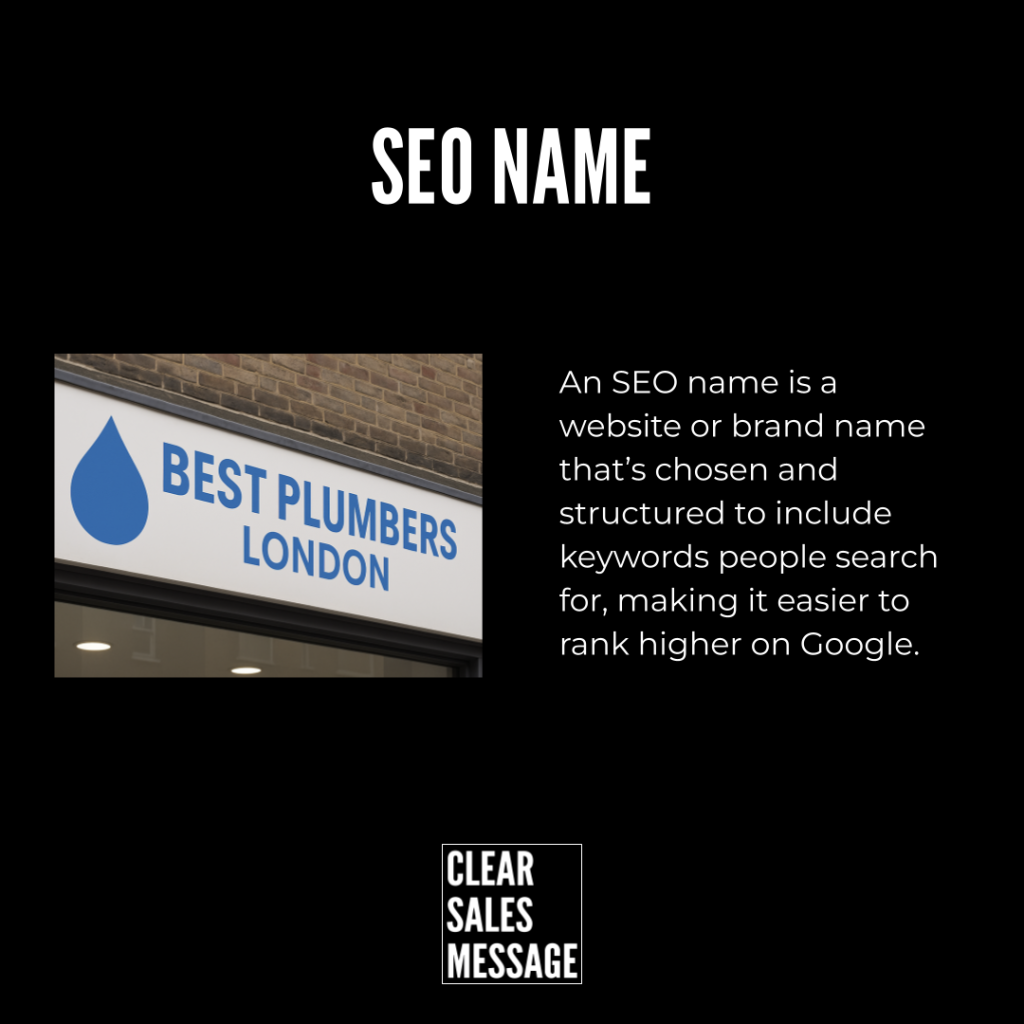
What if your business name was exactly what people typed into Google? That’s the idea behind an SEO name. Instead of a brand name, you use a search phrase. “Plumber Near Me.” “Best Cheap Flights.” “Buy Shoes Online.”
The logic is simple. If someone searches for “Thai food near me” and your restaurant is literally called that, you might just appear at the top. And sometimes it works. But the approach comes with real trade-offs that are worth understanding before you commit to it.
Used well, an SEO name can drive traffic and attention. Used poorly, it signals that your business has no real identity. And that signal reaches buyers before they’ve even clicked on your listing.
What Is an SEO Name?
An SEO name is when a business, product, or service takes its name directly from a common search term. The goal is to match what people type into Google and rank higher as a result.
Examples include “Plumber Near Me” as a company name, “Best Cheap Flights” for a travel website, and “Buy Shoes Online” as a store name. Each one mirrors the exact phrase a potential customer might search for. So instead of the brand driving search, the search term becomes the brand.
This approach was more common in the early days of search engine optimisation. Back then, exact-match domains and names could rank highly with little competition. The internet was younger, algorithms were simpler, and a well-chosen phrase in a business name could open the door to significant organic traffic.
Why Does an SEO Name Work?
It works because search engines reward relevance. When someone types a phrase and your business name contains that exact phrase, there’s a direct match. In the early days of search, that match carried significant weight. So a business called “London Plumber” would rank well for anyone searching that term.
There’s also a human psychology element. When a buyer sees a business name that directly matches what they searched for, it creates an immediate sense of relevance. They feel like they’ve found exactly what they were looking for. Because the name does the work of confirmation before the buyer has even visited the site, it reduces the friction between the search and the click.
Similarly, an SEO name can generate attention and talkability when it’s unexpected or funny. A restaurant literally called “Thai Food Near Me” becomes a story. People share it. It goes viral. As a result, the name delivers attention that goes far beyond organic search rankings.
How Can You Use an SEO Name In Sales?
You can use the principle of an SEO name without committing to a purely functional business name. Here’s how to apply it sensibly.
Clarity First
Pick a name that signals what you do without being spammy. A name like “FlowRight Plumbing” tells the buyer what you do. But it also builds a real brand identity. So you get the clarity benefit of an SEO name without the generic, faceless feel that pure keyword names create.
Combine Clarity With Creativity
Balance keywords with a brand identity people will remember. For example, instead of “Plumber Near Me,” you could be “FlowRight Plumbing, Local Experts Near You.” The tagline carries the search phrase. The brand name carries the identity. As a result, you get both visibility and memorability.
Use Keywords in Your Domain or Tagline
You don’t have to put the search term in your business name. Place it in your domain, your tagline, your page titles, or your meta descriptions instead. Because search engines read all of these, you get the SEO benefit without naming your business something generic. That way the brand can grow without being shackled to a phrase.
Build Brand Authority
Modern search algorithms reward trust, content quality, and user experience. So build those things. A well-named brand with strong content and genuine reviews will outrank a keyword name with thin content and no identity. However, a clear, memorable name makes it easier for buyers to find you, refer you, and return to you over time.
Use It for Attention, Not Just Search
If the name is memorable and shareable, an SEO approach can generate attention beyond search. A business name that makes people laugh or say “wait, is that really what they’re called?” gets talked about. So consider whether the name has social and word-of-mouth value, not just ranking potential. Because attention from people is often more valuable than attention from algorithms.
When an SEO Name Works Best
It works best in markets with low competition and high search volume. If you’re in a niche where few competitors have optimised their names, an exact-match name can still give you a real ranking advantage. However, in competitive markets where everyone has optimised their content, a keyword name alone won’t cut through.
It also works well when the name is so funny or unexpected that it generates its own attention. A restaurant called “Thai Food Near Me” goes viral not because of its SEO value but because it’s a joke the internet wants to share. So when the name itself is the story, the SEO mechanic becomes secondary to the attention mechanic.
Similarly, it works well as a short-term strategy during a launch phase. A new business with a clear keyword name can pick up early traffic while it builds the content and authority needed to rank on its own terms. Because early visibility matters, the name can buy time while the brand builds strength.
When an SEO Name Becomes Dangerous
It becomes a problem when the name feels generic and lifeless. A business called “Best Cheap Flights” has no personality. It signals that the only reason it exists is to capture search traffic. Buyers sense that. As a result, they trust it less than a brand with a real identity and a clear point of view.
It also backfires when the name limits the brand’s ability to grow. If your business is called “London Plumber” and you want to expand to Birmingham, the name works against you. Because the name is tied to a place and a phrase, it becomes a ceiling rather than a foundation. A real brand name grows with the business. A keyword name can trap it.
And it loses its SEO value over time anyway. Search algorithms have become far smarter. Today they reward quality, authority, and user experience far more than keyword matching in a business name. So the advantage of an SEO name shrinks while the disadvantage of having no brand identity stays permanent.
Common SEO Name Mistakes
Treating It as a Shortcut to Rankings
An SEO name alone doesn’t guarantee visibility. Modern search engines look at content quality, backlinks, reviews, and user behaviour. So a keyword name without the content and authority behind it won’t rank well for long. The name can open the door. But only real substance keeps it open.
Sacrificing Brand Identity Entirely
A name that is purely a search phrase has no brand equity. Buyers can’t refer it naturally. It doesn’t stand out in a market. And it tells the customer nothing about who you are or why you’re different. So if you go down this route, make sure the tagline, the design, and the experience create the identity the name can’t.
Choosing a Phrase That Dates Quickly
Search behaviour changes. The phrases people type today may not be the ones they type in three years. So a name built on a current search term carries a shelf life. Instead, build a brand name that’s clear about what you do but flexible enough to evolve. Because a name is hard to change once it’s established, and the cost of rebranding usually exceeds the early SEO benefit.
Ignoring How the Name Sounds to a Human
SEO names are optimised for algorithms, not people. But people are the ones who decide to click, call, buy, and refer. So test how the name sounds when someone says it out loud or reads it on a sign. Because if it sounds awkward, robotic, or untrustworthy to a real buyer, no amount of search ranking will compensate for the loss of confidence it creates at the moment of decision.
SEO Name – An Example
A Thai restaurant in New York went viral for taking the concept to its logical extreme. The business called itself “Thai Food Near Me.” The name is exactly what someone would type into Google when hungry and looking for Thai food in their area. It’s also funny. As a result, it generated significant press coverage and social media attention far beyond what any organic search ranking could have produced.

It works as an example because it shows both sides of the SEO name. The name is functional: it genuinely matches a high-volume search phrase. But it’s also memorable, shareable, and funny enough to travel on its own. So the best version of an SEO name isn’t one that just games the algorithm. It’s one that does that and gives people a reason to talk about it too.
See also