Practical Sales Training™ > How People Work > Solomon’s Paradox
Solomon’s Paradox
What Is It
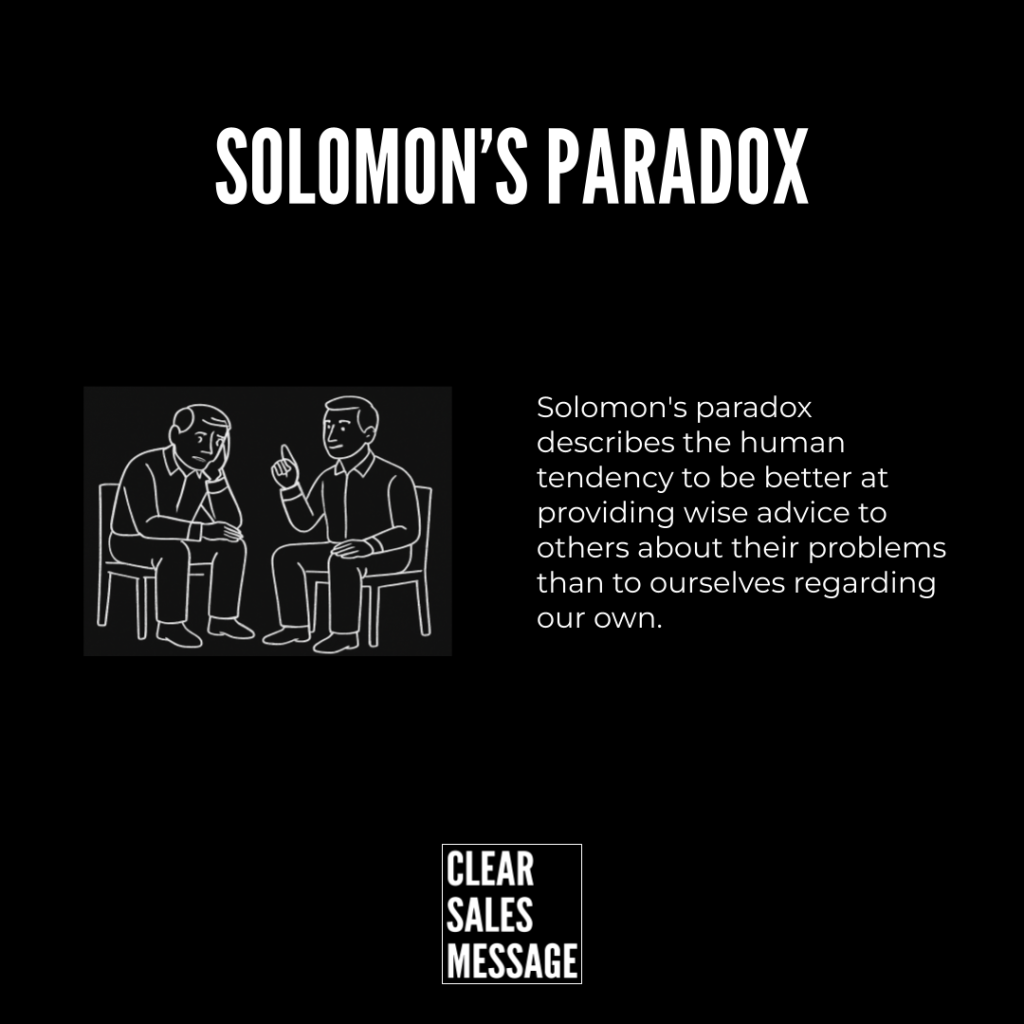
You’ve done it. You solved a friend’s problem in five minutes flat. Then you went home and made a mess of the same kind of decision in your own life.
That’s Solomon’s Paradox. It’s named after King Solomon, a king famous for his wisdom. He handed out brilliant advice to others. But he made a mess of his own personal choices. So the pattern isn’t new. We think clearer about someone else’s mess than our own.
Why Does It Work
It works because objectivity gets harder the closer you are to a problem. Emotions, ego, and fear all cloud the picture when the stakes are yours.
But hand someone else the same problem, and you go calm. You zoom out. You think long-term instead of reacting. So the smart move looks obvious, right up until it’s your own life on the line.
How Can You Use It
Ask What You’d Tell A Friend
So step outside your own head. Picture a friend stuck in your exact situation, and ask yourself what you’d tell them to do. The answer usually comes fast.
Say It Out Loud
Write the problem down as a letter, or say it out loud to an empty room. Either way works. It creates the same distance a friend would naturally have. So the noise clears, and the decision gets sharper.
When It Works Best
This works best on decisions tangled up with fear or identity. Career changes, relationships, money. The bigger the emotional stake, the more this trick helps.
It also works well under time pressure. So when you’re stuck spinning in your own head, borrowing a friend’s perspective breaks the loop fast.
When It Becomes Dangerous
It becomes a problem if you only ever borrow someone else’s clarity and never build your own judgement. Use it as a shortcut. Build your own judgement too.
It can also backfire if the advice you’d give a friend ignores details only you know. Context still matters, even from a distance.
Common Mistakes
Skipping The Exercise Entirely
Most people know this trick and still skip it under pressure. So build the habit before the crisis hits, not during it.
Softening The Advice For Yourself
Some people do the exercise, then quietly ignore their own advice because it feels too harsh for their own life. So notice when this happens. Trust the version you’d give a friend instead.
Overcomplicating It
This works because it’s simple. So don’t turn it into a huge process. One honest question is usually enough.
Solomon’s Paradox – An Example
Same Problem, Two Different Answers
Imagine a friend stuck in a toxic job. They’re underpaid, undervalued, and constantly stressed, but too scared to leave because it feels risky.
You’d probably say: “Mate, you’re better than this. You’ve got experience, you’ve got options. Start applying elsewhere. You don’t need to put up with this.”
Now flip it. You’re in that same job, with the same stress, the same doubts. Suddenly you overthink it.
“What if I don’t find anything else? What if I regret it? Maybe it’s not that bad…”
That’s Solomon’s Paradox. You see the situation clearly when it belongs to someone else, but your own emotions blur the obvious choice.
Use the paradox on purpose, by stepping outside yourself, and you get to the same clarity you’d hand a friend for free.
See also: