Practical Sales Training™ > How To Connect > The Actually Use Effect
The Actually Use Effect
The best product does not always win. In fact, the most advanced, most feature-rich option often loses to something simpler – because buyers are not just asking “what is best?” They are asking “what will I actually use?”
The Actually Use Effect describes this tendency. Buyers instinctively weigh up not just what a solution can do, but whether they will realistically adopt it, maintain it, and keep using it over time. So if something feels too complex, too time-consuming, or too far from how they already work, they pull back – even if it would deliver better results in theory.
This matters a great deal in sales. Because the buyer who goes quiet after a demo is not always unconvinced by your product. They may be quietly worried they will not actually use it. And if you are not speaking to that concern, you are losing sales you should be winning.
What Is The Actually Use Effect?
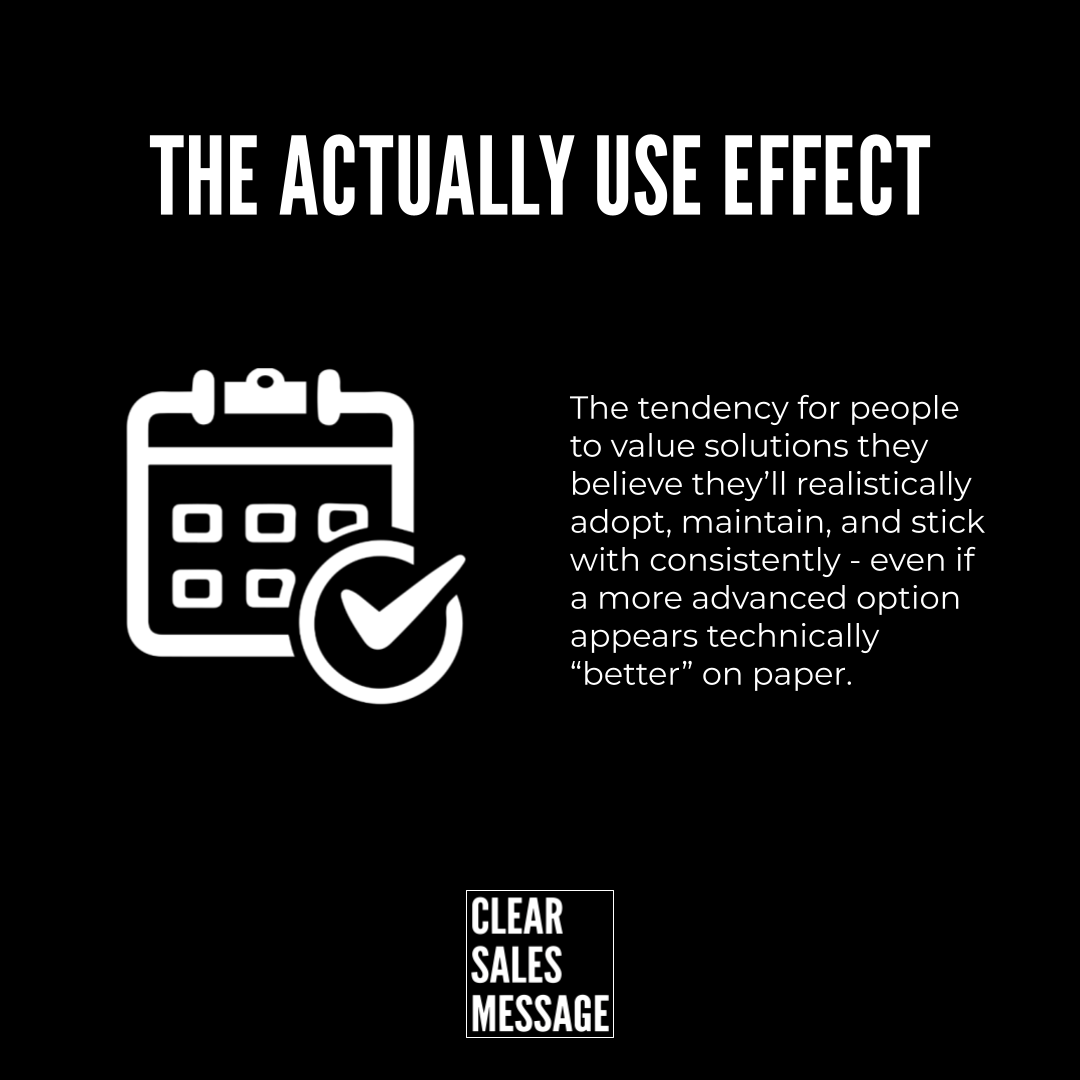
The Actually Use Effect is the tendency for people to place higher value on solutions they believe they will genuinely adopt, rather than ones that are theoretically superior but feel hard to commit to.
It shows up in every kind of buying decision. A person chooses a simple fitness app over a more powerful one because they know they will open the simple one every day. A business picks a straightforward CRM over a complex platform because the team will actually fill it in. The outcome they choose is not the best possible outcome – it is the most believable one.
However, this is not the buyer being lazy or unambitious. It is the buyer being honest with themselves. They have bought things before that sat unused. They have signed up for tools they abandoned after a week. As a result, they have learned to filter for what they will stick with, not just what sounds impressive.
Why Does The Actually Use Effect Happen?
Buyers carry the memory of past purchases that did not deliver – not because the product was bad, but because nobody used it properly. That experience creates a filter. Before they commit again, they run a quiet internal check: “Will this actually happen, or am I kidding myself?”
There is also a practical side to it. People are busy. They know that anything requiring significant time, training, or behaviour change has a high chance of slipping down the priority list and eventually dying. So they factor that in before they buy.
In fact, research into habit formation and behaviour change consistently shows that ease of adoption predicts whether people actually stick with something. The solutions people keep using are the ones that win. Therefore, buyers who understand this about themselves will always favour the realistic over the ideal.
How Can You Use The Actually Use Effect In Sales?
The goal is to make adoption feel easy and believable before the buyer has even said yes. You are not just selling the outcome – you are selling the confidence that the outcome will actually happen.
Reduce the perceived effort of getting started
The bigger the gap feels between where the buyer is now and where your solution requires them to be, the more the Actually Use Effect works against you. So show them how small the first step is. Make onboarding feel light, not heavy. Because the easier it is to start, the easier it is to say yes.
Use social proof that speaks to consistency
Case studies and testimonials that highlight results are useful. But case studies that highlight how easy it was to adopt and maintain carry even more weight for buyers the Actually Use Effect is affecting. “We were up and running in a day” or “the team actually uses it” speaks directly to the fear of buying something that gathers dust.
Acknowledge the concern directly
If you sense a buyer is hesitating because they are not sure they will follow through, name it. Say something like “a lot of our clients had the same worry before they started.” That kind of honesty builds trust fast, because it shows you understand how buying decisions really work – not just how they are supposed to work.
Match your pitch to their reality
Find out how the buyer currently works and frame your solution as a natural fit for that. The less change your product appears to demand, the more believable adoption feels. Instead of selling the transformation, sell the transition – small, manageable, realistic.
When The Actually Use Effect Works Best
This effect is strongest when the buyer has been burned before – by a tool they bought and abandoned, a system they invested in but never rolled out, or a change programme that stalled after the first month. In those situations, the question “will I actually use this?” sits at the front of their mind before you have even started your pitch.
It also shows up strongly with busy buyers who have limited bandwidth. For them, any solution that requires significant setup, training, or ongoing effort starts at a disadvantage. So simplicity and ease of use become genuine selling points, not just nice-to-haves.
Similarly, the effect is powerful in team buying situations. One person might be convinced, but they know their colleagues need to use it too. Getting a whole team to adopt something new is harder than getting one person to. So the more you can show that adoption is realistic across a group, the more you cut through that hesitation.
When The Actually Use Effect Becomes Dangerous
The risk comes when you oversimplify your offer just to win the sale. If you downplay complexity or skip important details about what the buyer needs to do to make it work, you may win the deal but lose the client. They will not use it well, results will disappoint, and they will not come back.
It can also work against you if a competitor pitches simplicity more convincingly than you do – even if your product is genuinely easier to use. Perception drives the Actually Use Effect, not just reality. So if your product feels harder to adopt in the conversation, you will lose even if it is actually simpler in practice.
Also, some buyers use “I’m not sure we’ll use it properly” as a polite way of saying something else – they are not convinced of the value, or the budget is not there. Therefore, treat it as a real concern first, but stay curious about whether something else sits underneath it.
Common Actually Use Effect Mistakes
Selling features instead of adoption
A long list of features can make a product feel more impressive but harder to use. For buyers the Actually Use Effect is driving, more features can actually reduce confidence rather than build it. Focus on the features they will use every day, not every feature you offer.
Ignoring the onboarding conversation
Many salespeople focus entirely on the outcome and skip over how the buyer gets there. But for a buyer worried about adoption, the “how do we get started” conversation matters just as much as the outcome itself. Walk them through it clearly and that clears the fear fast.
Comparing yourself to the technically superior option
If a competitor has more features or a stronger spec, do not try to win that battle. Instead, shift the conversation to usability, adoption, and real-world results. Because a better product that nobody uses delivers nothing. Your job is to make realistic success feel more likely than impressive failure.
Not asking about past experience with similar solutions
If you do not know whether the buyer has been burned before, you cannot speak to it. Ask early in the conversation whether they have tried something similar in the past and what happened. The answer will tell you exactly how much work the Actually Use Effect is doing in this sale.
The Actually Use Effect – An Example
A sales manager is looking for a new CRM for her team of eight. She has seen two options. The first is a powerful platform with deep reporting, full pipeline visibility, and integrations with every tool they use. The second is simpler, less featured, but extremely easy to learn and quick to update on a phone.
On paper, the first option wins. But she has been here before. Her last CRM was similarly impressive and only two people out of eight actually used it. The data stayed out of date, the reports told her nothing, and the team stopped trusting it within three months.
So she chooses the simpler one. Not because it is better, but because she genuinely believes her team will use it. As a result, the data stays clean, the pipeline stays visible, and the tool actually does its job – because the team uses it consistently. The Actually Use Effect did not push her toward the inferior product. It pushed her toward the one most likely to deliver a real outcome.
See also:
- 100+ ways to connect with buyers
- 50+ ways that people work & make decisions
- 80+ ways to justify the price
- Failed Attempts