Practical Sales Training™ > How People Work > The Blank Slate Effect
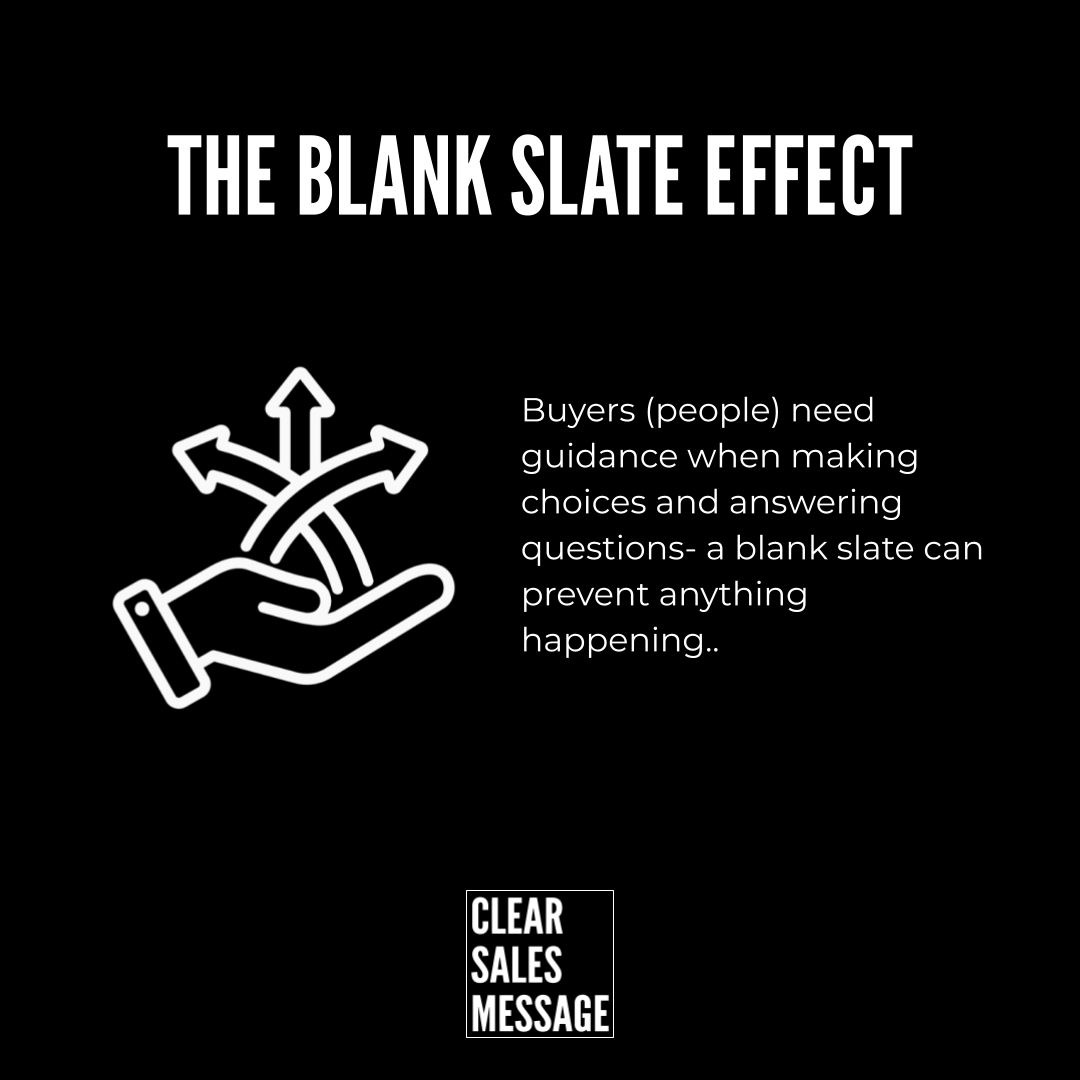
The Blank Slate Effect
More choice sounds like a good thing. But in sales, too much freedom is one of the fastest ways to lose a deal. When a buyer has no clear path, no examples to react to, and no obvious next step, they freeze. Not because they are not interested. Because they do not know where to start.
The Blank Slate Effect describes exactly this. It is what happens when a buyer faces too many open options and too little structure. Instead of feeling free, they feel lost. So they delay. They ask for more time. Or they just go quiet.
The fix is not to take away choice. It is to frame it. Because buyers do not want unlimited options. They want confident direction.
What Is The Blank Slate Effect?
The Blank Slate Effect happens when buyers are given too much freedom or too little guidance. Faced with a completely open choice, the brain struggles. There is nothing to compare, nothing to measure against, and no clear sense of what good looks like.
As a result, buyers stall. They may say they need to think about it, ask for more information, or simply disengage. But the real issue is not the decision itself. It is the lack of structure around it.
This is why people find it far easier to choose between three clear options than to design something from scratch. Options give the brain something to work with. A blank slate gives it nothing. And nothing leads to no decision.
Why Does The Blank Slate Effect Happen?
Human decision-making depends on comparison. We judge things relative to something else. When there are no reference points, no boundaries, and no examples to react to, the brain has no anchor. So it defaults to inaction.
Open questions make it worse. “What do you need?” or “What’s your budget?” sound reasonable. But for a buyer who is not sure yet, they create pressure without direction. Instead of helping the buyer move forward, they push the decision further away.
The Blank Slate Effect also appears in messaging. When a business talks in broad, vague terms, the buyer cannot picture a specific outcome. So they move on to someone who can show them exactly what they will get.
How Can You Use The Blank Slate Effect In Sales?
The answer is to give buyers something to react to. A starting point. An example. A recommended path. When you do that, you remove the paralysis and replace it with momentum.
Give Examples
“Most clients start with our Growth Plan because it balances support and flexibility.” This does two things. It removes the blank slate and it signals what a sensible choice looks like. Buyers feel guided rather than abandoned.
Offer Templates
“Here are three versions of how this could look based on your goals.” Templates give buyers a concrete starting point. They can react, adjust, and refine. That is far easier than building from nothing.
Frame Your Questions
Instead of “What do you want to focus on?” ask “Would you like to improve lead generation or conversion first?” Bounded questions are easier to answer. They move the conversation forward instead of stalling it.
Use Defaults
“Unless you tell us otherwise, we will begin with a three-month pilot.” A sensible default removes the need to decide everything upfront. It also signals confidence. You are not waiting for the buyer to figure it out. You are leading them.
Show What Good Looks Like
Share case studies, before-and-afters, or clear outcomes from past clients. When buyers can see what success looks like, they can picture their own version of it. That makes the decision feel real rather than abstract.
When The Blank Slate Effect Hurts Most
It hurts most at the start of a buyer relationship. When someone does not yet know you, your work, or your process, everything feels open and uncertain. A blank slate at that stage creates doubt rather than excitement.
It also hits hard in complex sales. The more moving parts there are, the more the buyer needs structure to navigate them. Without clear options and a recommended path, complexity becomes a reason not to proceed.
Similarly, it shows up in messaging. Vague claims like “we help businesses grow” give the buyer nothing to hold on to. There is no specific outcome, no clear buyer, and no reason to act. The message is a blank slate in itself.
When The Blank Slate Effect Becomes Dangerous
It becomes dangerous when you confuse freedom with helpfulness. Giving a buyer total control over the shape of an engagement sounds generous. But it often just creates work for them. And buyers who have to do the work of figuring out your offer will find someone who has already done it for them.
It also creates a credibility risk. When a business cannot describe a clear process or a typical starting point, buyers wonder whether they really know what they are doing. Structure signals expertise. A blank slate signals the opposite.
But the deepest danger is the lost deal you never see. Buyers who hit a blank slate rarely tell you that is why they left. They just stop responding. You assume they were not ready. In fact, they were just not guided.
Common Blank Slate Effect Mistakes
Asking Open Questions Too Early
Questions like “What are you looking for?” or “What’s your budget?” sound neutral. But for a buyer who is still forming a view, they create pressure with no direction. Lead with a recommendation first and ask open questions once the buyer has something to react to.
Using Vague Messaging
Broad claims give buyers nothing specific to connect with. “We help you grow” could mean anything. So be specific about who you help, what you do, and what the result looks like. Specificity removes the blank slate from your messaging.
Offering Too Many Options
More choice does not always help. When a buyer faces too many options with no recommended path, the decision feels harder, not easier. Instead, suggest a starting point and explain why it fits. You can always adjust from there.
Not Showing a Clear Next Step
If a buyer does not know what happens after they say yes, they will hesitate. A clear next step removes that uncertainty. Tell them exactly what to expect and the decision becomes much easier to make.
The Blank Slate Effect – An Example
This advert from a marketing company is a good example of the Blank Slate Effect in action. The headline reads “Need help growing your business?” and the call to action is “Get in touch.”

The problem is that “growing your business” could mean almost anything. For a marketing company, the message should be far more specific. What kind of growth? More leads? Better conversion? More clients from social media? Instead, the buyer is left to fill in the blank themselves.
As a result, the ad does not connect with anyone in particular. It speaks to everyone and no one at the same time. A stronger version would name the specific outcome, the specific buyer, and the specific way the company delivers it. That is how you remove the blank slate and give the buyer something real to act on.
See Also
- 50+ ways that people work & make decisions
- 99+ ways to simplify a complex offering
- Overchoice
- The Default Effect