Practical Sales Training™ > How To Connect With Your Buyer > The Good Cause Effect

The Good Cause Effect
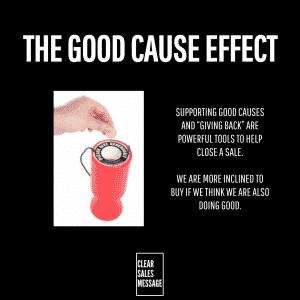
Two products can be identical on paper. But if one does some good in the world and the other doesn’t, that difference can decide the sale.
What Is It
The good cause effect means making sure your sale does some good in the world. So every purchase gives something back, on top of whatever the buyer actually gets.
Why Does It Work
We’re all becoming more aware of our impact as consumers. So when a purchase gives back and a rival’s doesn’t, that gap matters.
It’s often enough to tip a close decision. Even if the buyer wasn’t thinking about ethics beforehand, the option becomes hard to ignore once it’s in front of them.
How Can You Use It
You don’t need a huge budget to make this work.
Match Every Purchase With A Good Deed
TOMS shoes made this famous. For every pair sold, they gave a pair to someone in need. So you could match a purchase the same way, donate to charity, or fund something like meals for people who need them.
Pick Any Good Cause
The cause doesn’t need to relate directly to what you sell. What matters is that you genuinely do some good. In fact, that alone becomes a closing factor for plenty of buyers.
When It Works Best
This works best when the good deed feels real and easy to picture. So a specific outcome, like trees planted or meals given, lands harder than a vague promise to “give back.”
It also works well when buyers are already choosing between similar options. In that moment, the good cause becomes the deciding factor.
When It Becomes Dangerous
This backfires fast if the claim turns out to be exaggerated or fake. Buyers feel genuinely misled once that happens, and trust is hard to win back.
It’s also risky if the good cause becomes the only reason to buy. Since the product itself still needs to hold up on its own merit too.
Common Mistakes
Being Vague About The Impact
“We give back” means nothing on its own. So say exactly what happens with each purchase, since specifics build trust.
Overstating The Contribution
Exaggerating your impact is a fast way to lose trust once someone checks the facts. So keep every claim accurate and provable instead.
The Good Cause Effect – An Example
A Coffee Brand Plants Trees With Every Bag
A small coffee brand called Brew For Good donates 10% of every bag sold to reforestation projects in the Amazon. Each bag even carries a QR code, so customers can see exactly where their trees get planted.
Customers feel they’re not just buying coffee. They’re also making a small but real difference. So given a choice between a regular brand and Brew For Good, that environmental benefit can easily be the tipping point.
See also