Practical Sales Training™ > How To Get Attention > The World First Effect

The World First Effect
Two words stop people in their tracks. “World’s first.” They signal something new. Something worth noticing. Something that has not existed before.
Being first creates curiosity. It also creates credibility. People naturally want to know what makes it different, and that curiosity earns attention before a single feature is explained.
In a world full of products that all sound the same, the World First Effect cuts straight through. Because first is a category of one.
What Is the World First Effect?
The World First Effect is the use of a “world’s first” claim to grab attention, signal innovation, and build instant credibility. It tells buyers that what they are looking at has never existed before.
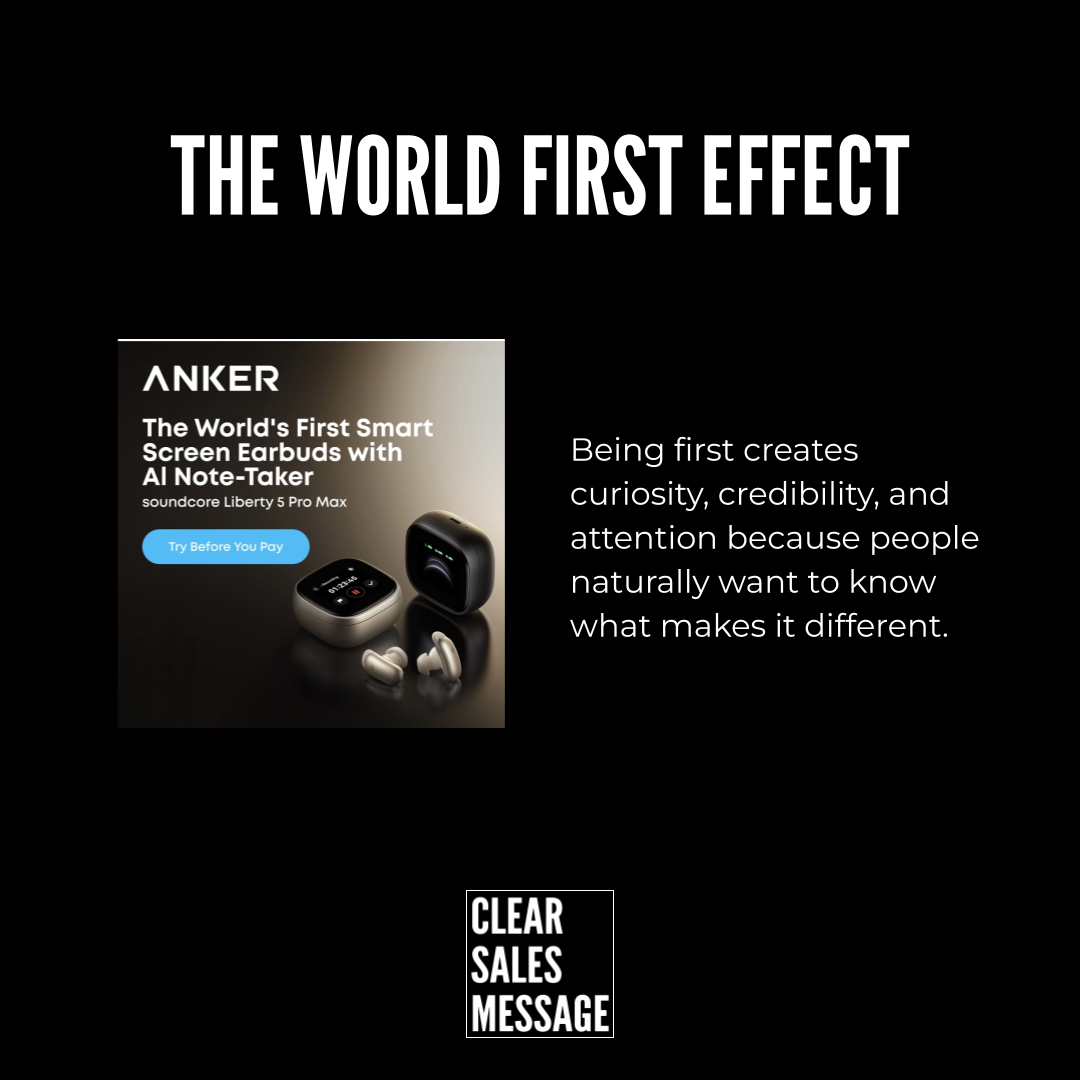
The claim does not have to cover the whole product. It can apply to a specific feature, a combination of features, or a new way of doing something familiar. Anker did this well with the soundcore Liberty 5 Pro Max – “The World’s First Smart Screen Earbuds with AI Note-Taker.” Not just earbuds. A world first in a specific, defined way.
That specificity is what makes it powerful. A vague “world first” means little. But a precise one – naming exactly what is new – gives buyers something real to react to.
Why Does the World First Effect Work?
People pay attention to firsts. It is how the brain works. New things signal potential value and possible threat, so we notice them automatically. A “world’s first” claim triggers that response fast.
There is also a credibility effect. Being first implies expertise, investment, and confidence. If a company can genuinely claim it, buyers assume they know what they are doing. That assumption helps across the whole buying process, not just at the point of the claim.
Curiosity plays a role too. When something is described as a world first, buyers want to understand why. What is new? How does it work? What does it mean for them? Those questions keep people reading, watching, and engaging for longer than a standard feature headline ever could.
How Can You Use the World First Effect In Sales?
Lead with the claim in headlines
Put “world’s first” at the front of your headline where it earns the most attention. Do not bury it in the body copy. The claim does its best work at the moment of first contact – on an ad, a landing page, a pitch deck cover, or a social post.
Be specific about what is first
“World’s first” on its own is weak. “World’s first earbuds with an AI note-taker built into the case” is strong. The more specific the claim, the more credible and compelling it becomes. Specificity also makes it harder for competitors to dispute.
Use it to frame a new category
Being first at something means you define how that thing works. You set the standard others get compared to. So a world first claim is not just an attention tool – it is a positioning tool that can shape how an entire market thinks about a problem.
Pair it with a risk reversal
Something new carries a perception of risk. Buyers wonder if it actually works. Anker paired their world first claim with “Try Before You Pay” – which is smart. The claim creates curiosity, and the risk reversal removes the hesitation that curiosity alone can create.
When the World First Effect Works Best
It works best when the claim is genuine and provable. A world first you can defend earns lasting credibility. One that unravels under scrutiny does serious damage – so only use it when you can back it up.
New product launches suit this technique particularly well. At launch, the claim is fresh and cannot yet be matched. So the window of competitive advantage is widest right at the moment of release, and the World First Effect should lead the launch messaging.
It also works well in crowded markets where differentiation is hard. When products look similar and sound similar, a world first claim in a specific area cuts through immediately. Even a small innovation, framed well, can position a brand as the leader in that space.
When the World First Effect Becomes Dangerous
The main risk is overclaiming. If the “world’s first” label is not accurate, someone will find out. Buyers, journalists, and competitors all check. A false claim does not just embarrass – it destroys the credibility the technique was built to create.
Vagueness is also a problem. “World’s first solution for business growth” says nothing. It sounds like marketing fluff rather than a real claim. So the more vague the world first statement, the less it earns – and the more suspicious buyers become.
There is also a shelf life issue. A world first does not stay first forever. Competitors catch up. So the claim needs to evolve as the market moves, or it starts to sound dated rather than pioneering.
Common World First Effect Mistakes
Claiming first without proof
A world first claim invites scrutiny. If you make it, be ready to back it up. A patent, a verifiable date, a named feature that genuinely did not exist before – these turn a claim into a fact. Without evidence, the claim is just noise.
Burying the claim
A world first mentioned in the fifth paragraph does almost no work. Place it upfront. In the headline, the subject line, or the opening line of a pitch. The claim earns attention – but only if buyers see it before they have already moved on.
Not following through with proof
The claim gets the click. The content has to justify it. If the page, pitch, or proposal that follows a world first claim does not explain clearly what is new and why it matters, the attention you earned gets wasted. So always back the claim with substance directly after it.
The World First Effect – An Example
Anker used this technique for the soundcore Liberty 5 Pro Max. “The World’s First Smart Screen Earbuds with AI Note-Taker” is specific, credible, and curious. It tells you exactly what is new. It also pairs with “Try Before You Pay” – so the excitement of a world first is matched with the safety of a risk-free trial. That combination is hard to ignore.

See Also