
Practical Sales Training™ > How To Get Attention > The Award Winning Effect

The Award Winning Effect
Two products sit side by side. One says award-winning on the label. The other does not. Most buyers will pick up the award-winning one first. That is the Award Winning Effect.
The award itself might be small, the ceremony local, the panel just three people and a spreadsheet. None of that matters as much as you think. The label still works. The signal still lands.
Regardless, the Award Winning Effect is the use of awards and recognition to signal quality and build trust. Any award, however niche, implies that someone qualified judged your offering and approved it.
What Is The Award Winning Effect?
Awards work because they are a form of third-party validation. Buyers discount most claims a business makes because the business has every reason to say good things. But an award is different. A panel decided. Qualified people passed judgement. That gives the claim a credibility that self-promotion can never achieve on its own.
There is also a social proof element. Buyers see an award as evidence that others have already evaluated the offering and found it worthy. Because someone else already concluded this one is good, the buyer can skip the comparison and trust the result.
The best awards are those given by consumers. Think best nappies as voted by mums, or most trusted brand as rated by customers. Because the judges are people like the buyer, the endorsement feels more relevant than one from an industry body. Buyers identify with the voters and trust their verdict.
Why Does The Award Winning Effect Work?
An award moves your claim from something you say about yourself to something a third party has said about you. That distinction matters enormously. Buyers apply a natural filter to self-promotion. They do not apply the same filter to external recognition. Because the source is independent, the signal carries far more weight.
There is also a standing-out factor. In crowded markets where products look similar on paper, an award gives a buyer a reason to choose without having to think too hard. It resolves the decision. Because it signals that someone already did the evaluation work, the buyer feels comfortable following that lead.
Awards also stack. One award is useful. Several awards across different categories build a picture of consistent quality. Over time, the Award Winning Effect compounds into a reputation, not just a marketing claim.
How Can You Use The Award Winning Effect?
Look at what awards exist in your sector. Trade magazines, industry bodies, regional business networks, and consumer publications all run awards programmes. Many are free to enter. Look at what your rivals have won. That will show you which awards your buyers are likely to recognise and value.
Enter the Right Ones
So not every award carries equal weight. Prioritise the ones your buyers are most likely to notice and trust. That might be a consumer choice award in your category, or a trade body award if buyers are professionals. Match the award to your audience and the signal lands more clearly.
Use It Everywhere When You Win
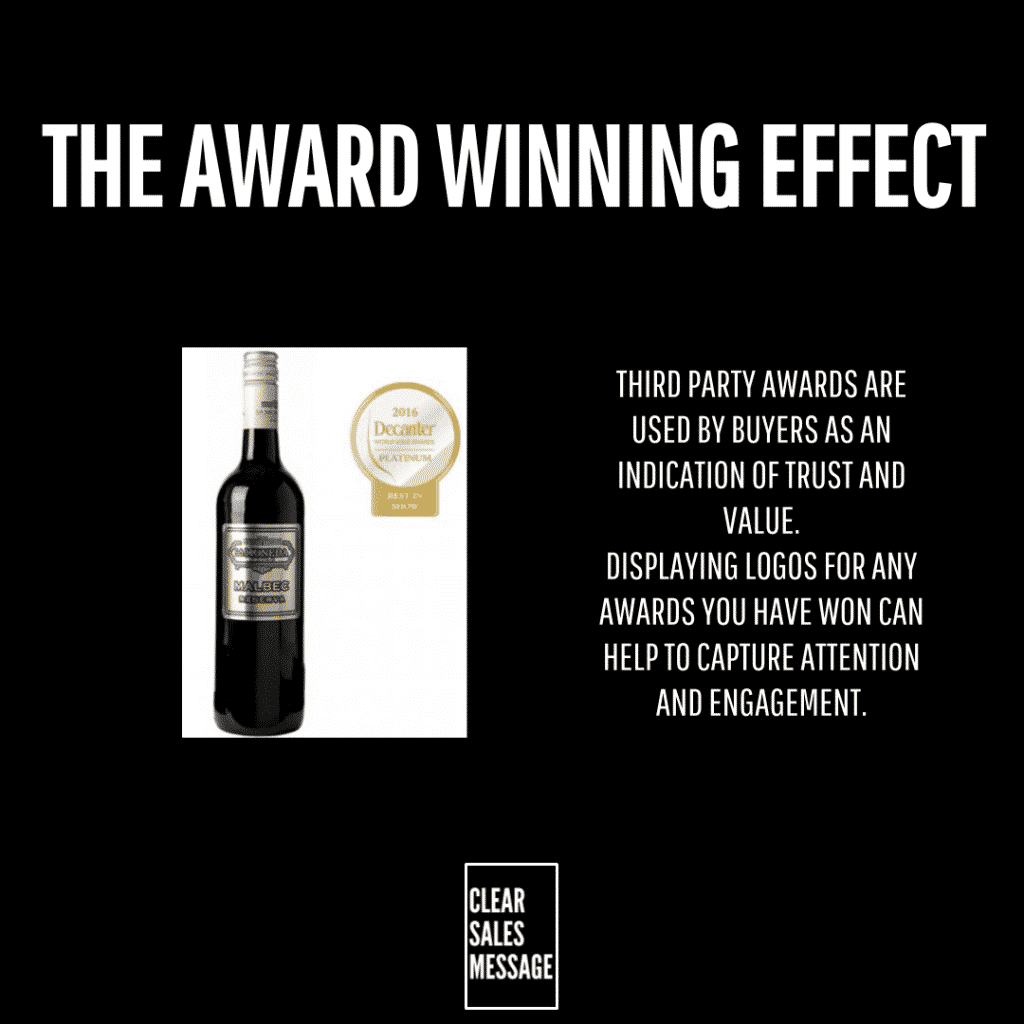
When you win, make it visible: on the product label, on your website homepage, in your email signature, on social media, at the top of proposals. Many businesses win awards and quietly file the certificate. So you can stand out just by being visible about it. The award only works when buyers can see it.
Keep the Language Clear
Award-winning often works better than the full formal title. Buyers scanning packaging or a website rarely stop to read a long technical award name. So lead with the short, punchy version and link to the full details for anyone who wants them.
When The Award Winning Effect Works Best
The Award Winning Effect works best when the award is relevant to the buyer. An award for best independent coffee roaster matters to a coffee lover. The same award on a corporate financial services website would carry little weight. Match the award to the audience.
Also, consumer awards carry the most power because they come from the people the buyer is most like. Because the voter is a peer rather than an expert, the endorsement feels personal. It says not just that this is good but that people like you chose this.
It is also particularly effective at the point of comparison. When a buyer is weighing up two similar options, an award on one of them creates an instant tiebreaker. Because the buyer has no strong reason to choose either way, the award becomes the deciding signal.
When The Award Winning Effect Becomes Dangerous
The main risk is an award that buyers do not recognise and cannot understand. A long technical title from an obscure trade body may mean nothing to a buyer scanning a label. Keep it clear and readable. Award-winning tends to land better than the full formal title.
There is also a risk of over-relying on old awards. An award from five years ago says something different from one received last month. Keep your credentials current. Enter new awards regularly. And when you win, make sure the dates are visible so buyers can see the recognition is recent.
Common Award Winning Effect Mistakes
Not Entering Awards at All
The most common mistake is not entering awards at all. Many businesses assume they would not win, or that the process is too time-consuming. Both objections are often weaker than they appear. Entering is the only way to find out. Also, preparing an entry is a useful exercise in itself. It forces you to articulate what makes you different.
Winning and Then Not Using the Award
A second mistake is winning and then not using the award visibly. Instead, the certificate goes on a wall in an office no customer ever visits. Update the packaging. Change the website. Add it to every proposal. The award only works when buyers can see it.
Using the Award Without Linking It to the Buying Decision
A third mistake is displaying an award without connecting it to the reason the buyer is considering you. An award for customer service matters when the buyer is worried about support. An award for product quality matters when they are comparing specifications. Place the award where it answers the specific question the buyer is asking.
The Award Winning Effect – An Example
A small artisan coffee brand wins Best Independent Coffee Roaster 2024 at a regional food and drink awards ceremony. They update their packaging, website, and social media immediately to display Award-Winning Coffee alongside the award logo. Buyers scanning a shelf see the label and think: if experts judged this the best, it is worth trying. Trust rises. Sales follow.
The award happened once, but the signal keeps working every time a buyer sees the label.
See Also