Practical Sales Training™ > How To Convert > Activity Counter
Activity Counter
Most businesses say they are experienced, busy, and trusted. But they never prove it.
Saying “we have helped thousands of clients” is easy. Anyone can say it. But putting a real number in front of a buyer is different. 12,847 clients helped. 99 billion served. That feels real.
Activity counters turn a vague claim into a concrete fact. And facts persuade. So if you have a number worth sharing, use it.
What Is An Activity Counter?
An activity counter is a specific figure that shows the volume of work you do. It might be clients served, journeys made, emails sent, or burgers sold. The exact metric matters less than the impression it creates.
A big, specific number tells buyers that many others have already trusted you. And that matters. Because buyers look for proof that they are not the first to take the risk.
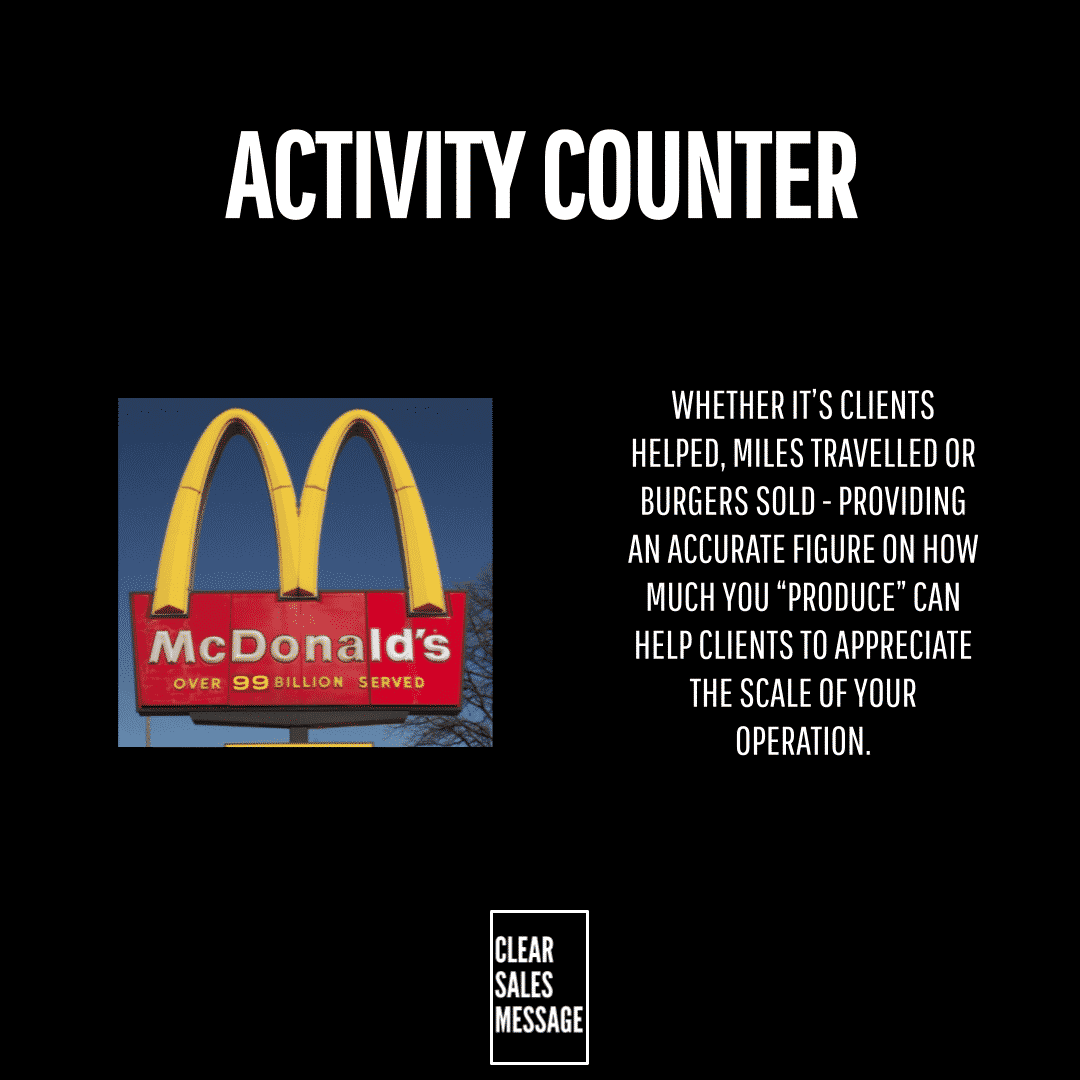
McDonald’s did this with “Over 99 Billion Served.” Nobody needed to understand the exact figure. The scale of it said everything. As a result, it became one of the most recognised phrases in marketing history.
Why Does An Activity Counter Work?
It works because it creates a sense of abundance. Abundance signals that you are good at what you do. It also signals that you are popular. And it shows that many others have already made the same choice the buyer is now considering.
That last point matters a lot. When buyers see a large number, two things happen. First, they feel safe. Second, they feel a quiet pull of FOMO. The sense that not acting means missing out on something others are already getting.
So you are not just showing volume. You are showing proof. And proof moves buyers in a way that words alone rarely do.
How Can You Use An Activity Counter In Sales?
Start by thinking about which numbers you can share. Consider what is commercially safe to publish, and also what would genuinely impress your buyer. Not every figure tells the right story.
Good metrics to consider include number of clients, value of work done, deliveries made, calls handled, or meetings booked. Pick the number that best reflects the value you deliver. Then use it clearly and often.
On Your Website
An activity counter works well as a live or updated figure on your homepage. A number that ticks upward in real time creates energy and trust. See also: The Live Activity Effect. Even a static figure updated each month sends a signal. It shows buyers your business is active and growing. That impression alone can shift how they feel about you.
In Sales Conversations
“We have done over 3,000 projects in this sector” lands differently to “we have a lot of experience.” One is a claim. The other is evidence. Numbers are also easier to remember than adjectives. So instead of reaching for a superlative, reach for a stat. It will stick far longer.
In Marketing and Content
“Join 14,000 businesses already using X” is one of the most effective phrases in marketing. It combines social proof with scale in just a few words. In fact, adding a specific number to an ordinary headline can make the whole message feel more credible. So use your counter in emails, ads, and social posts too.
When Activity Counters Work Best
They work best when the number is big, specific, and current. A vague or small number can backfire. It can make you look smaller than the buyer hoped. The more precise the figure, the more trust it builds.
They are also most effective in sectors where scale implies skill. Logistics, software, professional services, and hospitality all benefit. In these fields, a high volume of experience directly links to quality in the buyer’s mind.
When Activity Counters Become Dangerous
The biggest risk is using a number that does not impress. If you have served 14 clients, do not lead with that. A small number raises doubts rather than removing them. Context matters a great deal here.
Old figures are also a problem. A counter that has not changed in three years signals stagnation. So keep your numbers current. And if the figure is not yet impressive enough to share, wait until it is.
Common Activity Counter Mistakes
Most businesses either skip this entirely or use the wrong number. Here are two mistakes worth avoiding.
Choosing the Wrong Metric
Not every number tells the right story. Leading with emails sent or calls made rarely impresses a buyer. Instead, pick a metric they actually care about. Clients helped, problems solved, results delivered. Those are the numbers that build confidence. Everything else is just noise.
Being Vague When You Could Be Specific
“Thousands of clients” is weaker than “4,200 clients.” Vague figures feel like estimates. Specific ones feel measured and honest. Buyers trust precision. So if you know the exact number, use it. The extra detail costs nothing and gains a great deal.
Activity Counter – An Example
HubSpot use their counter well, sharing the number of customers they serve and the countries they work in. For a buyer looking at a CRM, those figures answer a quiet but important question: is this company big enough to trust with my business?
A taxi firm could do the same. Journeys completed. Miles covered. Five-star ratings earned. Each number builds a picture of a busy, reliable operation. The figure does not close the deal. But it makes the buyer feel safe enough to keep reading. And that is often all you need.
See also
- 180+ ways to improve conversion
- Live Activity Effect
- The Abundance Effect
- The Bandwagon Effect
- 100+ ways to be more memorable

