

Practical Sales Training™ > How To Connect With Your Buyer > The Bandwagon Effect
The Bandwagon Effect
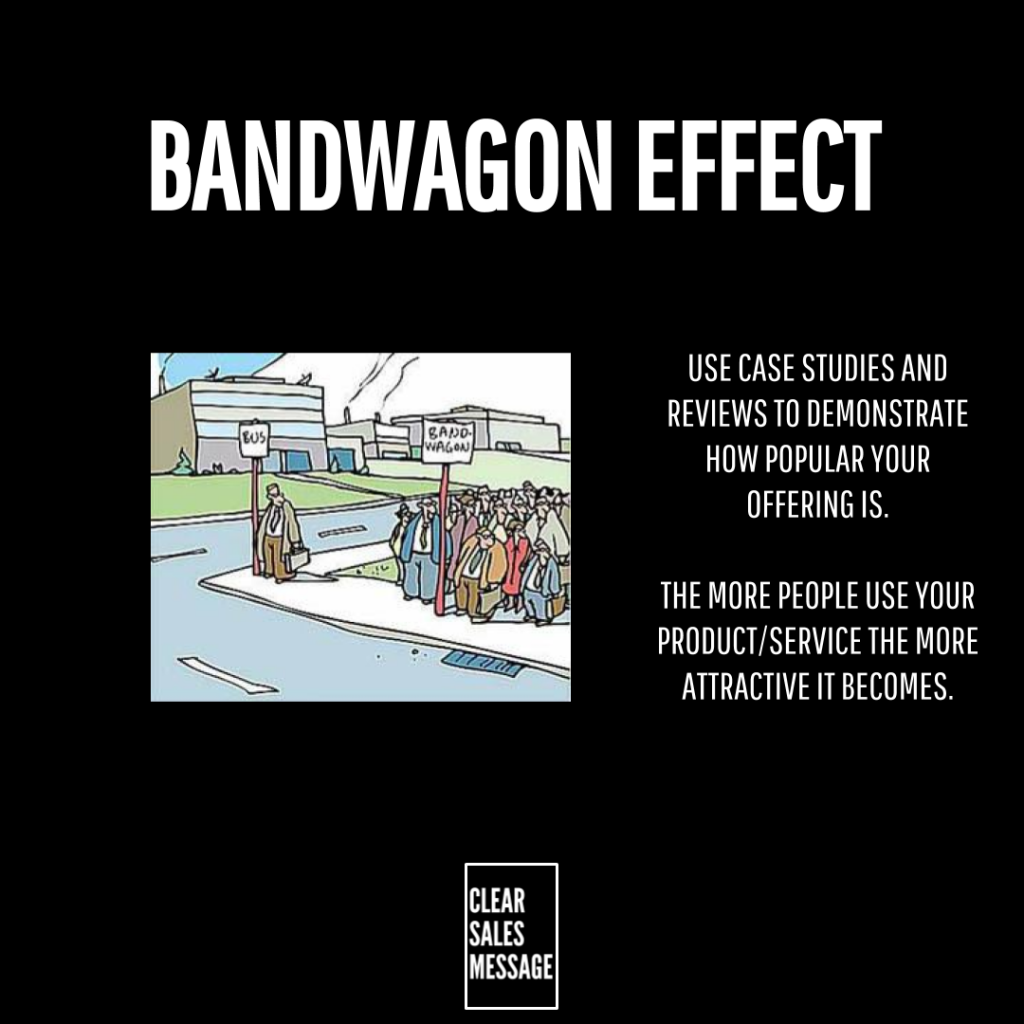
You join a queue without knowing what it is for, buy a bestselling book without reading a review, and choose the restaurant with the most people in it over the empty one next door. None of this is rational. All of it is human. That is the Bandwagon Effect.
When many people have already chosen something, the choice feels safer. The crowd has done the evaluation work. Following them carries less risk than going it alone.
The Bandwagon Effect describes the tendency to follow the behaviour of a large group. In sales, showing buyers how many others have chosen your offer makes them more likely to choose it too.
What Is The Bandwagon Effect?
We buy to minimise risk as much as to gain value. When lots of people have already committed to something, the message is clear: tried, tested, and found good. Because the crowd has validated it, the lone buyer feels safer joining in.
It is why bestseller labels work on books, restaurants display their popularity, and software companies show user counts. The number itself is secondary. What it signals is primary: you would not be the first. You would be joining something.
There is also a fear of missing out angle. When a buyer sees thousands already use something, they wonder whether they are the one falling behind. Because the crowd is moving, standing still starts to feel like a cost.
Why Does The Bandwagon Effect Work?
Buyers do not always have the time or knowledge to evaluate an offer from scratch. The Bandwagon Effect offers a shortcut. If this many people chose it, the thinking goes, there must be a good reason. Because the crowd has already done the hard work of comparison, the buyer can follow their lead without doing the same.
There is also a social identity element. When a buyer sees that a large group has already made a choice, joining that group starts to feel like the right move. Because we are social beings who look to others for behavioural cues, a visible crowd creates a powerful pull.
Loss aversion adds further weight. Being the last person to discover something good feels worse than being among the first. When the crowd is already there, delay carries a psychological cost. Buyers move faster to avoid that feeling.
How Can You Use The Bandwagon Effect?
Look at your numbers and find the ones worth sharing:
How many clients do you have?
How many units have you sold?
How many people are on your mailing list?
How many have attended your events or taken your courses?
Any of these, if compelling, can anchor a Bandwagon Effect statement. Make it direct and specific. Trusted by over 1,000 businesses is clear and compelling. Join our mailing list of 15,000 people gives the same effect. Because the number is precise, it carries more weight than a vague phrase like popular across the UK.
Place It Early
Because buyers form impressions fast, this works best when it appears early, before the buyer hesitates. Put it on your homepage, in your email subject line, at the top of a proposal, in a product description. The Bandwagon Effect earns the most when the buyer encounters it before they have started to doubt.
Use the Real Number
A round, vague number feels invented; a precise, meaningful number feels true. So instead of saying thousands of businesses, say over 1,400 businesses. The specificity is the signal. It tells the buyer the number is real and worth paying attention to.
Scale and Reach
If appropriate, focus on the scale and reach of your business. Promote the large numbers that show your offering is popular and well received. Think about the full picture – total clients, total transactions, total reviews, total followers. Each one adds to the picture of a business that many have already trusted.
When The Bandwagon Effect Works Best
It works best when the number is large enough to impress the buyer and specific enough to feel real. It also works well when the number relates directly to what the buyer is about to do. If a buyer considers signing up for a course, showing how many others have taken it lands directly. Because the crowd matches the exact choice the buyer is weighing, the reassurance is immediate.
It is also effective in markets where buyers feel uncertain about quality and want external confirmation. Because the Bandwagon Effect provides that confirmation at a glance, it can do the work of multiple testimonials in a single number.
When The Bandwagon Effect Becomes Dangerous
The main risk is a number that is too small to impress. Three businesses trust us does not create the effect. In fact, it can undermine confidence. So use Bandwagon numbers only when the count is genuinely compelling. If the numbers are not there yet, build them first.
There is also a risk of a static claim that never updates. A trusted by 500 businesses statement from three years ago eventually becomes misleading. Update your numbers regularly, or use language that signals growth, such as and growing every month.
Common Bandwagon Effect Mistakes
Having the Numbers and Not Mentioning Them
The most common mistake is having compelling numbers and not mentioning them. Many businesses have impressive client counts, large mailing lists, or significant sales volumes that never appear in their marketing. Review your numbers. If any are genuinely impressive, put them in front of buyers.
Being Vague
A second mistake is being vague. Over a thousand clients is weaker than trusted by 1,247 businesses. Because precision signals honesty, a specific number lands harder than a rounded one. Use the real number, or as close to it as you can.
Using the Wrong Number for the Context
A third mistake is using a number that does not match the buyer’s decision. A large follower count on social media may mean nothing to a buyer who is considering a high-value B2B contract. Match the number to the context. The most compelling Bandwagon statement is the one that shows people just like the buyer have already made the same choice.
The Bandwagon Effect – An Example
A software company promotes its platform with one line:
“Join over 20,000 businesses already using our platform to grow faster.”
That statement describes no features and makes no claim about quality or price. It simply tells the buyer that 20,000 companies have already made the decision. Because the crowd is already there, joining feels safe, smart, and overdue. That is the Bandwagon Effect doing its work.
The best sales argument is often not the one you make. It is the one the crowd makes on your behalf.
See Also