Practical Sales Training™ > How To Convert > Buy One Get One Cheap

Buy One Get One Cheap
Everyone knows Buy One Get One Free. It works. But it gives away a lot. Every second item you hand over for nothing is margin you’ll never see again. Buy One Get One Cheap solves that problem.
By attaching a token price to the second item, you keep almost all of the psychology of a free offer. Customers still feel like they’re getting a bargain. But you recover something on every transaction. That small difference adds up fast at volume.
It’s a simple twist on a familiar idea. And in the right context, it outperforms the original.
What Is Buy One Get One Cheap?
Buy One Get One Cheap is a promotion where a customer buys one item at full price and gets a second at a heavily reduced price, typically £1, 1p, or another token amount. It’s a variation on the classic Buy One Get One Free offer, but instead of giving the second item away entirely, you attach a nominal cost to it.
Common examples include buying a pizza and getting a second for £1, buying a pair of shoes and getting another pair for £1, or buying a skincare product and getting the matching item for 1p. In each case, the second item feels almost free to the customer. But the seller still receives something for it.
That small distinction is what makes the mechanic worth understanding. The customer experience is nearly identical to a free offer. The commercial outcome is meaningfully different.
Why Does Buy One Get One Cheap Work?
It works because customers perceive 1p or £1 as essentially free. The brain doesn’t process a 1p price as a real cost. So the second item feels like a bonus, not a purchase. You get the same emotional response as a free offer without the same financial hit.
Four things drive the effect. First, perceived generosity. Customers feel like they’re getting a near-free bonus, which creates goodwill and urgency to act. Second, the anchoring effect. The full price of the first item makes the second look like an extraordinary deal by comparison. Third, upsell potential. Instead of selling one unit, you double your volume at a fraction of the usual cost to acquire that extra sale. Fourth, margin control. Unlike Buy One Get One Free, you still recover something on the second item. Over thousands of transactions, that recovery matters.
Together, these make Buy One Get One Cheap one of the most efficient promotional mechanics available. You drive volume, reward buyers, and protect your numbers at the same time.
How Can You Use Buy One Get One Cheap In Sales?
You can apply this promotion across many sectors to drive sales and increase the average value of each transaction.
Retail
Offer a second item for £1 to encourage customers to buy more in a single visit. This works well for products people buy regularly or in multiples, because the second item feels like a smart stock-up rather than an impulse. As a result, basket size goes up without heavy discounting on the core price.
Food and Drink
Running a “buy one main, get another for £1” offer fills seats during quieter periods and increases spend per table. Restaurants also use it to drive delivery orders and app downloads. Because the perceived saving is so high, customers who might not have ordered feel pulled to act.
Health and Beauty
Bundle products so the second costs 1p to encourage customers to try more of the range. This is especially effective for complementary products, because the buyer gets introduced to something new at almost no cost. Many then go on to repurchase at full price once they’ve tried it.
E-commerce
Add the promotion at checkout to increase basket size before the customer completes their order. At that moment, they’ve already decided to buy. So the barrier to adding a second item for £1 is very low. It’s one of the simplest checkout optimisations you can make.
Tips for Running It Well
Choose products with strong enough margins to absorb the discount. Make the second item complementary to the first so uptake is high. Keep the pricing simple, because 1p or £1 is instantly understood as a deal. And set a time limit on the offer, because scarcity and urgency are what turn interest into action.
When Buy One Get One Cheap Works Best
It works best when you need to shift volume quickly. A time-limited promotion with a near-free second item creates urgency that a standard discount rarely matches. Customers who were on the fence move because the window to act is closing.
It also works well when you want to introduce customers to a second product in your range. Because the cost of the second item is so low, the barrier to trying something new almost disappears. That trial often leads to a full-price repurchase later, which is the longer-term gain behind the short-term promotion.
Similarly, it works in competitive markets where you need to stand out without a race to the bottom on price. You’re not cutting the price of your core product. Instead, you’re adding perceived value on top of it. That distinction matters for how buyers perceive your brand.
When Buy One Get One Cheap Becomes Dangerous
It becomes a problem when the margin on your product can’t support the discount. If the cost of delivering the second item at £1 or 1p leaves you underwater, the volume you drive makes things worse rather than better. So the maths must work before the promotion goes live.
It can also train buyers to wait for the offer. If you run Buy One Get One Cheap too frequently, customers learn the pattern. They hold off buying at full price because they know the deal is coming. As a result, you end up cannibalising your own full-price sales over time.
And it can attract the wrong buyers. Customers who come in only because of a near-free second item often have low loyalty. They’ll move to whoever is running the best deal next time. So use it to acquire customers you can then retain, rather than as a permanent fixture in your pricing.
Common Buy One Get One Cheap Mistakes
Running It on the Wrong Products
Not every product can absorb a second unit at 1p or £1. If margins are thin, the promotion costs you money on every transaction. Choose products with room in the margin, or use the offer to clear stock you need to move anyway. Either way, run the numbers first.
Making It Too Complicated
The power of this promotion is its simplicity. “Buy one, get one for £1” is instantly understood. But when conditions are added, such as minimum spend thresholds or exclusions, the offer starts to feel like a trick. Keep it clean. Because the moment buyers have to think hard about whether they qualify, they disengage.
Offering It Too Often
Run the promotion too frequently and it stops being a promotion. It becomes the expected price. Customers who know the deal comes around every few weeks will simply wait. So use it with intention and space it out enough to preserve the urgency that makes it work.
Forgetting the Follow-Up
Buy One Get One Cheap brings buyers in. But the real value is in what happens next. If you have no plan to convert a promotion buyer into a repeat customer, you’ve paid for volume without building anything lasting. Use the first purchase as the start of a relationship, not just a transaction.
Buy One Get One Cheap – An Example
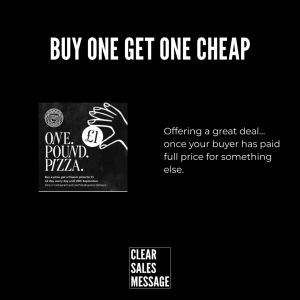
Pizza Express ran a Buy One Get One Cheap campaign during school holidays, a period when weekday footfall typically drops. The offer was simple: buy a pizza, get a classic pizza for £1. All day, every day, until a set end date.
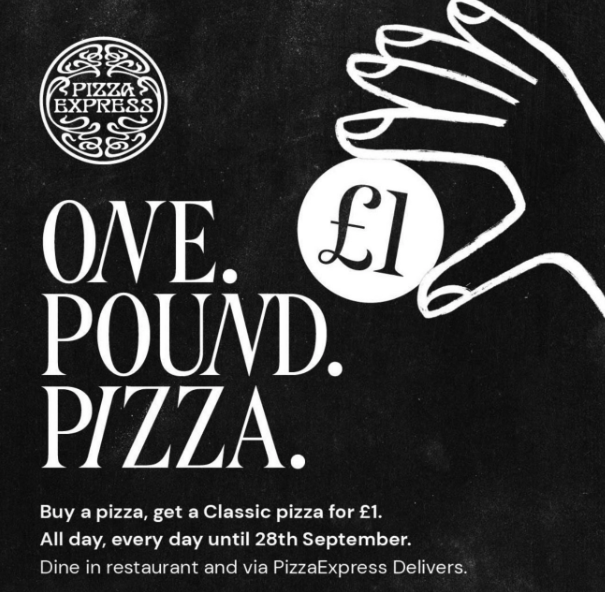
The creative made the price the hero. “One. Pound. Pizza.” Three words. No small print in the headline. The offer was so clear that it needed no explanation. As a result, it drove customers in during a period when they’d normally stay away, and it did so without touching the full price of the lead item. That’s Buy One Get One Cheap working exactly as it should.
See also
- 180+ ways to improve conversion
- 100+ ways to differentiate
- The Buy One Give One Effect
- One Price Sale