
Practical Sales Training™ > How To Convert > The Build Your Own Effect

The Build Your Own Effect
Nobody wants to pay for things they’ll never use. So instead of forcing buyers into one fixed package, you hand them the parts and let them choose.
That’s the Build Your Own Effect. It turns a rigid offer into something the buyer shapes themselves.
And when someone builds it, they trust it more. It’s no longer your package. It’s theirs.
What Is The Build Your Own Effect?
The Build Your Own Effect is about providing the component parts and allowing your buyer to build their own solution. Instead of one fixed bundle, they pick exactly what they need, piece by piece.
It works for products and services alike, anywhere an offer can be broken down into separate, useful parts rather than sold as a single take-it-or-leave-it package.
Why Does The Build Your Own Effect Work?
It’s a variation of The Generation Effect and The Customised Effect, and it harnesses the same idea: building the most appropriate solution makes the buyer feel understood and catered for, because they get everything they need and no more.
There’s also a sense of ownership. Once someone’s chosen each piece themselves, the final result feels personal, so they’re less likely to second-guess the decision later.
How Can You Use The Build Your Own Effect In Sales?
Break your offer into real components
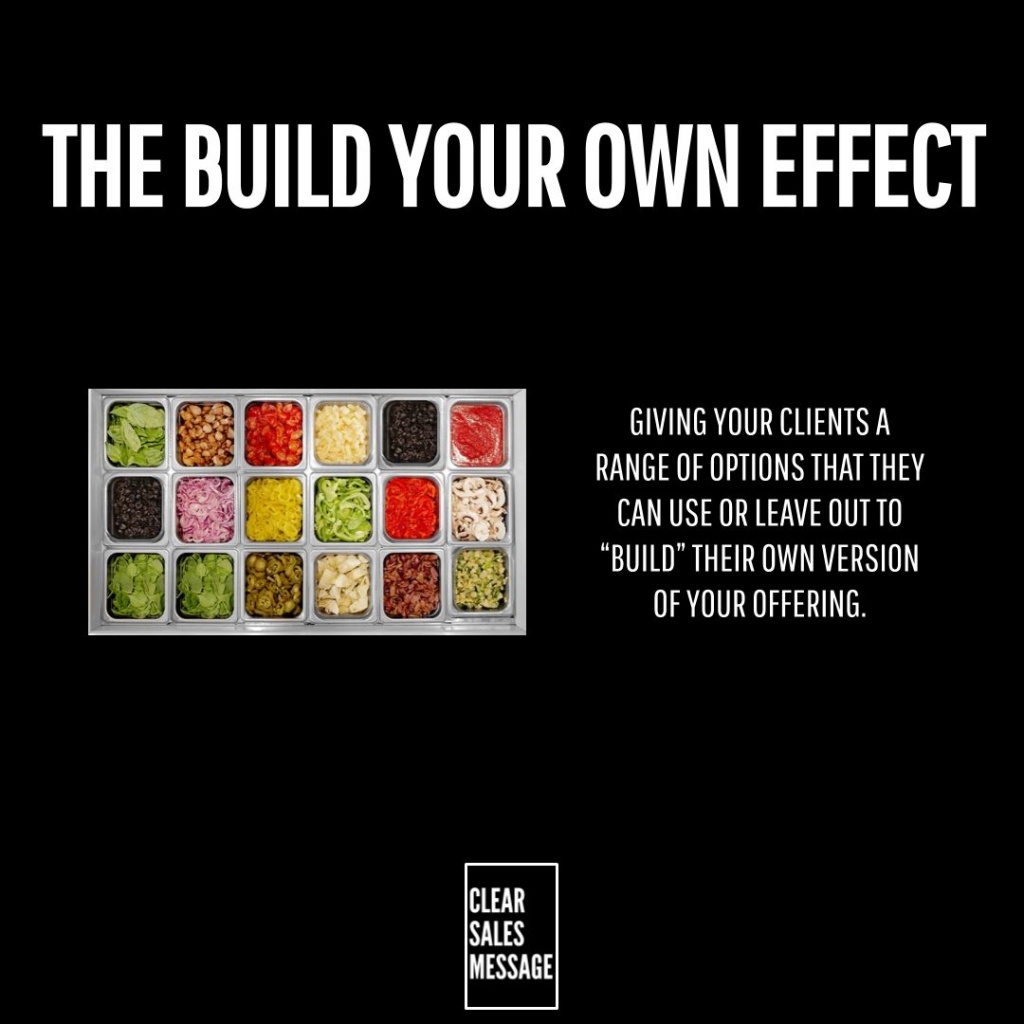
Work out how to dismantle what you do into component parts, then offer these as individual items that can be configured into a whole. Subway is the best example here. They offer all the basic ingredients, which lets you build the best sandwich for your own taste.
Price each part clearly
If buyers can’t see what each piece costs, they can’t build with confidence. Show the price of every component, so the final total always feels transparent rather than confusing.
Make a sensible starting point obvious
Too many options with no guidance can overwhelm a buyer. So offer a core starting package, then let add-ons build from there, instead of presenting every part as equally important.
When The Build Your Own Effect Works Best
It works best when buyer needs genuinely vary, so a single fixed package would always be wrong for someone. The more diverse your customer base, the more value a build-your-own structure adds.
It also works well for products with a clear core and optional extras, since that structure naturally lends itself to a build-your-own format without confusing the buyer.
When The Build Your Own Effect Becomes Dangerous
It becomes dangerous when there are too many choices. If buyers feel overwhelmed trying to configure their own solution, they’re more likely to abandon the decision entirely.
It can also backfire if the final price climbs higher than buyers expected, since stacking individually small costs together can create an unwelcome surprise at checkout.
Common Build Your Own Effect Mistakes
Offering too many components
More choice isn’t always better. So keep the component list focused enough that buyers can build a solution without feeling lost in options.
Hiding the running total
If buyers can’t see the price building as they add parts, the final number can feel like a shock. Show the total clearly at every step.
Not offering a sensible default
Some buyers don’t want to build from scratch. So give them a recommended starting point they can adjust, rather than a blank slate that demands every decision upfront.
The Build Your Own Effect – An Example
A Build Your Own CRM Plan
A software company offers a “Build Your Own CRM Plan” where buyers can select only the features they need, for example a core CRM at £20 a month, email automation as a £10 a month add-on, an analytics dashboard at £5 a month, and extra user seats at £2 a month each.
Rather than paying for a large, expensive package full of features they might never use, buyers build their own solution that fits their needs perfectly.
See also