Practical Sales Training™ > How To Keep Your Clients Happy > Consumption Notification

Consumption Notification
Most businesses wait for a buyer to run out of something before they say anything. The credit runs dry. The storage fills up. The hours get used. And then the buyer is frustrated, scrambling, and wondering why nobody warned them.
A Consumption Notification changes that. It’s a message that goes out before the problem lands. It tells the buyer where they are, what’s coming, and what they can do about it. That small shift changes the whole dynamic.
Done well, a Consumption Notification doesn’t feel like a sales message. It feels like good service. And good service is one of the most powerful sales tools you have.
What Is a Consumption Notification?
A Consumption Notification is a message sent to a buyer when their usage of your product or service reaches a certain level. It could be storage space, data, hours, credits, sessions, or any other unit that gets used up over time.
The notification acts as a trigger. It prompts the buyer to act before a problem occurs, rather than after. And because it comes from you, it positions you as someone looking out for them rather than waiting to catch them out.
You’ll see Consumption Notifications used by cloud storage providers, mobile networks, subscription platforms, and software tools. However, the principle applies to any business where what a buyer consumes defines what they spend.
Why Does a Consumption Notification Work?
Buyers dislike being caught off guard. Running out of something unexpectedly causes frustration, and that frustration often gets directed at the supplier. So a timely Consumption Notification removes the surprise and protects the relationship.
But there’s a commercial benefit too. When a buyer sees they’ve used 80% of something, they think about the remaining 20%. That awareness creates a natural moment of decision. Do they upgrade, top up, or buy more? Because the moment is buyer-led, it converts far better than a cold upsell message would.
There’s also a trust effect. A Consumption Notification signals that you’re paying attention to the buyer’s account. As a result, they feel looked after rather than sold to. That feeling keeps them loyal and makes them more likely to stay when renewal time comes around.
How Can You Use a Consumption Notification In Sales?
Start by identifying what your buyers consume. What unit of your offering gets used up over time? Once you know that, you can set thresholds that trigger a Consumption Notification at the right moment.
Set the Right Threshold
The notification needs to land early enough to be useful. If you wait until a buyer has used 99% of something, they may already be in trouble. Instead, aim for 70% to 80% as the trigger point. That gives them time to act without pressure and makes the message feel helpful rather than urgent.
Make the Next Step Easy
A Consumption Notification without a clear action is a missed opportunity. So always include a direct route to upgrade, top up, or extend. One click, one call, one reply. The easier the next step, the more buyers will take it. Friction at that moment costs you sales that were almost certain.
Add an Incentive Where It Fits
A Consumption Notification is already a good moment to buy more. But an incentive can make it even stronger. For example: “You’ve used 80% of your data. Add 5GB now and save 20%.” The saving rewards fast action and adds urgency without feeling pushy. Because the buyer already knows they need more, the offer lands at exactly the right time.
Use a Helpful, Not Salesy, Tone
A Consumption Notification should feel like a heads-up from a trusted supplier, not a push from a sales team. Lead with what the buyer needs to know, then offer the solution. “You’ve used 80% of your storage. Here’s how to avoid running out” works better than “Upgrade now before it’s too late.” The first serves the buyer. The second serves you.
When a Consumption Notification Works Best
A Consumption Notification works best in any business where a buyer’s usage is trackable and tied to what they pay. Software, utilities, data plans, time-based retainers, and credit-based services are all obvious fits. However, the idea also applies in less obvious contexts. A retained consultant tracking hours, a printer supplier monitoring ink levels, or a gym tracking session usage can all benefit from this approach.
It also works particularly well for pre-purchase situations. When buyers see their usage climbing, they’re more open to buying ahead of time. That’s good for them because it often comes with a saving, and good for you because it locks in revenue early.
Similarly, a Consumption Notification works well as part of a broader retention strategy. Paired with a Renewal Schedule, it keeps buyers engaged and informed throughout the relationship, not just at the start and end of a contract.
When a Consumption Notification Becomes Dangerous
Too many notifications become noise. If a buyer gets a message every time they use 10% more of something, they’ll start ignoring all of them. So choose your trigger points carefully and keep the number of notifications low.
Also watch out for a tone that feels threatening rather than helpful. A message that implies the buyer is about to lose something important can cause panic or resentment. Keep the language calm, clear, and solution-focused throughout.
And make sure the data is accurate. A Consumption Notification that fires at the wrong time, or shows the wrong usage figure, destroys credibility fast. Buyers trust you to know their account better than they do. Getting it wrong signals the opposite.
Common Consumption Notification Mistakes
Sending It Too Late
A Consumption Notification at 95% usage isn’t helpful. By that point the buyer has almost no time to act comfortably. Earlier is better. Give buyers enough runway to make a calm decision rather than a rushed one.
No Clear Call to Action
Telling a buyer they’ve used 80% of their allowance and leaving them to figure out what to do next is a wasted touchpoint. Every Consumption Notification needs one clear next step. Make it obvious, make it easy, and make it relevant to where they are.
Making It Feel Like a Sales Push
If a Consumption Notification reads like a pitch, buyers will tune it out or feel annoyed. The framing should always lead with their situation and their benefit. The commercial outcome follows naturally when the message is positioned around helping rather than selling.
Consumption Notification – An Example
A cloud storage company notices that most users only upgrade after they completely run out of space. That moment is always frustrating for the buyer and creates a real risk of losing them altogether.
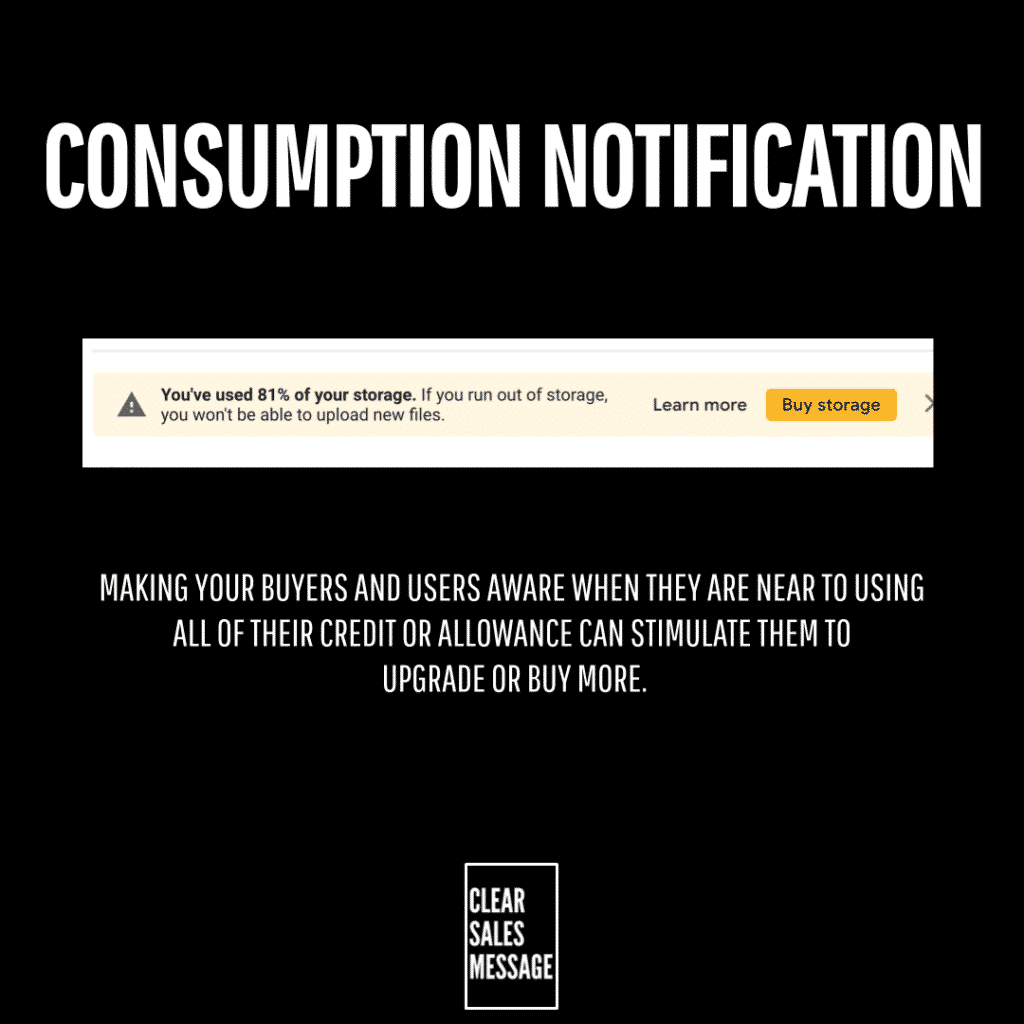
So the company introduces a Consumption Notification that fires at 80% usage: “You’ve used 80% of your storage. Upgrade now to avoid running out.”
The result is a better experience for the buyer and more upgrades for the business. Because the buyer acts before the problem hits, they never feel let down. And because the notification arrived at the right moment, the upsell happens naturally rather than as a last resort.
Similarly, a mobile network sends: “You’ve used 90% of your data. Add 5GB now and save 20%.” The message is timely, useful, and gives the buyer a reason to act straight away. As a result, both sides win. That’s the power of a well-timed Consumption Notification.
See Also