Practical Sales Training™ > How To Connect With Your Buyer > Conversation Prop
Conversation Prop
A conversation prop is a small object with a big job. You wear it, carry it, or set it on your desk. So it has one purpose. It exists to make people ask “what’s that?”
Once someone asks, you get permission to talk. That’s the whole trick. Nobody wants a pitch, but almost everyone will ask about something odd sitting on your desk.
Good props connect to your message. They are not random novelty items. Instead, each one carries a story or a point you want buyers to remember.
What Is It
A conversation prop is any physical object used deliberately to start a conversation. For example, it could be a badge, an ornament, a card or even a toy on your desk. The object itself is not the point. Instead, it’s the reaction it creates.
You choose it because it says something about you. When someone spots it, curiosity kicks in before you’ve said a word. That’s the whole strategy working quietly in the background.
Why Does It Work
People remember stories, not slogans. So a conversation prop turns your message into something buyers experience, rather than something you simply tell them.
It also flips the usual order. Instead of you opening the sales conversation, they do. That small shift changes a lot. Buyers relax more when they think the conversation was their idea.
Curiosity does the heavy lifting. We’re wired to want answers to unresolved questions. So a prop creates a small gap in someone’s understanding, and they can’t help asking you to fill it.
How Can You Use It
Pick An Object With Meaning
Don’t grab something just because it looks odd. Also, choose an object tied to your message or your values. If it doesn’t connect to a point, it’s just a gimmick.
Use It Consistently
A prop only builds recognition if you use it again and again. One appearance is a novelty. But ten appearances become part of who you are.
Let The Question Come First
Resist the urge to explain the prop straight away. Instead, wait for someone to ask about it. The explanation lands much harder when it answers a real question, rather than a rehearsed script.
When It Works Best
This works best face to face, or on video calls where the object is visible. It needs to be seen. So conferences, meetings and casual introductions all give it room to breathe.
It also earns its keep when your message needs a bit of warmth first. A prop softens the moment before you get anywhere near anything commercial, too.
When It Becomes Dangerous
A prop becomes a problem when it takes over the conversation. If people remember the object and forget your message, you’ve lost the plot. The prop should open the door. But it should never become the whole house.
It also backfires when it feels forced. Buyers can tell the difference between a genuine talking point and a desperate attempt at attention, too.
Common Mistakes
Choosing Novelty Over Meaning
Many people pick a prop simply because it’s funny or unusual. It says little about who they are, though. So it gets a laugh, but it’s forgotten a minute later.
Explaining Too Soon
Jumping in with the story before anyone asks kills the curiosity stone dead. Instead, let the silence do some work first.
Dropping It After One Use
Some people use a great prop once, but then forget about it completely. Instead, repetition is what turns a prop into a signature.
Conversation Prop – An Example
Pete Cohen’s Rubber Duck
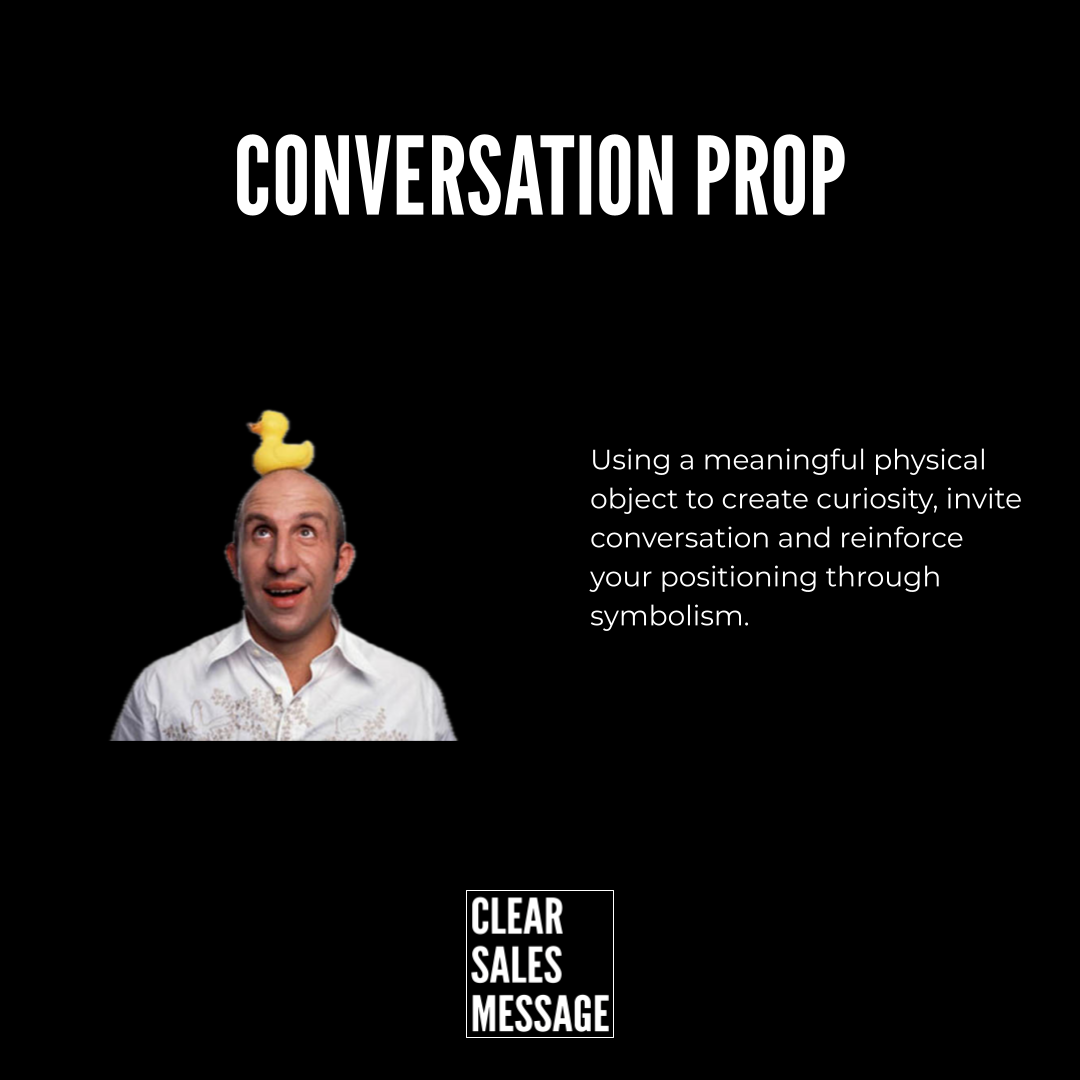
Pete Cohen carries a small rubber duck with him wherever he goes. So it ties to his “shut the duck up” message. That’s his phrase for the inner voice that talks people out of taking action.
People spot the duck and ask about it almost every time. So that single question gives Pete an opening to explain his whole philosophy, without ever pitching anyone.

See also