Practical Sales Training™ > How To Lose The Sale > Drop Off Points

Drop Off Points
Most sales losses don’t look like losses. There’s no angry email. No clear rejection. The buyer just goes quiet – and stays that way. That’s a Drop Off Point.
It might be confusion after pricing comes up. It might be a long wait between demo and proposal. Whatever the cause, the effect is the same – a buyer who was moving forward stops, and doesn’t start again.
Most businesses study their wins. Fewer study where the momentum died. But fixing Drop Off Points often produces faster results than adding more leads to the top of the funnel.
What Are Drop Off Points?
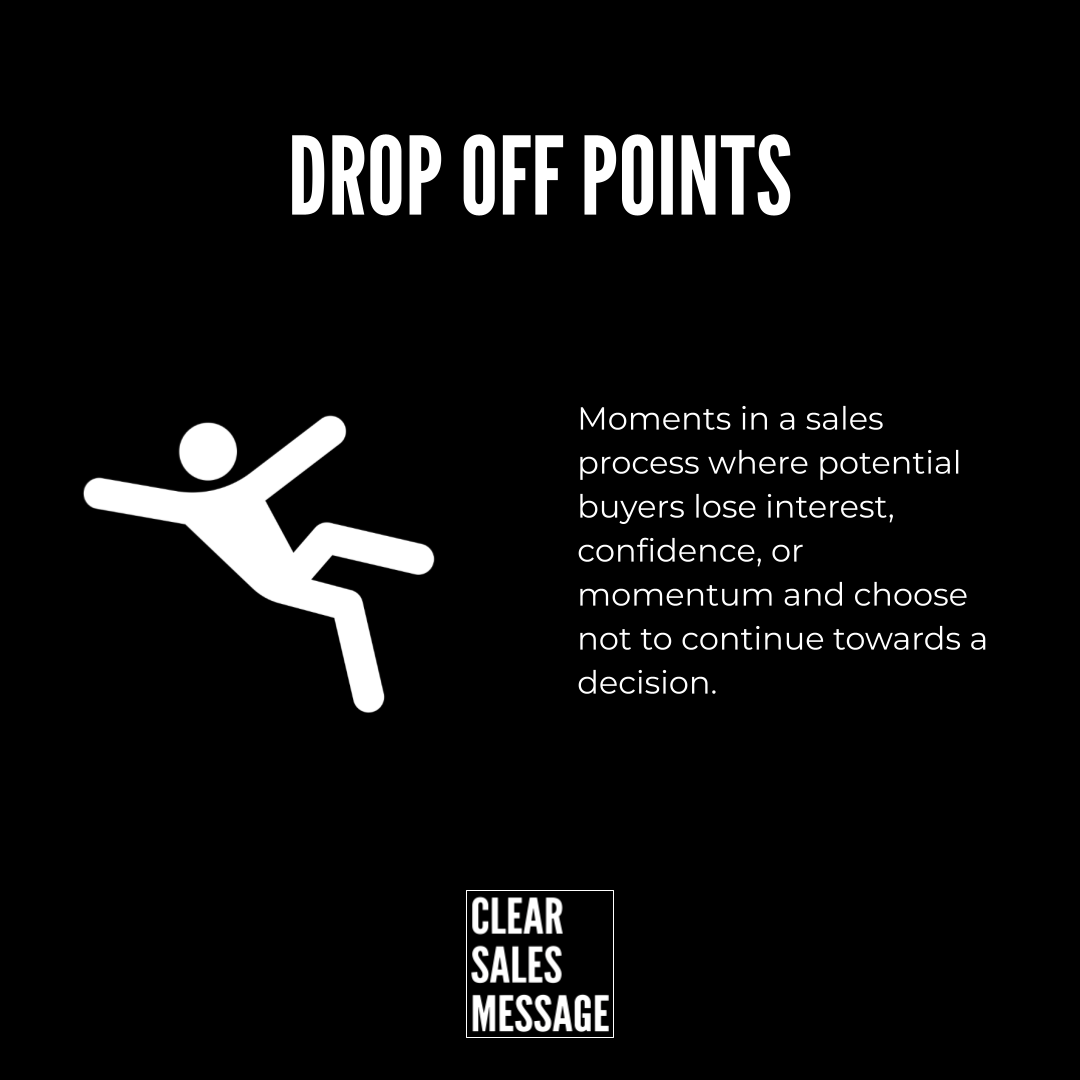
Drop Off Points are moments in a sales process where buyers lose momentum, confidence, or clarity – and decide not to continue. They’re not always obvious. Often they’re small friction moments where progress quietly stops rather than dramatically fails.
This might be a confusing step, an unanswered question, a long delay, or too many decisions at once. However, the common thread is that the effort of moving forward starts to feel greater than the value of doing so. So the buyer pauses – and the pause becomes permanent.
Understanding where this happens explains more about a struggling sales process than almost anything else. Because the problem is rarely a lack of interest. It’s a lack of momentum.
Why Do Drop Off Points Matter?
Every buying process needs the buyer to keep choosing to move forward. Each step asks them to commit a little more – time, attention, trust, money. So when friction rises, progress stops.
Research into conversion consistently shows that reducing friction improves results more than increasing persuasion. In other words, making the next step easier beats making the pitch louder. But most businesses do the opposite – they add more pressure instead of removing the obstacle.
Behavioural research also shows that both effort and uncertainty drive abandonment. Any step that feels hard or unclear is a potential Drop Off Point. As a result, even small improvements to those moments can produce a big lift in overall conversion.
How Can You Use Drop Off Points In Sales?
Start by finding where buyers pause or disappear. Look at your data and your pipeline with fresh eyes – not for what’s working, but for where progress consistently stalls.
Map your funnel steps and find the gaps
Look at each stage of your sales process and check what share of buyers move from one step to the next. For example, if most prospects book a demo but few reach proposal stage, that gap is a Drop Off Point. The step itself may be fine – but something between the two is breaking momentum.
Look at where buyers go quiet
Check your email threads and pipeline for patterns. If buyers regularly stop responding after a certain type of message or meeting, that’s a signal. Treat recurring silence as data – because it usually points to the same unresolved friction, repeated across different deals.
Reduce uncertainty at the exact drop off step
Once you’ve found a Drop Off Point, the fix is usually simple. Clarify what happens next. Answer the common question earlier. Shorten the wait. However, keep the fix targeted – changing too much at once makes it hard to know what worked.
Fix the biggest one first
There will always be more than one Drop Off Point. Trying to fix them all at once wastes effort and muddies results. Therefore, start with the step where the most buyers disappear – one well-targeted fix there will do more than five small tweaks spread across the process.
When Drop Off Point Analysis Works Best
It’s most useful when lead volume looks healthy but conversion feels low. If buyers enter the process but don’t reach the end, the problem is almost always friction – not fit. So that’s where the focus needs to go.
It also helps when sales cycles keep stalling, when buyers go quiet after early interest, or when growth feels inconsistent despite decent activity. In these cases, improving flow tends to produce faster results than driving more traffic in at the top.
When Drop Off Point Thinking Becomes Dangerous
It’s less useful when volume itself is the problem. If very few qualified buyers enter the process, fixing friction won’t drive growth – you need more of the right people first, then optimise the path they take.
It’s also important not to remove all drop off. Some is healthy. Not every buyer should make it through, and a process that filters out poor fits protects delivery quality and saves time. So the goal is to remove unnecessary loss, not eliminate all loss.
Similarly, don’t try to fix every Drop Off Point at once. That approach spreads effort thin and makes it hard to measure what’s working. Fix one thing, see the result, then move to the next.
Common Drop Off Point Mistakes
Treating all drop off as failure
Some drop off is a sign the process is working. Poor fit buyers leaving early saves everyone time. So before you try to fix a Drop Off Point, ask whether the buyers stopping there should have been stopping anyway. The goal is better conversion – not higher conversion at any cost.
Adding more persuasion instead of less friction
When buyers stall, the instinct is often to push harder – more follow-ups, stronger offers, bigger discounts. But most drop off happens because something felt unclear or difficult, not because the buyer needed more convincing. As a result, more pressure rarely fixes the real problem.
Fixing symptoms instead of causes
A buyer going quiet after a demo might look like a follow-up problem. But the real cause might be that pricing was never discussed and uncertainty killed the momentum. So look for the friction behind the symptom – because fixing the root cause will always outperform treating the surface.
Not tracking the data
Drop Off Points only become visible when you measure each step of the process. Many businesses track only the start and the end – leads in, deals closed. Everything in between stays a blind spot. Therefore, start tracking the steps between, and the friction points will start to show themselves.
Drop Off Points – An Example
A SaaS company notices that most prospects book demos but very few move to proposal stage. The team assumes it’s a follow-up problem and sends more emails. Nothing changes.
So they look closer. Prospects leave the demo without any idea of what things cost – no pricing guidance, not even a range. Because of that, they can’t build a case internally, so they stall and go quiet.
The fix is simple. The team starts sharing a rough pricing range during the demo itself, and proposal progression improves quickly. The issue was never interest – it was uncertainty. And uncertainty, left unaddressed, becomes a Drop Off Point every time.
Most companies try to fix outcomes. The stronger move is to fix the moments where outcomes are lost.
See also