

Practical Sales Training™ > How to connect with your buyer > Number Groups

Number Groups
Most people are not great with numbers. Give them a random list of figures and they will forget them almost immediately. But give them a set of numbers with a clear pattern and the brain holds on much longer.
Number Groups are about choosing and arranging numbers so they feel natural together. The rhythm makes them easy to say out loud. The pattern makes them easy to remember. And when buyers can recall your numbers without effort, your offer stays in their mind long after the conversation ends.
It is a small change that can make a real difference to how clearly your offer lands.
What Are Number Groups?
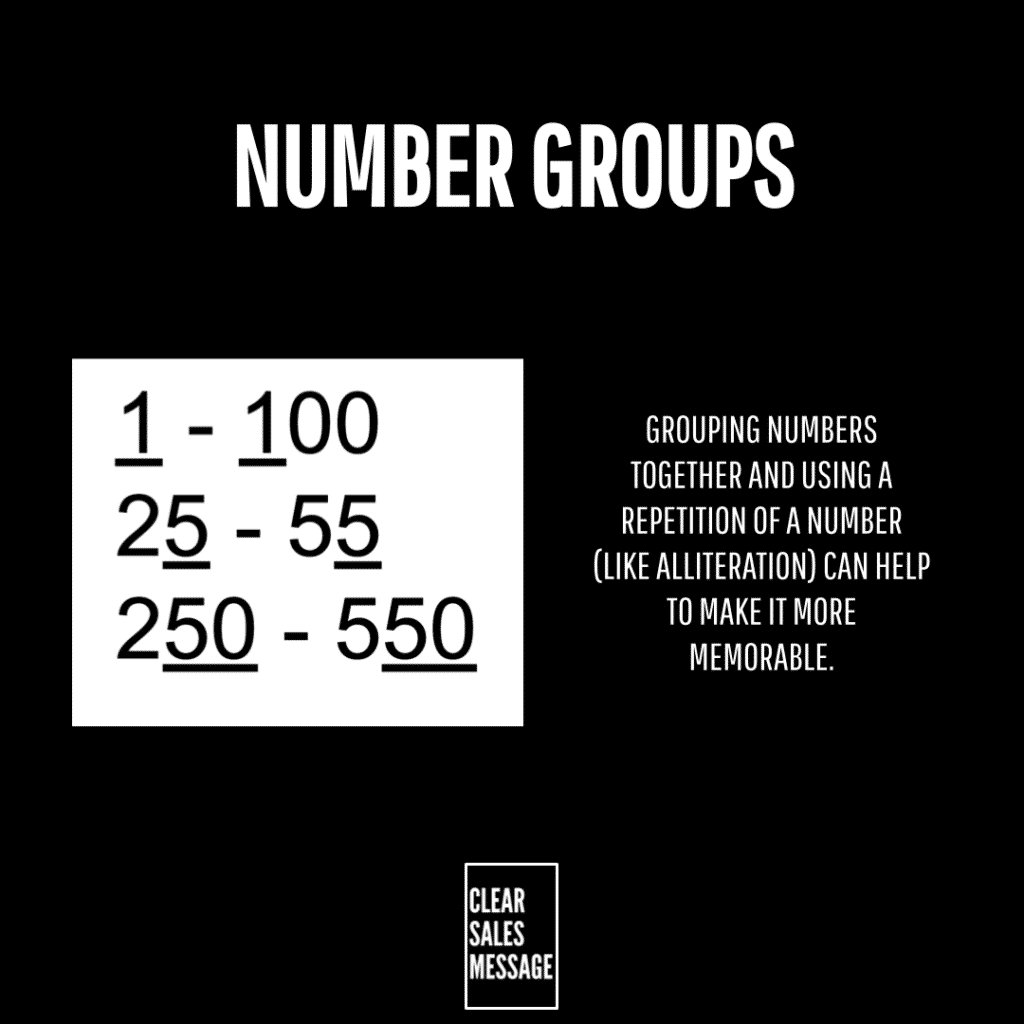
Number Groups are sets of numbers that follow a pattern, a sequence, or a rhythm that makes them easier to recall. Instead of a random list of deliverables or a price pulled from nowhere, you arrange your numbers so they feel connected and intentional.
The idea draws on the same principle as alliteration in language. Just as repeated sounds make words stick, repeated patterns make numbers stick. The brain responds to both in the same way. When something has a rhythm, it is easier to hold in the memory.
Why Do Number Groups Work?
They work because the human brain is wired to notice and store patterns. Random data is hard to hold. But a sequence that follows a logic, even a simple one, is far easier to keep.
When you present the scope of your offering with numbers that group naturally, buyers can repeat them to someone else. That means your offer travels further. A client who can say “they do 3, 6, and 12” to a colleague is far more useful to you than one who vaguely remembers “something like three or four things.”
There is also a clarity benefit. A well-structured number group makes an offer feel considered and deliberate. As a result, buyers perceive more value in something that looks designed rather than thrown together.
How Can You Use Number Groups In Sales?
Structure Your Packages Around a Pattern
If you offer tiered packages, look at whether the numbers involved follow a natural sequence. Doubling, tripling, or stepping up by the same amount each time gives the set a rhythm. For example, a package built around 5, 10, and 15 deliverables is easier to explain and easier to recall than one built around 4, 9, and 17.
Use Number Groups in Proposals and Pitches
When you present a proposal, group your numbers so they flow. Say them out loud before you send. If the figures have a natural rhythm when spoken, they will land better. Because a buyer who can follow your numbers verbally will find it much easier to relay them to a decision-maker who was not in the room.
Apply It to Pricing Too
Pricing that follows a clear pattern feels more transparent. Three tiers at £500, £1,000, and £2,000 feel logical and easy to compare. Three tiers at £490, £975, and £1,840 feel arbitrary and harder to hold in the head. Where it makes sense for your business, consider whether small adjustments to your pricing could create a more memorable set of numbers.
When Number Groups Work Best
They work best when you are presenting packages, tiers, or bundles where multiple numbers appear together. The more numbers a buyer has to process at once, the more a clear pattern helps. So if your offer involves several figures, this is worth applying every time.
They are also useful when buyers need to repeat your offer to others. If a contact has to explain your pricing or scope to a colleague or a board, a number group makes that much easier. Because the pattern does the memory work for them, the message reaches more people in better shape.
When Number Groups Become Dangerous
The danger is in forcing the numbers to fit at the expense of what is right for the business. Changing your price or the scope of your work just to make the numbers match is not always wise. If it distorts your margin or misrepresents your offering, the benefit of a tidy pattern is not worth it.
Also, a pattern that is too neat can feel contrived. Buyers may sense that the numbers were designed to look good rather than reflect genuine value. So use Number Groups to present your offer more clearly, but never let the pattern override the substance.
Common Number Groups Mistakes
Changing the Numbers Just to Make Them Match
A pattern that hurts your margins or forces you to over-deliver is not a smart trade-off. The goal is to present your numbers more clearly, not to build your offer around a sequence. Start with what makes sense for your business and then see whether the numbers can be arranged to flow better.
Using a Pattern Without Meaning
A number group works best when each figure represents something real and valuable. If the pattern is there but the buyer cannot see what they get for each number, the rhythm does not help. So always pair the numbers with clear, simple descriptions of what they mean.
Overcomplicating the Set
Four or five numbers in a group is usually the limit before it becomes hard to follow. Beyond that, the pattern stops helping and starts to overwhelm. Keep it tight. Two or three well-chosen numbers in a clear sequence will always outperform a longer list trying to do too much.
Number Groups – An Example
A gym creates a membership package called “3-6-12.” It includes 3 personal training sessions, 6 group classes, and 12 months of access. The numbers have a clear pattern, a natural rhythm when spoken, and make the package feel structured and worth the price.
A marketing agency takes the same approach and structures a content package as “5 Ads, 10 Emails, 15 Social Posts.” Each number steps up by five. Because the pattern is clean and easy to follow, the buyer can repeat it word for word to a colleague without thinking. That repeatability is exactly what Number Groups are designed to create.
See Also: