Practical Sales Training™ > How To Get Attention > Pavement Projection

Pavement Projection
People look down when they walk. Most advertising assumes they look up. Pavement projection goes where the eye already travels.
It turns the ground into ad space. A light, a graphic, or a projected image lands where your audience is already looking. And because most people have never seen a brand message on the floor, they stop. They look. They remember.
It’s a simple idea. But in a busy street or a crowded venue, simple and unexpected is exactly what cuts through.
What Is Pavement Projection?
Pavement projection is an advertising technique. A business projects light, images, or messages onto the ground outside a store, venue, or busy walkway. Instead of relying on traditional signs, you use light or floor graphics to make your brand stand out.
You might see a logo, a call to action, or a moving image on the ground. A coffee shop might project “Fresh coffee this way” onto the pavement outside. A bar might project happy hour times onto the street at night. A retailer might project its logo and sale dates at the entrance.
The technique also extends to printed floor graphics. Both versions use the same principle. Put your message where people are already looking. Make it impossible to miss.
Why Does Pavement Projection Work?
It works because it interrupts the everyday environment. People aren’t used to seeing messages on the ground. So when something appears there, they notice it fast. The brain picks it up before they’ve decided to pay attention.
There are four reasons it works so well. First, it creates novelty. People stop because it feels unusual. Second, it guides attention physically. A projection can point people toward a door, a product, or an event. Third, it works especially well at night. When other signage fades into the background, light stands out. Fourth, it sparks conversation. People photograph creative projections and share them. So the reach extends well beyond the immediate location.
You can scroll past a social ad. You can’t walk past a floor graphic without seeing it. That’s the core advantage.
How Can You Use Pavement Projection In Sales?
You can use pavement projection to increase foot traffic, build brand awareness, and drive in-the-moment sales decisions. Here’s how it works in practice.
Retail and Hospitality
Project promotions, offers, or menus onto the ground outside your venue. A well-placed projection at the entrance tells a passing buyer what’s inside before they’ve considered stopping. As a result, it turns footfall that would otherwise walk past into actual visits.
Events and Venues
Highlight entry points or sponsor branding in a way that gets noticed. Floor space at events is often unused as an ad medium. So a projection on a busy walkway stands out from the banner and screen clutter everywhere else. It also gives sponsors a channel that’s hard to ignore.
Local Marketing
Use projections in busy city centres where traditional posters blend in. Floor-level messaging is still rare. So it carries a novelty value that wall-based advertising has largely lost. In high-footfall areas, even a simple logo projection can generate significant awareness at low cost.
Campaign Launches
Create buzz with temporary projections tied to a product release or promotion. A time-limited floor projection adds urgency. It also creates a visual event around your launch. People who see it share it on social media. So the reach of a physical activation extends into a digital audience too.
Tips for Success
Keep the message short so it reads at a glance. Use strong contrast so it’s visible in different lighting. Place it where people naturally walk or gather. And if you’re using a projector, test the output in daylight first. Projections can wash out in bright conditions, so check before you commit.
When Pavement Projection Works Best
It works best in high-footfall locations with lots of visual competition. The more cluttered the environment, the more a floor-level message stands out. In a busy shopping street or packed venue, a pavement projection cuts through in a way another poster never could.
It also works well at night. Projected light is far more visible in low light. So an evening venue or late-night retailer gets more impact than a daytime-only business. The novelty factor is also stronger at night. The contrast is sharper and the surroundings are darker.
And it works well for businesses that need to convert passing trade. If your customer has to decide whether to come in right now or walk on, a pavement projection gives them a reason to stop. That moment is where foot traffic turns into a sale.
When Pavement Projection Becomes Dangerous
It becomes a problem when the message is too complex. A pavement projection gets about two seconds of attention. If it requires reading more than a short phrase, most people walk past before they finish. Keep it simple or lose the impact entirely.
It can also create safety issues. A projection that distracts pedestrians or obstructs an entrance can cause real problems. So always check local rules before installing floor graphics or external projections. Some councils require permission. Some locations prohibit it entirely.
And it can look cheap when the quality is poor. A blurry projection or a faded floor graphic undermines the brand impression you’re trying to create. The medium draws attention to itself. So if the quality isn’t there, the attention it generates works against you.
Common Pavement Projection Mistakes
Putting Too Much Text on the Ground
A floor projection is not a poster. People read it while walking, often mid-stride. So the message needs to land in under two seconds. A logo, a price, a short phrase, or a directional arrow all work. A paragraph of copy doesn’t. If you can’t say it in five words or fewer, simplify it first.
Choosing the Wrong Location
A projection in a low-footfall spot generates almost no return. The technique depends on volume. The more people who walk past it, the more impressions it creates. So choose the highest-traffic point available, not just the most convenient one for installation.
Ignoring Daylight Visibility
Projected light works well at night. However, in direct sunlight it can become almost invisible. If your location gets significant daytime foot traffic, a printed floor graphic may work better than a projector. Test the visibility at different times of day before committing to either approach.
Skipping the Permissions Check
Pavement projection on public ground often requires permission from the local council or property owner. In some areas it’s prohibited entirely. So before you invest in equipment or installation, check what’s allowed. A projection that gets shut down on day one is an expensive way to find out you needed a permit.
Pavement Projection – An Example
The image below shows a floor graphic inside a warehouse retail store. A large, colourful promotion covers the floor at the entrance to an aisle. It shows the product, the price, and a directional message pointing to the beverage section. A shopper walks straight over it.
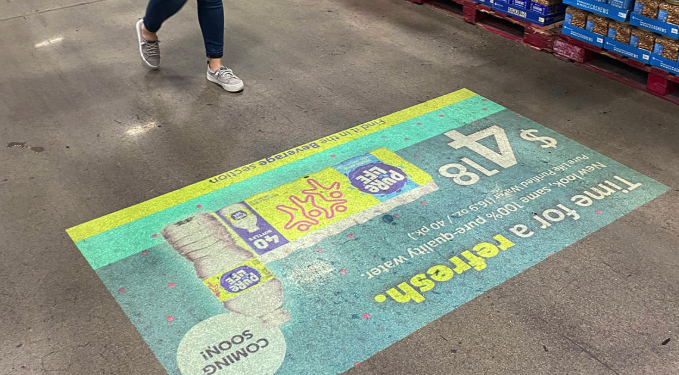
The graphic works because it sits in the path of foot traffic. It uses bold colour and contrast. And it carries a clear message at a glance. The shopper doesn’t have to look for the promotion. They walk into it. As a result, the brand gets an impression from every person who moves through that space. That’s pavement projection doing exactly what it should.
See also