
Practical Sales Training™ > Selling Communication Basics > Positive Feedback Loop

Positive Feedback Loop
Think about how dog training works. The dog sits. It gets a treat. So it sits again. Over time, the behaviour becomes automatic because the reward has made it worth repeating. A Positive Feedback Loop works on the same principle, and it applies just as well to buyers as it does to pets.
When a buyer takes an action and gets a positive outcome, they are more likely to take that action again. That is not a trick. It is just how people are wired. We repeat what gets rewarded. So if you want buyers to come back, spend more, or stay loyal, the question is simple: what are you rewarding them for?
Businesses that build Positive Feedback Loops into their model do not need to chase repeat business. Because the reward structure does the work, buyers come back on their own. They are not just buying a product. They are chasing a feeling they have already had once before.
What Is a Positive Feedback Loop?
A Positive Feedback Loop is a cycle where a rewarded behaviour leads to that behaviour being repeated. The reward does not have to be big. It just has to be consistent enough that the buyer starts to associate the action with the outcome.
The key word is conditioning. Over time, a buyer does not just repeat the behaviour because of the reward. They repeat it because they expect the reward. That expectation is powerful. In fact, even when the reward is absent, people will often still repeat the behaviour in the hope that it will return.
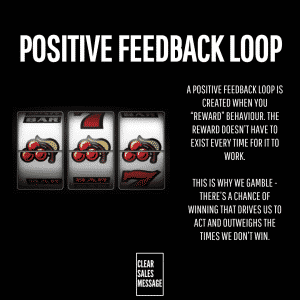
This is why slot machines work. The reward is unpredictable. But because it has come before, people keep pulling the lever. A Positive Feedback Loop in sales does not need to be as manipulative as that. However, understanding the psychology helps you build systems that keep buyers engaged long after the first sale.
Why Does a Positive Feedback Loop Work?
It works because we believe the past predicts the future. If action X led to outcome Y last time, our brains assume it will lead to outcome Y again. That shortcut is deeply rooted. It is not something buyers think about consciously. It just shapes what they do.
There is also an emotional element. When a buyer is rewarded, they feel good. That feeling gets tied to your brand, your product, or your service. So the next time they think about buying, the positive feeling comes with it. Because emotion drives decisions far more than logic does, that association is worth a lot.
Rewarded behaviour also builds habit. Once a buyer has repeated an action enough times, it stops feeling like a choice and starts feeling like a routine. Supermarkets understand this well. Their loyalty schemes are not just about points. They are about making your weekly shop feel like the obvious and natural thing to do, every single time.
Finally, a Positive Feedback Loop reduces the effort of repeat sales. When buyers are conditioned to return, you spend less time and money bringing them back. The loop does the heavy lifting for you. That means better retention, lower costs, and stronger long-term revenue.
How Can You Use a Positive Feedback Loop In Sales?
The goal is to create a clear link between a buyer action and a positive reward. The reward does not have to be financial. It just has to feel good and feel consistent.
Build a Loyalty Scheme
Supermarkets have used this for decades. The more you shop, the more points you earn. The more points you earn, the more rewards you get. Because the reward is tied directly to repeat behaviour, buyers have a reason to keep coming back rather than going elsewhere. You do not need a complex system. Even a simple stamp card creates a loop.
Use Free Gifts and Unexpected Touches
When buyers receive something they did not expect, the positive feeling is stronger than if they had expected it. A small gift, a handwritten note, or a surprise upgrade creates a moment that buyers remember and talk about. Over time, that memory pulls them back. They want to feel that way again.
Reward with Money Off Vouchers
Giving a buyer a voucher at the point of purchase is a direct Positive Feedback Loop. They just spent money with you. Now they have a reason to spend money again. The reward is concrete and immediate, so the link between the action and the outcome is very clear. That clarity makes the loop stronger.
Create Milestones and Progress Markers
People like to feel they are making progress. If your loyalty scheme shows buyers how close they are to the next reward, the loop gets stronger. The sense of being nearly there is a motivator in itself. As a result, buyers spend a little more, visit a little more often, or act a little sooner than they otherwise would have.
Acknowledge and Celebrate Loyalty
Sometimes the reward does not need to be a product or a discount. Recognition matters too. Telling a long-term buyer that you value them, giving them early access to something new, or simply treating them differently from a first-time buyer signals that their loyalty is noticed. Because buyers want to feel important, that signal is a reward in itself.
When a Positive Feedback Loop Works Best
A Positive Feedback Loop works best when the reward is closely tied to the action you want to reinforce. The clearer the link, the faster the conditioning. If a buyer has to work hard to understand how the reward system works, the loop loses its power before it has a chance to form.
It also works best when the reward arrives quickly. Delayed rewards are weaker than immediate ones. So if you can give the buyer something good at the moment of purchase, rather than weeks later, the association between the action and the outcome will be much stronger.
Consistency matters too. A loop that rewards sometimes and not others will still work, but it takes longer to build. When buyers can rely on being rewarded, the behaviour becomes habit faster. That reliability is what turns a one-time buyer into a loyal one.
When a Positive Feedback Loop Becomes Dangerous
The biggest risk is over-reliance on the reward. If buyers only return because of the incentive, removing it will cause them to leave. The loop has conditioned them to respond to the reward, not to your product or service. So if your loyalty scheme ends, so does their loyalty.
There is also a cost risk. Rewards need to be sustainable. A scheme that is too generous may drive repeat visits but at a margin that does not support the business. So design the reward carefully. The value the buyer gets should always cost you less than the value they bring back.
Finally, watch out for buyers who game the system. When a reward scheme is too predictable, some buyers will take the minimum action needed to claim the reward without ever becoming genuinely loyal. Those buyers are not in the loop. They are just harvesting it.
Common Positive Feedback Loop Mistakes
Making the Reward Too Hard to Reach
If buyers need to make twenty purchases before they see any benefit, most will give up before the loop forms. The first reward needs to come early enough that buyers feel the system is worth engaging with. Start small. Give them a reason to believe the loop is real before asking them to commit to it fully.
Rewarding the Wrong Behaviour
Be specific about what you want buyers to do and reward that exact thing. If you reward any engagement without tying it to a purchase or a return visit, you may train buyers to engage in ways that cost you without generating revenue. Because the loop reinforces whatever gets rewarded, make sure you are rewarding the right action.
Forgetting to Remind Buyers the Loop Exists
A loyalty scheme that buyers forget about is not doing any work. Send reminders. Show them how many points they have. Tell them how close they are to the next reward. Because out of sight means out of mind, keeping the loop visible is part of keeping it active.
Stopping the Reward Without a Plan
If you end a scheme suddenly, buyers feel the loss more than they felt the gain. That is loss aversion at work. So if you need to change or close a reward system, do it gradually and give buyers fair warning. A poor exit from a Positive Feedback Loop can undo a lot of the goodwill it built.
Positive Feedback Loop – An Example
A coffee shop introduces a stamp card. Every time a customer buys a coffee, they get a stamp. After ten stamps, the next coffee is free. The customer starts returning not just because the coffee is good, but because they are working towards something. They are three stamps away, then two, then one. That sense of progress keeps pulling them back.
When the free coffee arrives, it feels like a win. The customer associates that good feeling with the shop. So they start a new card and the loop begins again. Over time, this customer is not just a buyer. They are a conditioned, loyal one who thinks of this shop first, every time.
P.S. In this last year, we have helped 25 businesses use a specific Positive Feedback Loop strategy.
See Also