Practical Sales Training™ > How To Convert > Supply Chain Visibility
Supply Chain Visibility
Uncertainty kills sales. When a buyer isn’t sure if something is in stock or when it will arrive, they hesitate. And hesitation is where deals go to die.
Supply chain visibility removes that uncertainty. It shows the buyer what’s happening. It answers the questions they haven’t asked yet. And it turns a vague promise into something visible and real.
Most businesses treat their supply chain as an internal matter. But showing it to buyers is one of the most powerful conversion tools available. Because what buyers can see, they can trust.
What Is Supply Chain Visibility?
Supply chain visibility is the ability to show customers where products are, how they move, and when they will arrive. It’s not just an operational tool. It’s a direct driver of buyer confidence.
When buyers can see progress, they feel more confident to purchase. Instead of wondering whether stock is available or whether delivery will be on time, they get clarity. And clarity makes saying yes easier.
Examples include real-time delivery tracking, “in stock and ready to ship” badges on product pages, clear lead time updates for made-to-order items, and transparent sourcing that shows buyers where products come from. In each case, the visibility does the same job. It replaces doubt with certainty.
Why Does Supply Chain Visibility Work?
It works because uncertainty creates hesitation. When buyers don’t know what’s happening, their brain fills the gap with doubt. Doubt slows decisions. So anything that removes doubt also speeds up the sale.
There are four reasons it drives conversion. First, it reduces risk. Buyers feel reassured when they can see availability and timelines rather than taking your word for it. Second, it builds trust. Proactive updates signal that your business is organised and reliable. Third, it creates urgency. Showing limited stock or an upcoming deadline gives buyers a reason to act now. Fourth, it supports your promises. When buyers see real evidence of supply chain control, claims about speed or quality become far more believable.
So visibility isn’t just good operations. It’s good sales.
How Can You Use Supply Chain Visibility In Sales?
You can use supply chain visibility directly in your sales and marketing to reduce friction and increase conversion. Here’s how it works in practice.
E-commerce
Add real-time stock indicators and delivery tracking to reduce cart abandonment. When a buyer sees “only 3 left” or “order by 2pm for next-day delivery,” they have a clear reason to act now. The information is specific and time-sensitive. So it converts browsers into buyers at the exact moment they’re deciding.
B2B Sales
Share dashboards or reports that prove you can deliver on time and at scale. In B2B, buyers often need to justify their decision to others. A live view of your capacity, lead times, or fulfilment history gives them the evidence they need to make the case internally. As a result, the sale moves faster and with less back-and-forth.
Customer Onboarding
Give new clients visibility into order and project status from day one. The early stages of a relationship are when trust is most fragile. Regular, clear updates on what’s happening reduce anxiety fast. That confidence makes clients more likely to stay, spend more, and refer others.
Sustainability Messaging
Use transparent supply chain data to prove ethical or eco-friendly sourcing. Claims without evidence are easy to dismiss. But when you show the actual supply chain rather than just describing it, the claim carries real weight. That’s especially powerful in food, fashion, and consumer goods.
Proposals and Pitches
Include supply chain evidence in your proposals. Case studies showing on-time delivery rates, supplier certifications, or live tracking tools tell the buyer you’ve done this before. Because most competitors won’t include this level of detail, it makes you the more credible and lower-risk choice.
When Supply Chain Visibility Works Best
It works best when the buyer’s concern is reliability rather than price. If they’re asking “can you actually deliver?” rather than “how much does it cost?”, visibility is the answer. It turns an abstract promise into a concrete fact. And concrete beats abstract every time in sales.
It also works well in sectors where quality and ethics matter to the buying decision. Food, fashion, healthcare, and manufacturing all attract buyers who want to know where things come from. In these sectors, visibility isn’t just reassuring. It’s a genuine point of difference from competitors who can’t or won’t show the same.
Similarly, it’s powerful at moments of risk. A new supplier, a large first order, or a tight deadline are all situations where buyers need extra reassurance. Visible evidence at those moments reduces the risk of choosing you. As a result, the decision gets easier and faster.
When Supply Chain Visibility Becomes Dangerous
It becomes a problem when the visibility reveals something you’d rather the buyer didn’t see. A live tracker is powerful when things are on track. But when there’s a delay, it broadcasts the problem in real time. So only use visible supply chain tools when your operations can support them consistently.
It can also backfire when the information is too complex. A detailed dashboard might reassure a supply chain manager. However, it may confuse a buyer who just wants to know when their order arrives. Match the level of detail to what your buyer actually needs. Simpler is almost always better.
And it can create expectations you can’t always meet. If you show a frictionless, fully tracked experience during the sales process, buyers will expect that standard every time. So make sure your operations can deliver it reliably before you make it part of your proposition.
Common Supply Chain Visibility Mistakes
Treating It as Internal Rather Than Commercial
Most businesses see supply chain data as an operational tool, not a sales one. But the information that reassures your logistics team is often exactly what your buyer needs to feel confident. Look at what you already track internally. Then ask whether sharing it would help a buyer say yes faster.
Showing Visibility Without Context
A tracking number or a stock count means nothing without context. Tell the buyer what it means for them. “Your order left our warehouse this morning and will arrive by Thursday” is useful. A raw tracking code they have to work out themselves is not. Visibility needs to translate directly into confidence, not extra effort.
Only Using It After the Sale
Most businesses share supply chain information post-purchase. But visibility is just as powerful before the sale. Showing a buyer your delivery track record or your sourcing credentials during the pitch can be the detail that tips a hesitant buyer over the line. So don’t wait until they’ve already said yes.
Making Claims Without Evidence
Saying “we always deliver on time” is easy. Every competitor says the same thing. However, showing a fulfilment rate, a supplier audit, or a live order tracker is hard to fake and hard to ignore. Back every supply chain claim with something visible and specific. Because the evidence is what converts, not the claim itself.
Supply Chain Visibility – An Example
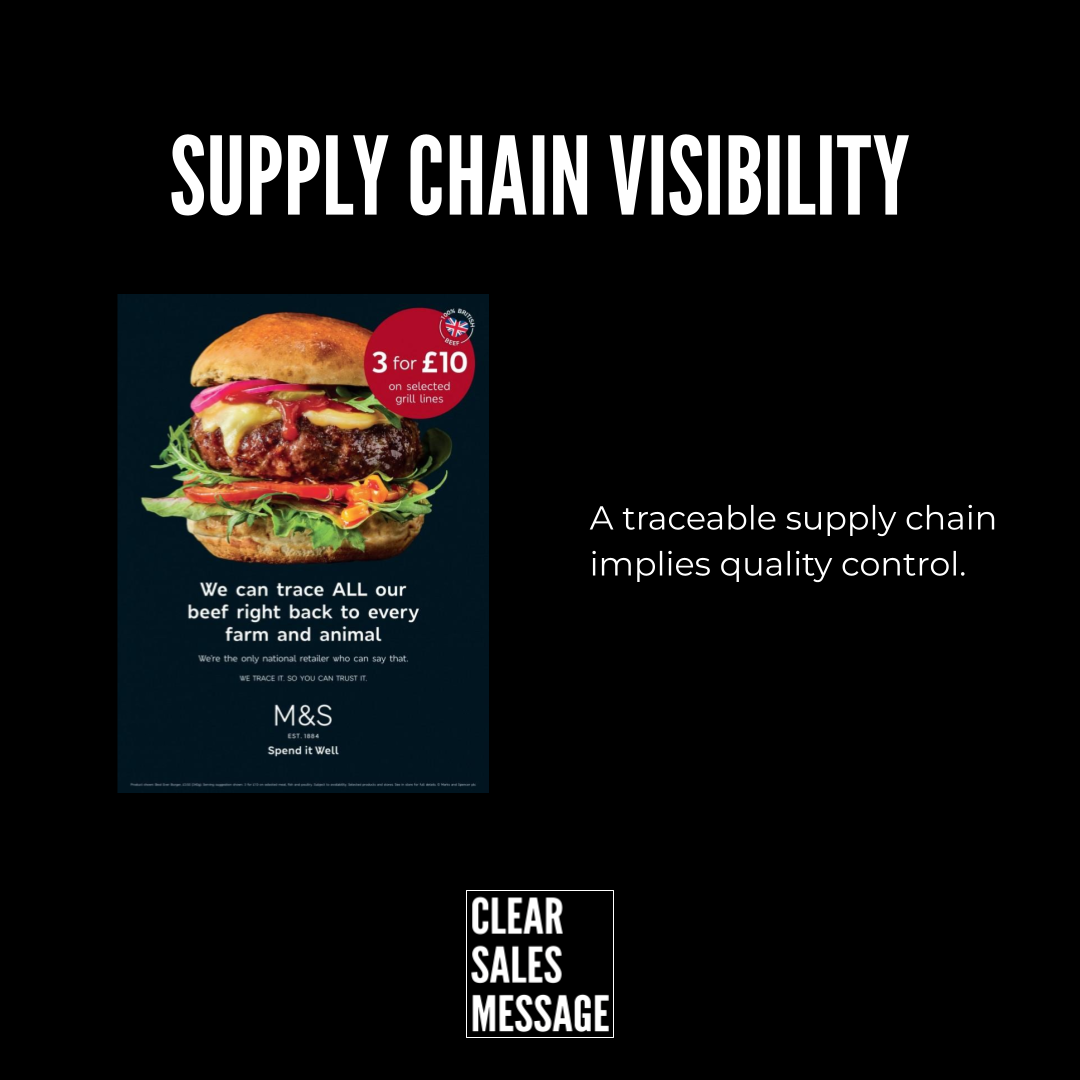
Marks and Spencer use supply chain visibility as a core part of their brand message. Their advert states: “We can trace ALL our beef right back to every farm and animal.” Then comes the line that does the real work: “We trace it. So you can trust it.”

That’s supply chain visibility used as a sales message. It doesn’t just describe a process. It turns the process into a promise. The promise is specific enough to be credible and distinct enough to stand out. As a result, a buyer who cares about where their food comes from has a clear reason to choose M&S over any competitor who can’t say the same.
See also
- 180+ ways to improve conversion
- 100+ ways to differentiate
- The Responsibly Sourced Effect
- The Certificate Effect