Practical Sales Training™ > How To Convert > The Smarter Spend Test

The Smarter Spend Test
Most businesses don’t review their spending. They renew what they had last year, add a few new things, and carry on. But because money is finite, every pound you spend in one place is a pound you can’t spend somewhere else. That’s the opportunity cost that most budgets never account for.
The Smarter Spend Test forces that conversation. Instead of asking “what will this cost?”, you ask “what else could we do with the same money?” It’s a small shift in framing. But it changes how you think about every line in your budget.
Used well, it’s one of the most practical tools for improving ROI without spending more. In fact, most businesses that apply it find they already have enough budget. They’re just not spending it in the right places.
What Is the Smarter Spend Test?
The Smarter Spend Test is a simple way to evaluate whether your marketing or business budget is working effectively. The question at the heart of it is: “Where else could you spend the same money to get a better result?”
By asking this, you compare the real return on your current spend against potential alternatives. As a result, you can identify waste, improve ROI, and make smarter decisions about where to invest your resources.
It’s not a complicated process. However, it does require honesty about what your current spend is actually delivering. That’s where most businesses stall. They assume existing activity is working because it’s familiar, not because they’ve measured it.
Why Does the Smarter Spend Test Work?
It works because it reframes spending as a choice rather than a commitment. Many businesses continue to spend in the same channels simply because they always have. The Smarter Spend Test breaks that habit by asking whether a better use exists for the same budget.
It also surfaces opportunity cost. Every pound you put into trade shows, for example, is a pound you don’t put into content, training, or digital ads. Most budgets never ask that question. So the money flows to whatever someone approved last year, instead of wherever it would work hardest now.
There’s also a clarity effect. When you compare your current spend against a specific alternative, the ROI of each becomes visible. Because the comparison is concrete rather than abstract, you can make a clear decision far more easily.
How Can You Use the Smarter Spend Test In Sales?
You can apply the Smarter Spend Test across your business to improve efficiency and ROI. Here’s how it works in practice across different areas.
Marketing Campaigns
Compare different channels side by side: social, SEO, email, events, print. For each one, ask what the same budget would generate elsewhere. For example, instead of spending £5,000 a month on trade shows, could the same £5,000 in targeted digital ads generate more leads? When you ask the question directly, the answer is often surprising.
Sales Investment
Test whether training, tools, or new hires deliver a stronger return than your current sales spend. Instead of putting £10,000 into a generic brand awareness campaign, could the same £10,000 in sales training directly increase your conversion rate? Because conversion improvements compound over time, the long-term return often far exceeds awareness spend.
Operations and Technology
Ask whether technology or automation could achieve better outcomes than manual processes. Instead of spending £2,000 on print flyers, could you invest £2,000 in video content that works online indefinitely? The flyer gets thrown away. The video keeps generating views. So the value compounds rather than expires.
Budget Planning
Use the test before you renew any contract or commit to new spend. Make it a standing question in every budget review: “Is this still the best use of this money?” Because without that question, budgets default to habit rather than evidence. The test keeps the decision active rather than automatic.
Using It As a Sales Tool
You can also use the Smarter Spend Test when selling to buyers. Show them what they currently spend across separate tools or suppliers, then compare it against what they’d spend with you. When you lay the numbers out side by side, the case makes itself. As a result, the buyer can see the decision clearly without you having to push.
When the Smarter Spend Test Works Best
It works best at budget review time, when spending decisions are still open. That’s the moment when the comparison carries the most influence. However, it’s also worth running mid-year when you’re tracking results, because that’s when the data to make the comparison actually exists.
It also works well when a business is growing and spending is increasing. More budget means more opportunity cost. So the test becomes more valuable as the numbers get larger. A £500 decision is low stakes. A £50,000 decision with no alternative comparison is a much bigger risk.
Similarly, it’s powerful when you use it with buyers who are stuck in a familiar pattern. Because they’ve always used the same supplier or channel, they’ve never questioned whether it’s still the best option. The test gives them a structured reason to look again.
When the Smarter Spend Test Becomes Dangerous
It becomes a problem when you use it to justify cutting rather than reallocating. The goal is to spend smarter, not spend less. When you treat the test as a cost-cutting tool instead of a value-maximising one, you often cut activity that was working and replace it with nothing. As a result, growth stalls rather than accelerates.
It can also mislead when the comparison isn’t fair. Comparing a mature, optimised channel against a new untested one will almost always favour the familiar. So when you run the test, compare like for like as much as possible and factor in the time a new channel needs to bed in.
And it can paralyse decisions when you apply it too broadly at once. Questioning every budget line simultaneously creates confusion rather than clarity. Instead, apply the test to your largest spend items first, because that’s where you’re most likely to find the biggest gains.
Common Smarter Spend Test Mistakes
Never Measuring Current Return
You can’t compare alternatives if you don’t know what your current spend is actually delivering. So before you run the test, establish a baseline. What are you getting from each channel or activity right now? Without that number, you’re comparing guesses rather than making a real decision.
Comparing Cost Without Comparing Value
The test isn’t about finding the cheapest option. It’s about finding the best return. So when you compare alternatives, focus on what each delivers, not just what each costs. A cheaper option that generates half the leads isn’t a smarter spend. It’s a worse one.
Only Running It Once
Markets change, channels mature, and buyer behaviour shifts. So a comparison that was accurate 18 months ago may no longer reflect reality. Run the Smarter Spend Test regularly, not just when something feels wrong. Because the best time to find a better use for your budget is before your current activity starts to underperform.
Not Presenting It Visually
When you use the test as a sales tool, a clear visual comparison does far more work than a verbal argument. A simple table showing what a buyer currently spends versus what they’d spend with you is immediately compelling. In fact, when you lay the numbers out clearly, buyers often reach the conclusion themselves before you’ve said a word.
The Smarter Spend Test – An Example
HighLevel, a marketing software platform, uses the Smarter Spend Test as a core part of their sales message. They show potential customers exactly what they currently spend across separate tools: CRM, sales funnels, email marketing, SMS, booking software, and more. Those tools from other providers add up to over £1,600 a month. HighLevel replaces all of them for £97 a month.
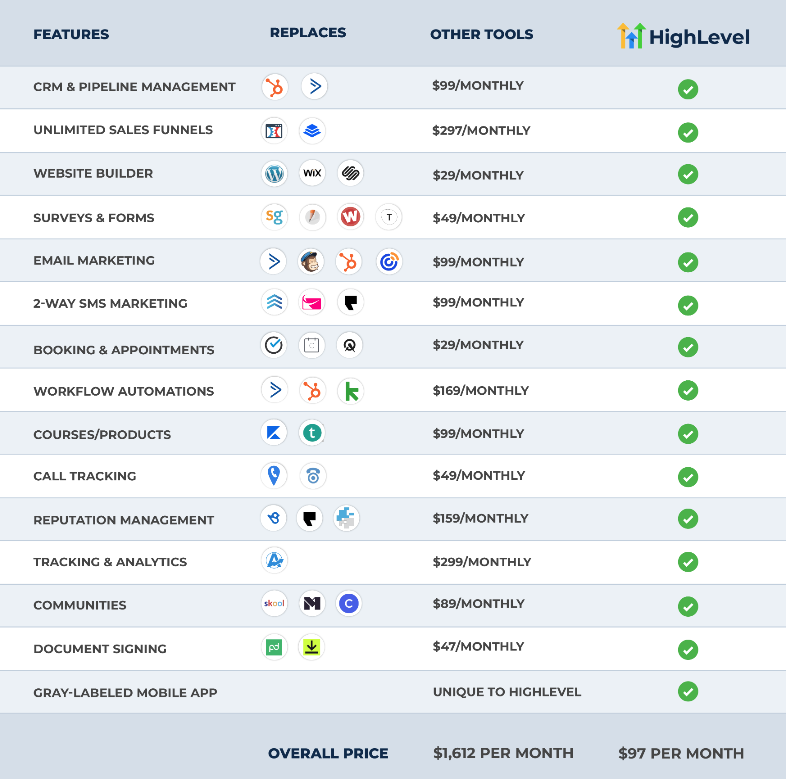
The comparison doesn’t require a hard sell. Because the numbers speak for themselves, the buyer can see the decision clearly. That’s the Smarter Spend Test working at its best: not as an argument, but as a mirror that shows the buyer exactly what their current choices are costing them.
See also