Practical Sales Training™ > How People Work > The Won’t Happen To Me Effect
The Won’t Happen To Me Effect
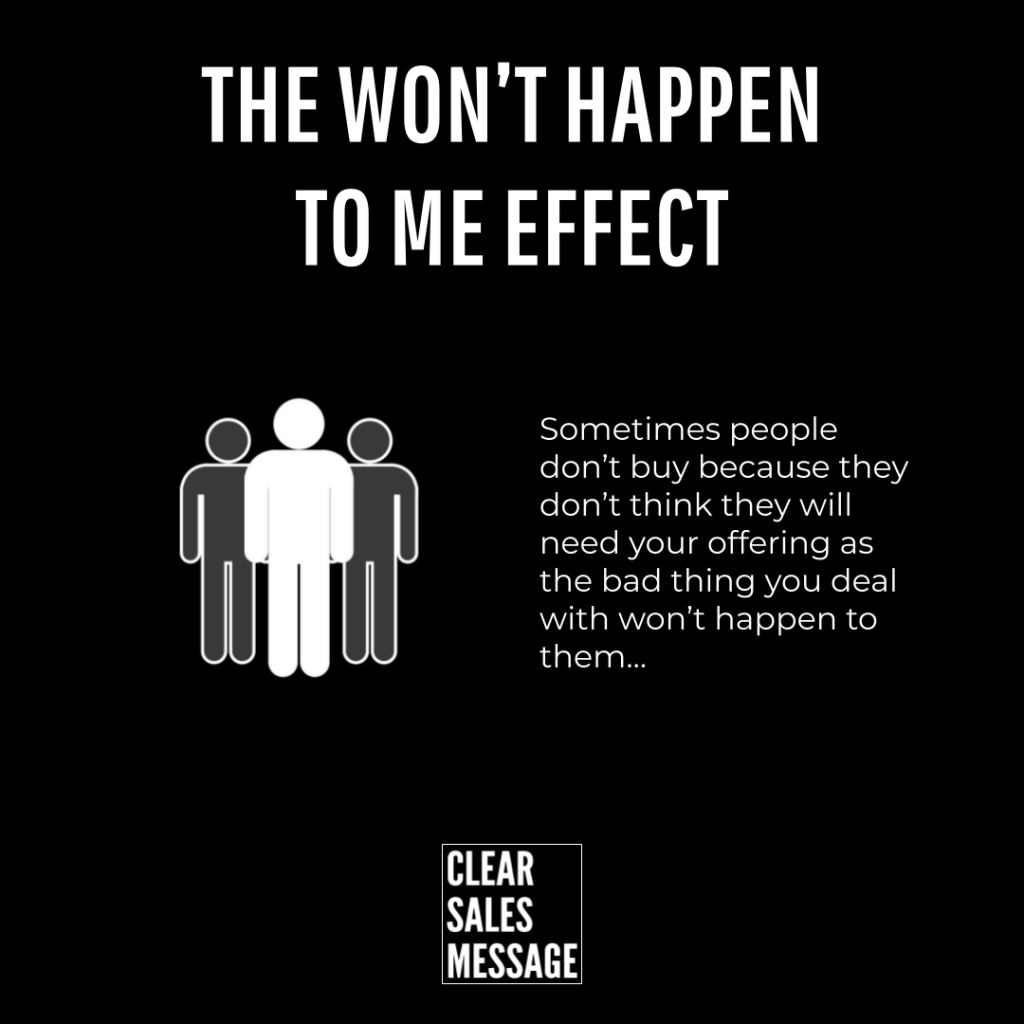
Some buyers won’t act because they don’t believe the risk applies to them.
So they take their chances, happy to sit with the odds as they see them.
That’s the won’t happen to me effect. And it quietly kills deals.
Why Does It Work
It’s understandable. Most people assume bad things happen to someone else.
But as the seller, your job is different.
So you need to surface the hidden choices and hidden costs that inaction creates.
Once those become visible, the risk stops feeling abstract.
How Can You Use It
Reframe To Preparedness
Reframe the conversation around preparedness, not fear.
Because scaring someone into a purchase rarely works. But people respect preparation.
So talk about readiness. Not disaster.
Remind Them Of The Consequences
Remind the buyer of the consequences of staying unprepared.
This is a hidden choice they’re already making, whether they realise it or not.
So make that choice visible. Let them decide with their eyes open.
Compare Using Equivalence
Compare the purchase to other preparedness spending, using equivalence.
Because most buyers already insure things they value.
So show them this is the same instinct, just pointed somewhere new.
Calculate The Invisible Costs
Calculate the invisible costs of doing nothing.
A quiet cost is still a cost, even if nobody’s written it down yet.
So put a number on the risk. Numbers are harder to ignore than warnings.
Use Examples Of People Like Them
Use examples of people like them who bought, and why.
Because a peer’s decision carries more weight than any argument you can make.
So tell a real story about someone in their position who chose to act.
When It Works Best
This works best when the risk is real but invisible, since that’s exactly where inaction hides.
Security, insurance and prevention-based offers all fit.
So use it whenever a buyer assumes the bad outcome won’t be theirs.
When It Becomes Dangerous
It becomes dangerous when it tips into fear-mongering.
Because exaggerating a risk to force a decision damages trust fast, even if it closes the deal today.
So stick to real consequences. Never invent a threat that isn’t there.
Common Mistakes
Leading With Scare Tactics
Leading with scare tactics is the most common mistake I see.
Because fear without substance just feels like pressure, not help.
So ground every warning in a real consequence, not a vague threat.
Staying Vague About The Cost
Staying vague about the cost is the second mistake.
If the buyer can’t picture the number, the risk stays abstract, and abstract risks get ignored.
So calculate something concrete. Even a rough figure beats no figure at all.
The Won’t Happen To Me Effect – An Example
The Cybersecurity Objection
An IT company offers cybersecurity services to small businesses. A prospect says:
“We don’t really need cybersecurity. No one’s going to hack a small business like ours.”
The salesperson reframes the conversation:
- Preparedness: “Cybercrime is often random. Like locking your car door, you don’t wait until you’re robbed to take action.”
- Consequences: “A single ransomware attack could lock your files for days and cost thousands in lost revenue.”
- Equivalence: “You already pay for insurance on your office, right? Cybersecurity is like insurance for your data.”
- Invisible Costs: “Even one day of downtime could cost you more than a year of our service.”
- Examples: “Several businesses like yours signed up after their competitors were hit. They realised prevention is cheaper than disaster recovery.”
By reframing the risk, the buyer begins to see that the cost of inaction outweighs the perceived savings.
See Also
- The Insurance Effect
- One Step Ahead
- 50+ ways that people work & make decisions
- 100+ ways to get your buyer to take action