Practical Sales Training™ > Selling Communication Basics > Typoglycemia

Typoglycemia
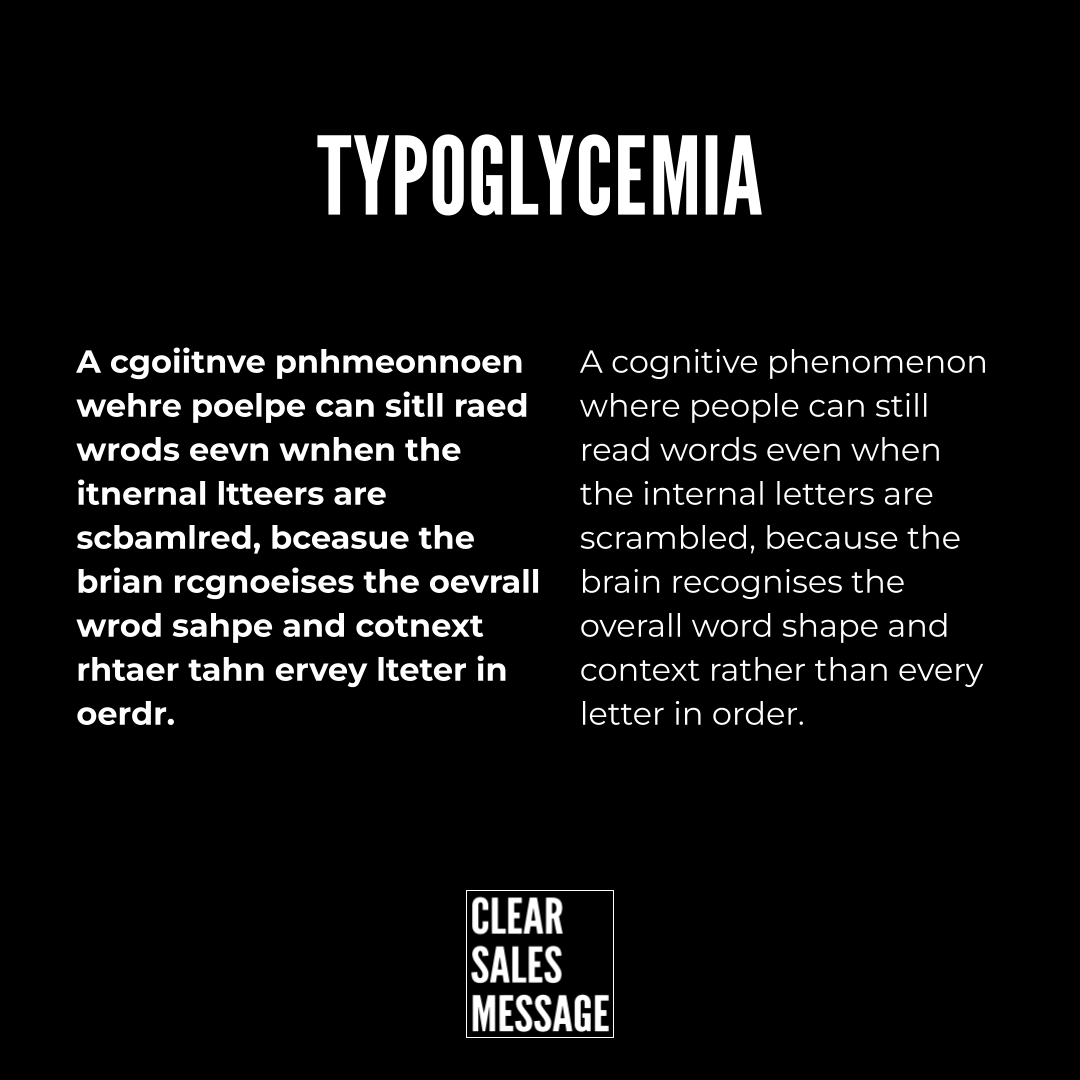
Try reading this: Aoccdrnig to rseaecrh, the human brian can raed wrods even when the ltteers are not in the rghit oerdr.
Most people read that without much effort. The letters are scrambled – but the meaning comes through. That’s Typoglycemia. And it reveals something important about how buyers read your messages.
People don’t read word by word. They predict. They scan. Gaps get filled in automatically. So if your writing is vague, complex, or easy to skim past the wrong way – they will. And they won’t always notice they got it wrong.
What Is Typoglycemia?
Typoglycemia is a cognitive effect where people can still read words even when the internal letters are scrambled. As long as the first and last letters stay in the right place, the brain can usually work out what the word is.
This happens because the brain doesn’t read every letter one by one. Instead, it recognises the overall shape of the word and the surrounding context. That’s what lets us read fast – but it also means we don’t always read accurately.
People often read meaning imperfectly. They see what they expect to see. In sales writing, that gap between what you wrote and what the buyer understood is where messages break down.
Why Does Typoglycemia Matter In Sales?
Research into reading behaviour shows that the brain doesn’t process every letter of a word one at a time. Instead, readers recognise the overall shape of words and use context to fill in the rest – which is why comprehension holds even when letters are rearranged.
Source: Cambridge University Language Research
In practice, this means your buyers are scanning your emails, proposals, and web pages – not reading them carefully. They’re predicting meaning from familiar shapes and patterns. Complex words, long sentences, and vague phrasing all create more room for the brain to misread, misinterpret, or skip past something important.
As a result, clarity isn’t just a style choice. It’s a way of reducing the gap between what you meant and what the buyer understood. Because in sales, that gap costs deals.
How Can You Use Typoglycemia In Sales Communication?
The lesson from Typoglycemia is simple: write for a brain that’s predicting, not analysing. The clearer and more familiar your words, the more accurately your message lands.
Keep words short and familiar
Short, common words are easier for the brain to recognise at speed. Complex or unusual words slow the reader down – and create more room for misreading. So wherever you can swap a long word for a short one without losing meaning, do it. For example, “use” instead of “utilise”, “help” instead of “facilitate”, “show” instead of “demonstrate”.
Break ideas into short sentences
Long sentences force the brain to hold more in working memory before it can make sense of the whole. That increases the risk of misreading – and the longer the sentence, the higher that risk gets. Short sentences reduce it. Each one should carry one idea, because when the structure is simple, the meaning is harder to miss.
Use familiar phrases over clever ones
Buyers scan quickly – especially online. Familiar language lets them recognise meaning straight away. However, novel or unusual phrasing forces them to slow down and work it out. That extra effort increases the chance they’ll skim past the wrong meaning or lose the thread entirely. So reach for clear over clever, every time.
Proofread from the reader’s perspective
Because the brain fills in gaps automatically, writers often miss their own mistakes. You wrote it, so your brain already knows what it’s supposed to say – and it predicts the correct version even when the page says something different. Therefore, read your copy slowly, out loud, or after a gap. Better still, ask someone else to read it. Fresh eyes catch what familiar ones skip.
When Typoglycemia Matters Most
It matters most when the stakes of being misunderstood are high. Proposals, pricing pages, onboarding emails, and key sales messages all carry real risk if the buyer reads them wrong – even slightly. So these are the pieces worth making as clear and simple as possible.
It’s also worth thinking about when buyers are busy or distracted. A hurried reader relies even more heavily on prediction and pattern recognition. As a result, complex writing in a fast environment is a recipe for being misread – or not read at all.
When Typoglycemia Becomes Dangerous
The risk is highest when your message contains something easy to misread as something else – a price, a deadline, or a key condition. If the surrounding language is vague or complex, the buyer’s brain fills in what it expects. And what it expects may not be what you meant.
Jargon carries the same risk. Buyers who don’t use your terminology regularly may read a familiar-looking word and assume they understand it – when in fact they’ve mapped it onto a different meaning entirely. So where precision matters, plain language protects you.
It’s also a reminder that proofreading your own work is unreliable. Your brain already knows the intended meaning, so it will predict the correct version even when the text is wrong. Time away from the copy – or a second reader – is the only reliable fix.
Common Typoglycemia Mistakes
Assuming buyers read carefully
Most don’t. They scan, predict, and move on. So if your message only makes sense when read slowly and carefully, most buyers will miss the point. Write for the fast read first. If the meaning survives a skim, it’ll land even better when someone takes their time.
Using long or unusual words to sound more credible
Complex language doesn’t signal expertise to a scanning brain – it signals effort. And effort is a reason to stop reading. In fact, research into cognitive fluency shows that ideas written in simpler language are more likely to be trusted. Plain writing isn’t dumbing down. It’s making the message easier to believe.
Proofreading your own copy straight after writing it
This is when the Typoglycemia effect is strongest. Your brain knows what you meant, so it reads what it expects – not what’s there. As a result, errors survive that a fresh reader would catch instantly. Step away, read it later, or read it out loud. All three make mistakes visible in a way that immediate review rarely does.
Hiding key information in complex sentences
If your most important point sits in the middle of a long sentence full of clauses, most readers will miss it. Important information needs short, clear sentences of its own. Because the brain is more likely to register a standalone idea than one buried in structure it has to work to decode.
Typoglycemia – An Example
A sales email reads: “Our platform facilitates the optimisation of your pipeline management processes through automated workflow integrations.”
The buyer scans it. Their brain recognises familiar shapes – platform, pipeline, automated. But the overall meaning is blurry, so they predict something generic and move on.
Now compare it to: “Our platform shows you exactly which deals need attention – and chases the rest automatically.”
Short words. Simple structure. One idea per sentence. The brain doesn’t have to predict – the meaning is right there. And because it’s clear, it sticks.
Typoglycemia doesn’t mean buyers are lazy readers. It means they’re fast ones. So the job of good sales writing is to make the right meaning the easiest one to land on – every time.
See also
- 25+ Selling communication basics
- 50+ ways that people work & make decisions
- The Stroop Effect
- The F Pattern