

Practical Sales Training™ > How People Work > The F Pattern
The F Pattern
Nobody reads a page top to bottom, word by word. Not really. Their eyes jump around instead.
The F Pattern explains how. And once you understand it, you can put your key points exactly where attention naturally lands.
What Is It
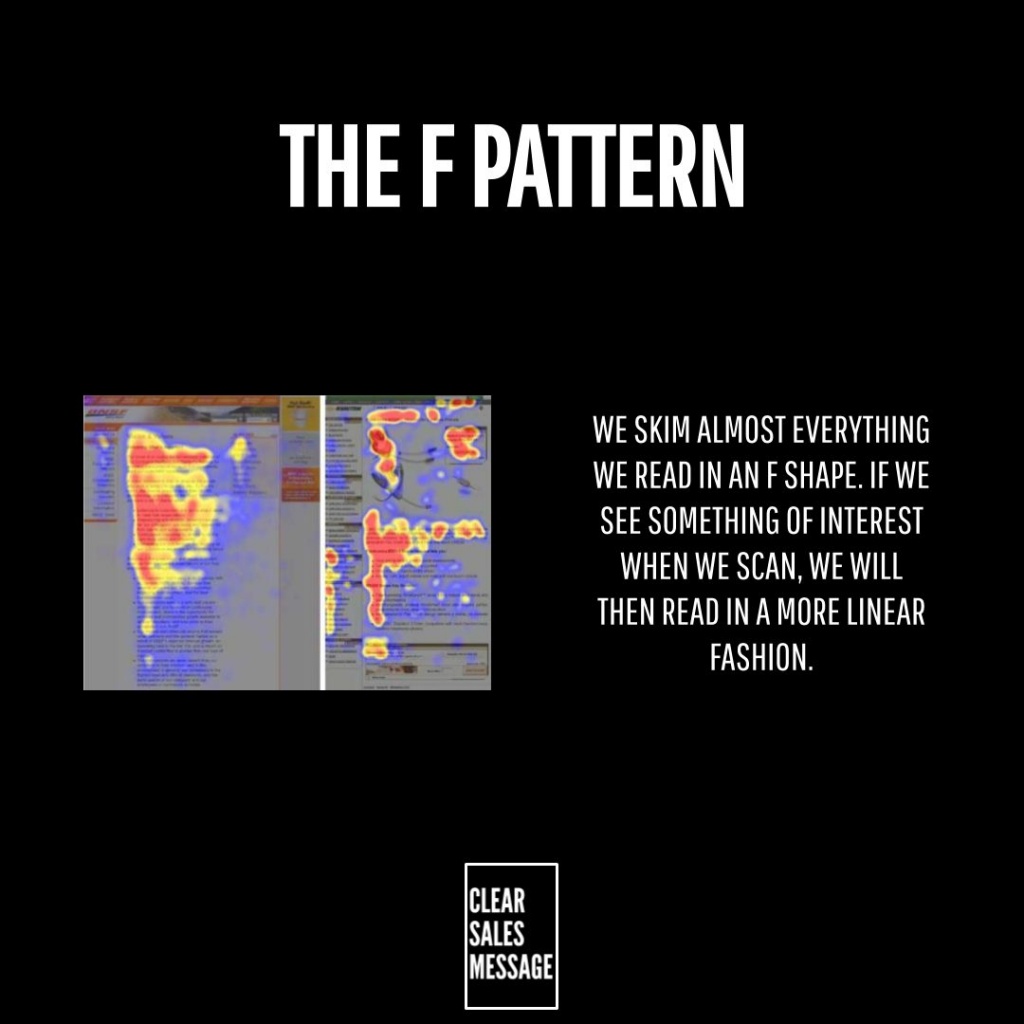
When we read something, especially on a screen, we scan in an F shape. We read the top line fully. Then we skim down the left edge, only stopping when something catches our eye.
Why Does It Work
This is just how humans behave when reading. It’s not a trick. It’s a pattern baked into how we process information on a page.
So it makes sense to work with it, not against it. Once you know where eyes naturally go, you can put your most important points there instead of burying them.
How Can You Use It
Space out your text by clustering it into short sections. Then try staggering
the text
(as well as using bold highlighting)
can help to keep
attention 🙂
See what happened there? Your eye followed the stagger without even trying to. That’s the F Pattern doing its job.
When It Works Best
This works best on long pages, where most readers won’t make it to the bottom anyway. Put your strongest point early, since that’s where attention is highest.
It’s also useful in emails and landing pages, where a reader decides in seconds whether to keep going or move on.
When It Becomes Dangerous
This backfires if you rely on formatting instead of substance. A staggered layout won’t save a weak point. It just makes a weak point easier to skim past.
It also fails if you overuse the trick. Stagger every paragraph, and nothing stands out anymore, since everything looks the same.
Common Mistakes
Burying The Key Point Halfway Down
If your most important line sits in the middle of a dense paragraph, most readers will miss it completely. Move it up, or give it its own space.
Writing Dense Blocks With No Breaks
A wall of text gives the eye nothing to land on. Break it up, so there’s something worth stopping for as the reader scans down.
The F Pattern – An Example
Say you’re writing a landing page for a new service. Instead of one long paragraph explaining everything, you break it into short lines with your strongest claim first.
You bold the one phrase that matters most, right where the eye naturally lands on the way down the page. A reader skimming in an F shape still catches it, even if they read almost nothing else.
That’s the whole point. You’re not fighting how people read. You’re writing for it.
See Also
- The Inverted Pyramid Effect
- 50+ ways that people work & make decisions
- 140+ ways to be easier to buy from