
Practical Sales Training™ > How To Lose The Sale > Unrealistic Discounts

Unrealistic Discounts
What Is It
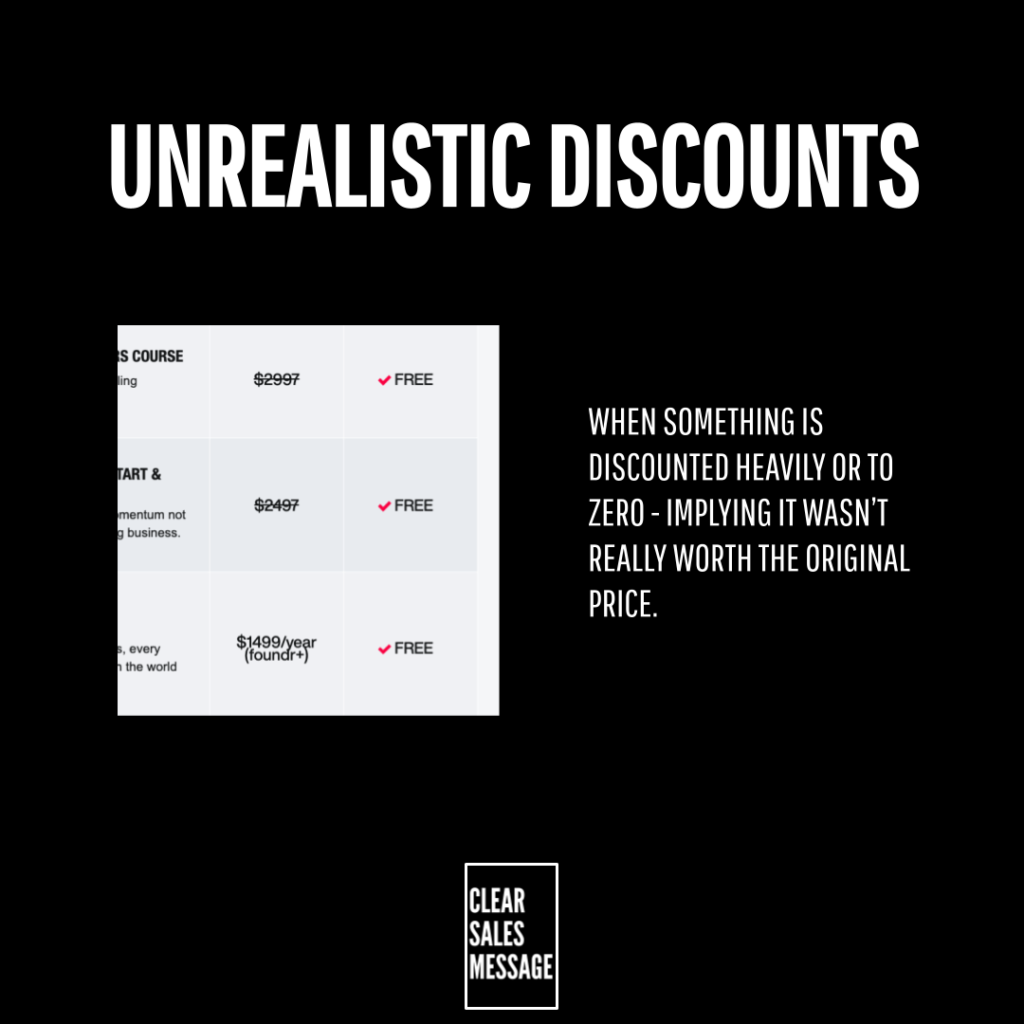
When you’re offered a discount that’s usually a very high price, but suddenly it’s very low or free, alarm bells start to ring.
So the deal doesn’t feel exciting. It feels suspicious.
That instinct is usually right.
Why Does It Work
This is because the heavily discounted thing has probably never sold for that price. It’s merely the estimation of its value.
And we know this. We aren’t that naive. Well, most of us aren’t.
The value of the “free” bonuses is often 20 times more than the price you’re paying. So how is this possible?
Surely it’s better to sell something for £2497, rather than give it away for free?
The maths simply doesn’t add up. So the buyer’s brain notices, even if they can’t say exactly why.
How Can You Use It
If you want to make buyers suspicious and unsure about buying from you, try this. Price everything at £2497, then discount it back to £25 or free.
It works like a charm every time.
When It Works Best
This never really works in your favour. There’s no version of an obviously fake discount that builds genuine trust.
The closest thing to an exception is a small discount so believable that nobody stops to question it.
When It Becomes Dangerous
It’s dangerous the moment a buyer notices the maths doesn’t add up. That’s usually within seconds.
It gets worse the more often it happens. A pattern of inflated prices trains buyers to distrust every future offer too.
It also damages more than the one sale. Buyers talk about being misled far more than they talk about a fair price.
Common Mistakes
Inventing a fake original price
Inventing a fake original price to make the discount look bigger is the fastest way to trigger scepticism.
Stacking wildly inflated bonus values
Stacking “bonuses” with wildly inflated values makes the whole offer look manufactured rather than generous.
Discounting past the point of belief
Discounting so heavily that the original price seems implausible undermines trust in every number on the page.
Unrealistic Discounts – An Example
A £2497 Course, Yours For £25
A course is marketed as worth £2497, yours today for just £25. No version of that course has ever actually sold for £2497.
The bonuses included are listed at combined values adding up to over £10,000. None of them have ever sold separately at those prices either.
A sceptical buyer does the maths in seconds. The numbers don’t hold together. The whole offer starts to feel like a trick rather than a bargain.
See also: