

Practical Sales Training™ > How To Get Attention > The Before / After Effect
The Before / After Effect
Claims are cheap. Anyone can say they get results. But a clear before and after shows it, instead of just stating it.
That contrast does the persuading for you. Buyers don’t have to take your word for it. They can see the difference for themselves.
And once they’ve seen it work for someone else, it becomes far easier to imagine it working for them.
What Is The Before / After Effect?
The Before and After Effect describes the powerful impact that contrasting the before and after of your offering has on a potential client. It turns an abstract claim into something the buyer can actually see or measure.
The starting point and the end point sit side by side, so the change between them becomes the whole argument.
Why Does The Before / After Effect Work?
It’s a form of Social Proof, which helps your potential client feel more confident in your offering. They’re seeing proof that you deliver the results you say you do, and the results they actually want.
So instead of trusting a promise, the buyer trusts evidence. That shift matters, because evidence is far harder to dismiss than a marketing line.
How Can You Use The Before / After Effect In Sales?
Use visuals where you can
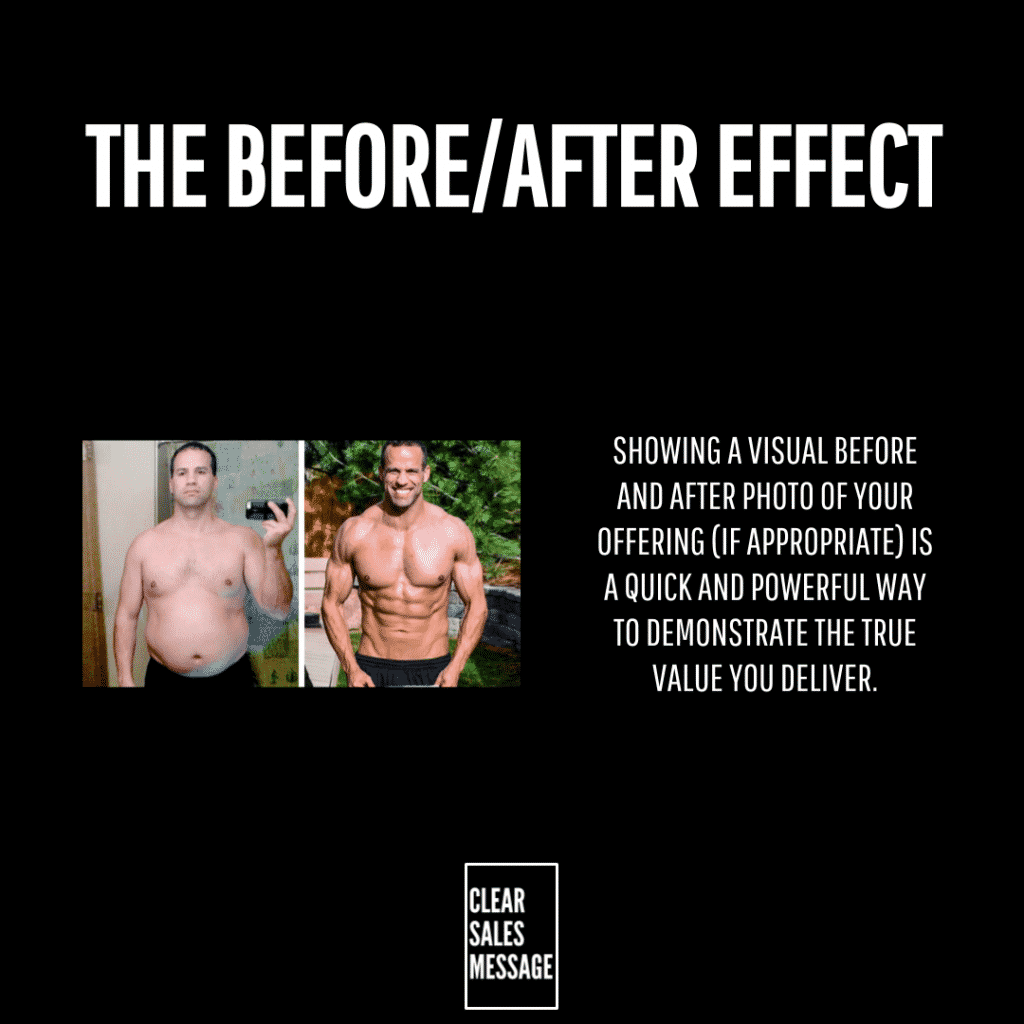
This works best when there are visual results that can be displayed in the before and after, such as photos of a physical transformation.
Use numbers when visuals aren’t possible
If what you do lacks this visual element, focus on the facts and figures instead. Top line achievements can provide a simple before and after contrast that works just as well.
When The Before / After Effect Works Best
It works best when the change is genuinely dramatic, since a small or subtle difference won’t carry the same weight. The bigger and clearer the contrast, the more persuasive it becomes.
It also works well when the buyer can easily picture themselves in the “before” state, because that’s what makes the “after” feel personally relevant rather than just impressive.
When The Before / After Effect Becomes Dangerous
It becomes dangerous if the comparison is exaggerated or staged unfairly, since sharp buyers can usually tell when a “before” has been made to look worse than it really was.
It can also backfire if the result isn’t typical. Showing your single best outcome as if it’s standard sets expectations you may not be able to meet for most buyers.
Common Before / After Effect Mistakes
Using an unrepresentative example
If your before and after is your single best result ever, it may set unrealistic expectations. So consider whether to label it as a typical outcome or an exceptional one.
Making the contrast too subtle
A before and after that looks almost the same won’t persuade anyone. So choose examples where the difference is genuinely clear.
Forgetting numbers when visuals aren’t available
Some businesses assume the effect only works visually, and skip it entirely. But a clear set of figures can tell the same story just as effectively.
The Before / After Effect – An Example
A kitchen renovation and a marketing campaign
A home renovation company showcases before and after photos of a kitchen they remodelled. Before, a dark, outdated kitchen with limited counter space. After, a bright, modern kitchen with an open layout and premium finishes.
Even if your business isn’t visual, you can still use this effect. For example, a digital marketing agency could present a before of “client website had 300 monthly visitors and 2 leads per month,” against an after of “now attracting 3,000 visitors and 50 leads per month.”
See also
- Transformation Statement
- Specific Proof
- 100+ ways to seize buyer attention
- 100+ ways to be more memorable