Practical Sales Training™ > How To Convert > False Economy

False Economy
Buyers make this mistake all the time. They look at the upfront cost, pick the lower number, and feel good about it.
But then the hidden costs appear. Quality drops. Time gets wasted. Problems build. And the saving quietly disappears.
That is a false economy. It was only cheaper at the start.
What Is A False Economy?
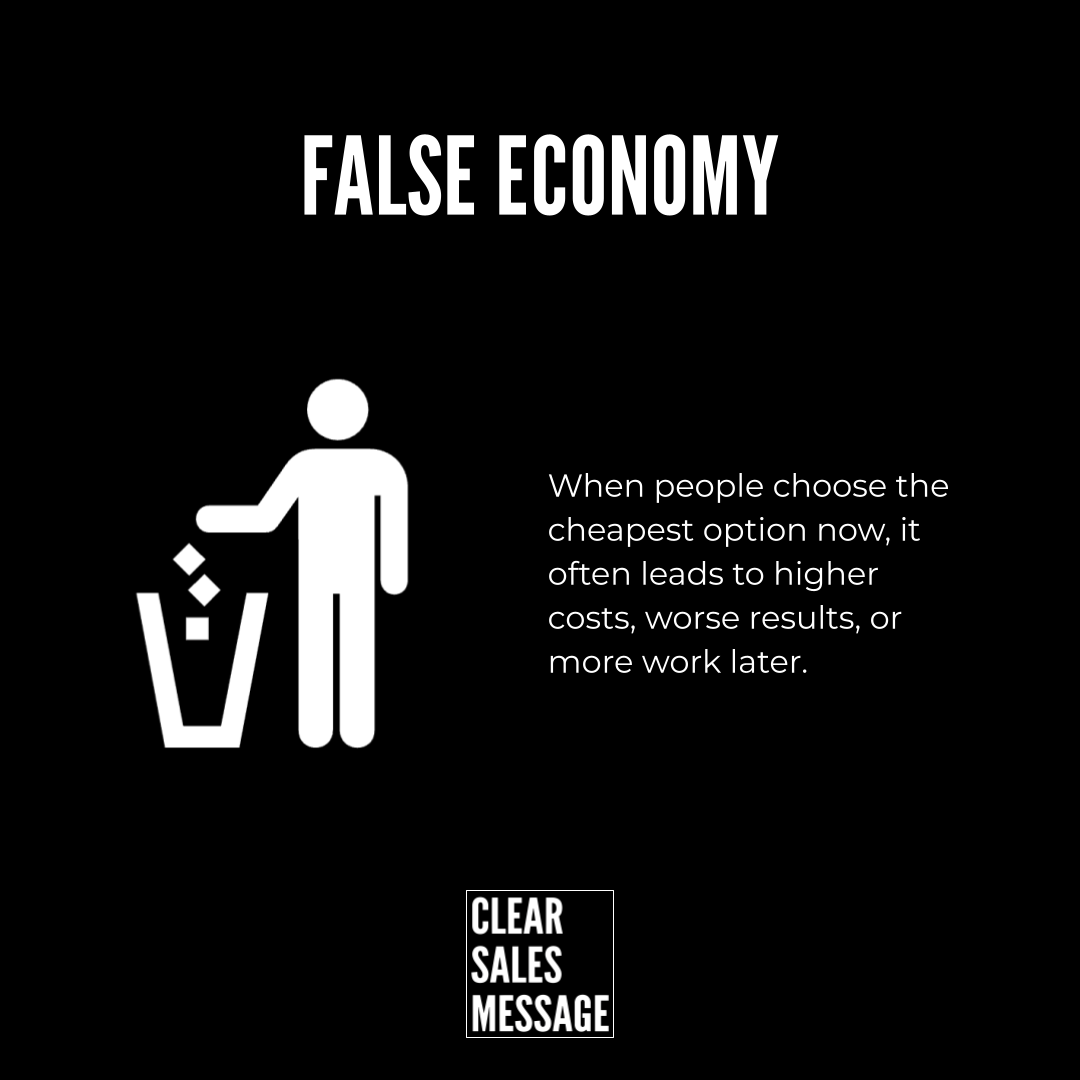
A false economy is a decision that looks smart at first but costs more over time. The buyer thinks they are saving money. But the consequences of the cheaper choice grow – and they often outweigh the original saving.
Think of cheap software that slows the team down. Or low quality suppliers that cause rework. Skipping training. Delaying maintenance. In each case, the short term saving leads to a bigger long term cost.
So the real question is never just “what does this cost now?” It is “what does this cost us overall?”
Why Do Buyers Fall Into False Economies?
Because immediate costs feel real and future costs feel abstract. The saving is visible right now. Consequences are somewhere in the future – easy to dismiss, easy to underestimate.
That gap distorts decisions. Buyers feel the upfront number clearly. But the downstream damage is harder to picture, so it gets ignored.
In many businesses, cost reduction is also easier to justify than long term investment. As a result, short term savings can win the argument even when the long term maths does not add up.
How Does False Economy Affect Sales?
Many businesses struggle to justify higher prices because buyers compare options too simply. They see the number, pick the lower one, and the conversation ends there.
But cheap and low risk are not the same thing. Strong sales conversations help buyers think about total cost – not just purchase price. Because reliability, support, and outcomes all have real commercial value too.
Visible Cost Often Hides Invisible Cost
Many costs are not visible at the point of purchase. Lost time, higher maintenance, poor user experience, and reputation damage all come later. So the buyer only sees the saving at first – the secondary consequences have not arrived yet. Cheap decisions can become expensive very slowly, which is part of what makes them so easy to justify at the time.
Short Term Thinking Distorts Value
When budgets are tight, immediate cost reduction wins the conversation. As a result, businesses sometimes pick what looks good now and quietly increase total cost later. The saving feels smart at first. But consequences arrive on a delay – and by then, the decision is already made.
How Can You Reduce False Economy Thinking?
Help buyers look at the wider picture. Not just the price – but lifetime cost, maintenance, risk, and operational impact. Because not all expensive options cost more overall. And not all cheap ones stay cheap.
Shift the conversation from “what does this cost?” to “what does this cost us if we get it wrong?” That reframe often changes what looks like the sensible choice.
When False Economies Become Most Dangerous
False economies are most dangerous in long term systems, customer-facing work, and high-dependency operations. Consequences compound in these areas. Small problems repeated daily become big ones over time. And the original saving still feels real while the damage builds quietly in the background.
Research Behind False Economy
False economy links to temporal discounting, short term bias, and behavioural economics. Research shows people consistently favour immediate savings over future consequences because near term costs feel more real. As a result, the brain underestimates the long term price of short term decisions.
You can read more here: False Economy
Common False Economy Mistakes
The most common mistake is judging a decision only on upfront spend. Total cost and purchase price are rarely the same – but many buyers treat them as if they are.
Focusing Only On Initial Price
Some buyers compare options purely on headline price, ignoring maintenance, reliability, support, and downstream consequences. That narrow view distorts real value. The cheapest option at purchase is sometimes the most expensive in practice – but by the time that becomes clear, the decision has already been made.
Underestimating Compounding Friction
Small problems feel small. But repeated daily over months and years, they add up fast. Minor delays, rework, and poor systems build quietly in the background – so what felt like a sensible saving at the start can become a serious commercial problem over time.
False Economy – An Example
A company picks the cheapest CRM. The subscription looks much lower than rivals, so it seems like a smart call.
Over time, though, staff slow down, manual work piles up, reporting breaks down, and customer follow-up weakens. The business ends up spending far more fixing the damage than it ever saved on the software.
The cheaper option was not truly cheaper. It was just cheaper at the start.
See also
- 180+ ways to improve conversion
- The Hidden Choice
- The Consequence Effect
- Return on Investment
- Sticking Plaster Solution

