
Practical Sales Training™ > How To Convert > The Goal Effect

The Goal Effect
There is a big difference between asking someone to do something and asking them to help you reach a goal. The words look similar. But the response is very different.
When you share a target, you give the other person a role to play. They are no longer just doing you a favour. They are part of something. That shift changes how the request feels and, as a result, how often people say yes.
The Goal Effect is one of the simplest and most overlooked tools in sales. It costs nothing to use, works across almost any ask, and gets results fast when you apply it well.
What Is The Goal Effect?
The Goal Effect is what happens when you share a specific target as part of a request. Instead of just asking someone to act, you tell them what you are trying to achieve and invite them to help you get there.
The goal creates context. It tells the person why their action matters and what it is part of. Because of that, saying no feels like more of a choice. Not just a neutral pass, but a small act of not helping someone who needed them.
That is not guilt in a heavy sense. It is just the natural pull of reciprocity. When someone has been generous with their time, their content, or their service, and then asks for help towards a goal, most people want to give something back. The Goal Effect makes that moment easier to act on.
Why Does The Goal Effect Work?
It works because a request with no consequence is easy to ignore. When someone asks you to leave a review with no other detail, the decision feels neutral. You might do it. You might not. Nothing hangs on it either way.
But when someone tells you they are trying to reach 500 reviews and they are at 487, the gap becomes visible. Your action closes it. Your inaction leaves them short. That is a very different dynamic, and most people respond to it.
Consider these two asks:
1. Can you write me a LinkedIn recommendation please?
2. Can you help? I’m trying to hit 500 LinkedIn recommendations and would really appreciate your support.
The first has no consequence if you say no. The second does. That consequence is not a threat. It is just a goal that you can either help with or not. But the pull to help is strong, and that is the point.
The Goal Effect also works because it makes the ask feel less about the person making it and more about the mission. People are more willing to help a cause than to do a favour. When your request has a clear target attached, it takes on the feel of a cause. So giving a reason why adds fuel to the fire.
How Can You Use The Goal Effect In Sales?
The most direct use is when asking for reviews, recommendations, or referrals. These are requests most businesses make badly because they give the person no reason to act. Adding a goal fixes that instantly.
Use It When Asking for Reviews
Set a target number and mention it in your review request. “I’m trying to reach 100 Google reviews this month” is a much stronger ask than “please leave us a review.” The goal makes the request specific, and it gives the reader a clear way to help. Because when people know exactly what they are contributing to, they are far more likely to do it.
Use It in Fundraising and Campaigns
Any campaign with a target benefits from showing that target clearly. “Help us raise £50,000 to provide 10,000 meals” works better than “please donate.” The number gives the donor a sense of scale. Their contribution has a specific place in something bigger. That sense of purpose drives action in a way that a general plea never can.
Use It to Drive Referrals
When asking happy clients for introductions, share a goal. “I’m looking to help three more businesses like yours this quarter” is a more compelling ask than “do you know anyone who might need me?” The target makes it easy to picture what you need and how they can help. So the referral feels purposeful rather than vague.
Use It Internally With Your Team
The Goal Effect works just as well inside a business as it does with buyers. When a team knows they are 12 sales away from a target, they push differently than when they are just told to sell more. A visible goal creates shared purpose. So share the number, track it openly, and let the goal do the motivating.
When The Goal Effect Works Best
It works best when the goal is specific and believable. A round number with no context feels made up. But “I’m at 94 reviews and trying to reach 100 by the end of the month” feels real. People can picture the gap. When the gap is visible, closing it feels satisfying.
It also works best when the person you are asking has a reason to care. A happy client, a loyal contact, or someone who has already benefited from what you do is far more likely to help than a cold contact. The Goal Effect amplifies goodwill. It does not create it from nothing.
Also, it works best when the goal is genuinely reachable. If the number is so large that one person’s contribution feels meaningless, the pull weakens. Keep the goal at a scale where each action clearly moves the dial.
When The Goal Effect Becomes Dangerous
The main risk is using goals that feel manipulative or made up. If you tell someone you are trying to reach 500 reviews but you already have 800, they may notice. When the goal is not real, the trust damage is significant. So only use targets that are genuine.
There is also a limit to what goals work for. Sharing a revenue target, for example, tends to land badly. “We’re trying to make £500k this year” is not a goal most buyers feel moved to help with. The goal needs to serve the other person’s desire to help, not your desire to earn. So keep the target focused on something the buyer or contact can connect with, such as impact, reach, or community.
However, the biggest danger is overusing it. When every ask comes with a goal attached, the effect wears thin. Use it for the requests that matter most, and let it work properly rather than diluting it across every message you send.
Common Goal Effect Mistakes
Using Goals That Feel Fake
One common mistake is setting goals that don’t ring true. If the number seems too convenient or the target too perfectly round, people sense it. The Goal Effect only works when the goal is real. So tie it to something genuine, share where you currently are, and let the honest gap do the work.
Making the Goal About You, Not Them
Another mistake is framing the goal in a way that only serves you. Revenue targets, profit goals, and personal milestones rarely move other people to act. Instead, frame the goal around something the other person can connect with. Reviews help future buyers. Referrals help businesses like theirs. Donations feed people who need help. When the goal serves a bigger purpose, people want to be part of it.
Not Following Up When the Goal Is Met
A third mistake is asking for help towards a goal and then going quiet when you reach it. When someone helps you hit a target, they deserve to know they made a difference. A short message saying “we hit 100 reviews, thank you for being part of it” closes the loop and builds goodwill for the next time you need to ask. Because people who feel their help mattered are far more likely to help again.
The Goal Effect – An Example
Here is the Goal Effect in action. Rather than sending a generic request for a LinkedIn recommendation, the message below mentions a specific target. That one detail changes everything.
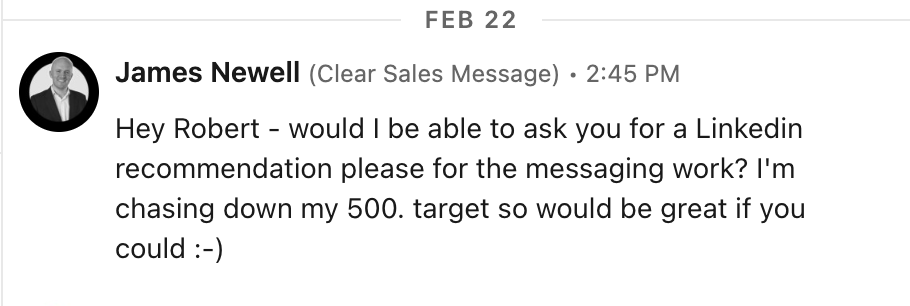
The message does not just ask for a recommendation. It shares a goal: hit 500. That number gives Robert a role to play. His yes moves the count forward. His no leaves it short. The pull to help is immediate, and the ask feels personal rather than automated.
This same approach works for reviews, referrals, donations, and campaigns. Share the target, show where you are, and let the gap do the work. Because when people can see exactly what their action achieves, they are far more likely to take it.
See Also