
Practical Sales Training™ > How To Lose The Sale > The Ratner Effect

The Ratner Effect
What Is It
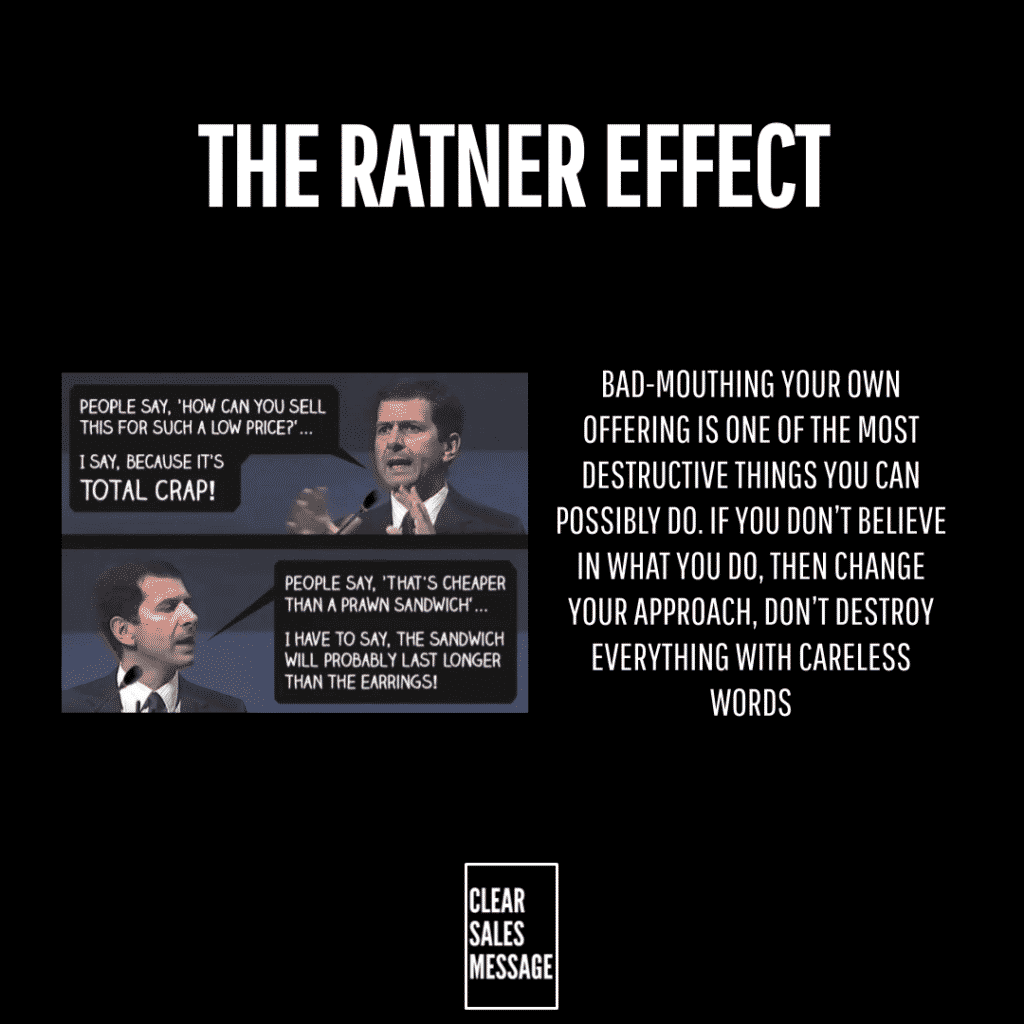
Famously, a businessman by the name of Gerald Ratner described his own products as “crap.” It led to his demise.

It’s an extreme example, but the pattern behind it shows up in far smaller ways too. Anytime you publicly undermine your own offering, even as a joke, you’re playing with the same fire.
The line between honest humility and self sabotage is thinner than most people think. Ratner crossed it in front of the whole country, and it cost him almost everything.
Why Does It Work
If you want to lose the sale, this does the job instantly. Far from promoting confidence, certainty and expertise, publicly questioning or insulting your own offering serves as an instant, permanent deterrent to your buyer.
Your job is to believe in your offering and promote it. Describing it as “total crap” instead means you’re being disrespectful to your buyer, since it signals potential quality issues that trigger their risk averse nature.
There’s no recovering the trust once it’s gone either. A buyer can forgive a flaw they discover themselves. They rarely forgive one you announced yourself, since it makes them question every other claim you’ve made too.
How Can You Use It
Watch for the “joke” that isn’t one
Describing your offering as “total crap” demonstrates that you don’t believe in it, and know it’s worthless. Worse, it also shows you find that funny, and think your buyers are foolish for buying from you anyway.
Taking this approach has a 100% success rate in destroying your chance of making the sale. It may even begin the downfall of your business overall.
Fix the doubt instead of joking about it
If you have any doubts about your offering, fix and improve them. If you don’t believe in your offering, how can you expect your buyers to?
Read the room before the punchline lands
Self deprecating humour can build warmth in the right context. So test it privately first, since a joke that lands fine with colleagues can read as genuine contempt to a paying customer.
When It Works Best
Honestly, it never works in your favour. There’s no version of publicly trashing your own product that ends well for the seller.
The closest safe territory is gentle, clearly affectionate self deprecation, and even that only works with an audience who already trusts you deeply.
When It Becomes Dangerous
It’s dangerous the moment it’s said, but it becomes catastrophic the more publicly it’s repeated. Ratner’s comment travelled far beyond the room he said it in, and so will yours.
It’s especially dangerous for anyone with a public platform, a media interview, a keynote, a viral clip. The bigger the audience, the smaller the room for a joke that lands wrong.
It also damages more than the sale in front of you. Existing customers hear it too, and it can make them second guess a purchase they were already happy with.
Common Mistakes
Mistaking honesty for self sabotage
There’s a real difference between admitting a limitation and mocking your own product outright. One builds trust, the other destroys it in a single sentence.
Assuming your audience is in on the joke
A comment meant for insiders can end up quoted everywhere. Assume anything you say publicly will be heard by the exact buyer you can least afford to lose.
Ignoring a doubt instead of fixing it
Joking about a flaw doesn’t make it go away. It just tells everyone you knew about it and chose not to fix it.
See also: