
Practical Sales Training™ > How To Get Attention > The Respect Effect

The Respect Effect
What Is It
Remembering to be courteous and respectful of everyone you meet is an essential part of making the sale. If you want to sell, you have to be nice. There’s no way around it.
It sounds obvious, almost too simple to count as a real technique. Yet it gets ignored constantly, in the smallest and most avoidable ways.
A single rude message or dismissive tone can undo weeks of otherwise good work in seconds.
Why Does It Work
It works because if you want to sell to someone, they need to know, like, and trust you. How many times have you decided not to buy from a particular place because of a poor past experience rooted in basic rudeness or a lack of courtesy?
Your clients’ emotions trump their logic, so it makes sense to treat everyone as well as you possibly can. Your reputation is a fragile thing, and the smallest negative feedback can undo a lot of good work, and cost you the sale.
There’s an asymmetry at play too. A rude moment gets remembered far longer than a polite one, since it violates an expectation people barely notice until it’s broken.
How Can You Use It
Treat everyone the same, not just the buyer
It sounds simple, but remembering to be nice and courteous to everyone you meet, prospect, client, or supplier, puts you in the best position to succeed. Rudeness to someone who isn’t buying today can still cost you the sale tomorrow.
Stay composed even when you’re technically right
If you get angry, riled, or lash out, you can damage your reputation and your chances of selling, even if you’re “in the right.” Being correct rarely matters as much as staying calm.
Make courtesy the default, not the exception
Above all else, be nice. Not as a rule you follow under pressure, but as the baseline you never have to think twice about.
When It Works Best
This works best in every interaction, honestly. There’s no context where basic courtesy actively hurts your chances of a sale.
It matters most in the moments people least expect it, a difficult complaint, a cold outreach message, a supplier negotiation. Those are the moments most likely to be remembered, for better or worse.
When It Becomes Dangerous
It becomes a real risk the moment a message or interaction implies something insulting, even accidentally. A poorly worded outreach can read as judgemental long before the sender intended it to.
It also becomes risky under pressure, a delay, a complaint, an unreasonable request. Those are exactly the moments a lapse in courtesy costs the most, since emotions are already running high on both sides.
Repeated small lapses do lasting damage too. One rude moment might get forgiven. A pattern of them builds a reputation that follows you well beyond a single sale.
Common Mistakes
Assuming courtesy only matters with paying clients
Rudeness to a supplier, a former client, or a prospect who said no still shapes your reputation. Word travels between all of them more than most people assume.
Not reading a message before sending it
A line that sounds harmless in your head can read as tactless, or worse, to the person receiving it. Re-read outreach messages as if a stranger were seeing them for the first time.
Defending yourself instead of de-escalating
Proving you were right in a heated exchange rarely saves the sale. Staying calm and courteous usually does more for you than winning the argument ever could.
The Respect Effect – An Example
A Cold Outreach Message Gone Wrong
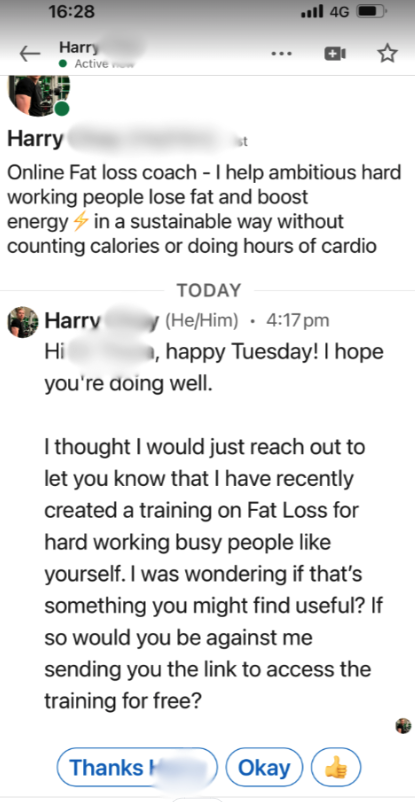
In this rather direct message, this person is targeting someone based on “fat loss,” which implies they think the recipient looks overweight in their profile picture. Not the best way to start a relationship.
The offer itself, a free training, might have been genuinely useful. But the framing around it undoes any goodwill before the recipient even considers the content.
See also